
The 10 Day Annapurna Base Camp (ABC) Trek in Nepal offers a full-spectrum Himalayan experience, combining high-altitude adventure, cultural immersion, and panoramic mountain vistas. This moderate-level trek guides hikers from subtropical landscapes at 1,000 meters to the glacial amphitheater of Annapurna Base Camp at 4,130 meters, encircled by seven of the world’s 14 highest peaks, including Annapurna I (8,091m) and Machhapuchhre (6,993m). Along the route, trekkers pass through Gurung and Magar villages, dense rhododendron forests, and the dramatic Modi Khola gorge, while staying in teahouses that provide authentic local cuisine and lodging. The 10-day itinerary balances acclimatization, cultural experiences, and manageable daily distances, making it the recommended duration for both first-time and experienced Himalayan trekkers.
Beyond its natural grandeur, the Annapurna Base Camp (ABC) Trek emphasizes safety, preparation, and logistics. Trekkers require the Annapurna Conservation Area Permit (ACAP) and the Trekkers’ Information Management System (TIMS) Card, a licensed guide, and travel insurance covering high-altitude evacuation. Fitness preparation, proper gear, including a -10°C down jacket and trekking poles, and strategic pacing prevent altitude sickness and ensure a successful ascent. Optimal trekking windows occur in autumn (September–November) and spring (March–May), when skies are clear and rhododendrons bloom. By combining Himalayan scenery, cultural richness, and practical guidance, the 10 Day Annapurna Base Camp (ABC) Trek delivers an unforgettable, fully immersive adventure in Nepal’s Annapurna region.
What Is the 10 Day Annapurna Base Camp Trek?
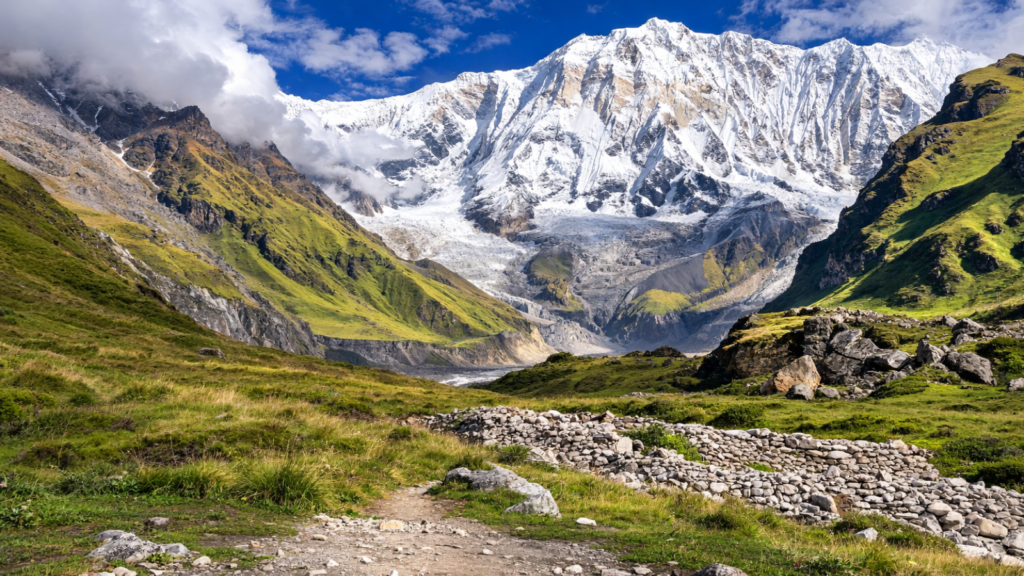
The 10 day Annapurna Base Camp Trek, commonly called the ABC Trek, is a teahouse trekking route in Nepal’s Annapurna Conservation Area that leads to the base camp of Annapurna I (8,091m), the world’s 10th highest mountain. The route begins and ends in Pokhara, Nepal’s adventure capital, and passes through Gurung and Magar villages, dense rhododendron forests, the Modi Khola river valley, and high alpine terrain before reaching the glacier-ringed bowl of Annapurna Base Camp.
The 10-day format builds in 1 full day of rest, a properly paced ascent, and a comfortable descent, making it the most recommended duration by experienced guides and trekking agencies operating in the Annapurna region.
Annapurna Base Camp: Altitude, Location, and Significance
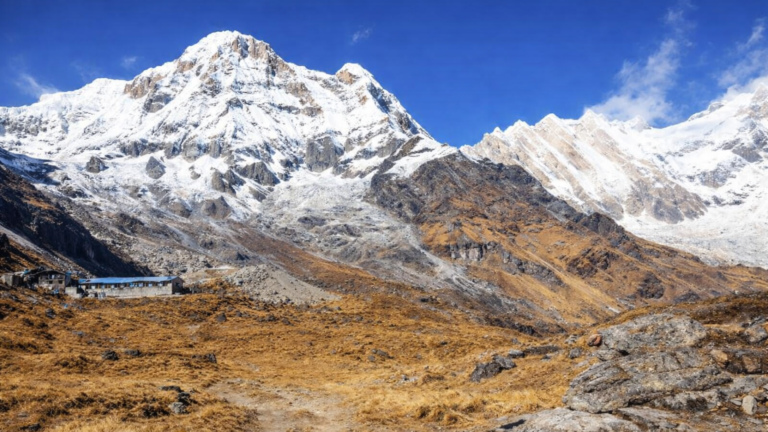
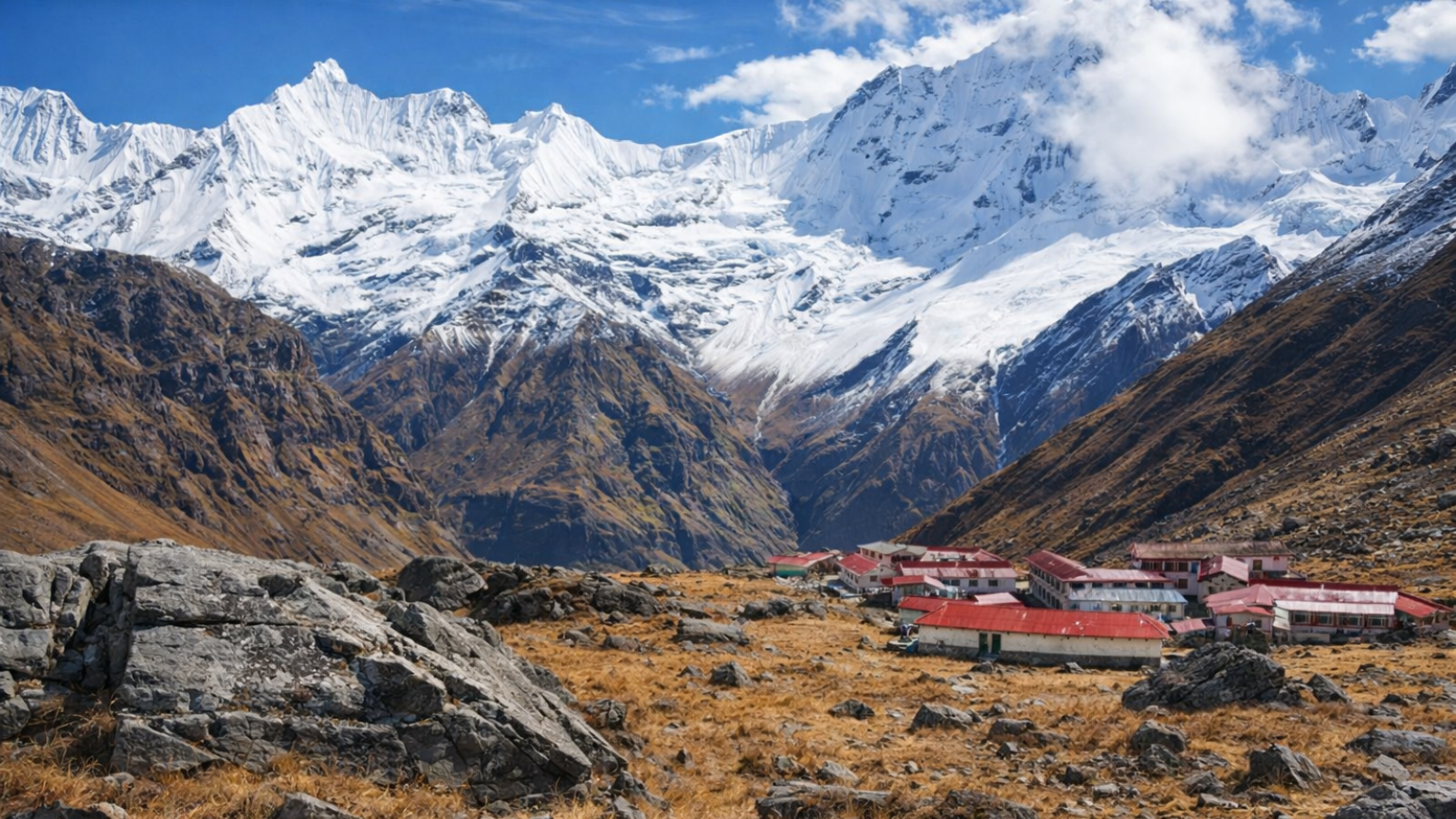
Annapurna Base Camp sits at 4,130 meters (13,549 feet) above sea level in the Annapurna Sanctuary, a glacially carved high basin in the Himalayas of north-central Nepal. The camp is encircled by Annapurna I (8,091m), Annapurna South (7,219m), Hiunchuli (6,441m), Machhapuchhre (6,993m), Gangapurna (7,454m), and Glacier Dome (7,193m), forming a nearly vertical wall of peaks on all sides.
Annapurna I holds the distinction of being the first 8,000-meter peak ever summited, achieved by French mountaineers Maurice Herzog and Louis Lachenal on June 3, 1950. The base camp serves as the advanced staging point for expeditions to Annapurna I and remains one of the most visually dramatic trekking destinations in the world.
The Annapurna Conservation Area itself spans 7,629 square kilometers, the largest protected area in Nepal, and supports diverse ecosystems ranging from subtropical forests at low elevation to permanent glaciers above 5,000 meters.
Why 10 Days Is the Ideal Duration for the ABC Trek
The ABC Trek is completable in as few as 7 days, but 10 days is the optimal duration for 3 concrete reasons:
- Acclimatization margin: One extra night at Chhomrong (2,170m) or Bamboo (2,310m) substantially reduces altitude sickness risk at the 4,130m base camp.
- Recovery buffer: A built-in flex day protects against trail closures due to snow, rain, or landslide, all common in the Annapurna region.
- Experience depth: 10 days allows meaningful time in Gurung villages like Ghandruk and Chhomrong, which a rushed 7-day schedule compresses into brief transit stops.
Trekkers attempting the route in under 8 days without prior high-altitude experience report a significantly higher incidence of headaches, nausea, and early descent at the Machhapuchhre Base Camp (4,000m) checkpoint. A 10-day plan prevents this.
Trek Difficulty Level: Who Is the 10 Day ABC Trek Best For?
The 10 day Annapurna Base Camp trek is rated moderate difficulty. It does not require technical climbing, glacier travel, or ropes. Trekkers with good cardiovascular fitness, no prior Himalayan experience, and a willingness to walk 5–8 hours per day complete it successfully.
The trail presents 4 specific physical challenges:
- Stone staircase sections between Chhomrong and Sinuwa, over 2,500 stone steps with significant elevation change
- River valley ascent through the Modi Khola gorge, narrow and steep in sections
- Cold temperatures at altitude, nighttime lows at Annapurna Base Camp reach -10°C to -15°C between November and February
- Sun exposure on open terrain above 3,500 meters, particularly on the return descent from base camp
The trek is not recommended for trekkers with active cardiac or respiratory conditions, or those who have not engaged in regular aerobic exercise for at least 6–8 weeks prior.
Best Time for the 10 Day ABC Trek
The 2 ideal trekking windows are:
- Autumn (September–November): Post-monsoon skies produce clear mountain views and stable trail conditions. October is peak season, trails are well-maintained, teahouses are fully staffed, and daytime temperatures range from 10°C to 20°C at mid-elevation.
- Spring (March–May): Rhododendron forests bloom at lower elevations, turning the trail vibrant red and pink. Visibility is excellent before the monsoon begins. April temperatures are similar to October.
What most guides don’t tell you: Late November and early December offer the clearest skies of the year and far fewer trekkers, often 40–60% fewer than October, while trails remain passable if you carry warm layers. March trails can be muddy following late-winter snowmelt above 3,000 meters.
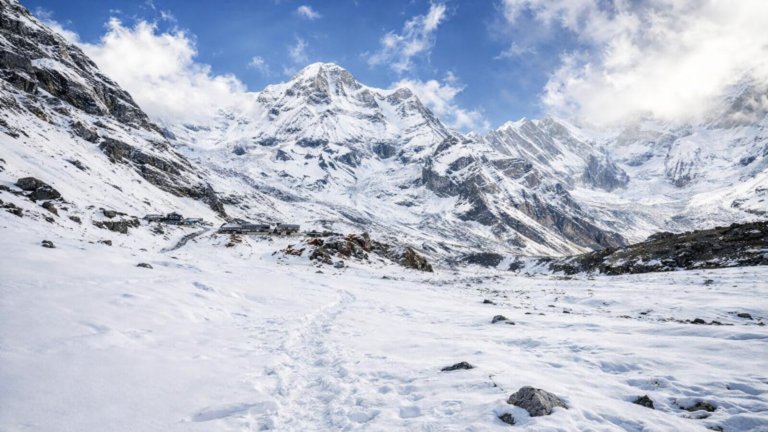
Monsoon season (June–August) brings trail washouts, leeches below 2,500 meters, and near-zero mountain visibility. Winter (December–February) creates deep snow and risk of trail closure above Deurali. Experienced winter trekkers with proper gear complete the route successfully, but it demands greater preparation.
Day-by-Day Itinerary for the 10 Day Annapurna Base Camp Trek
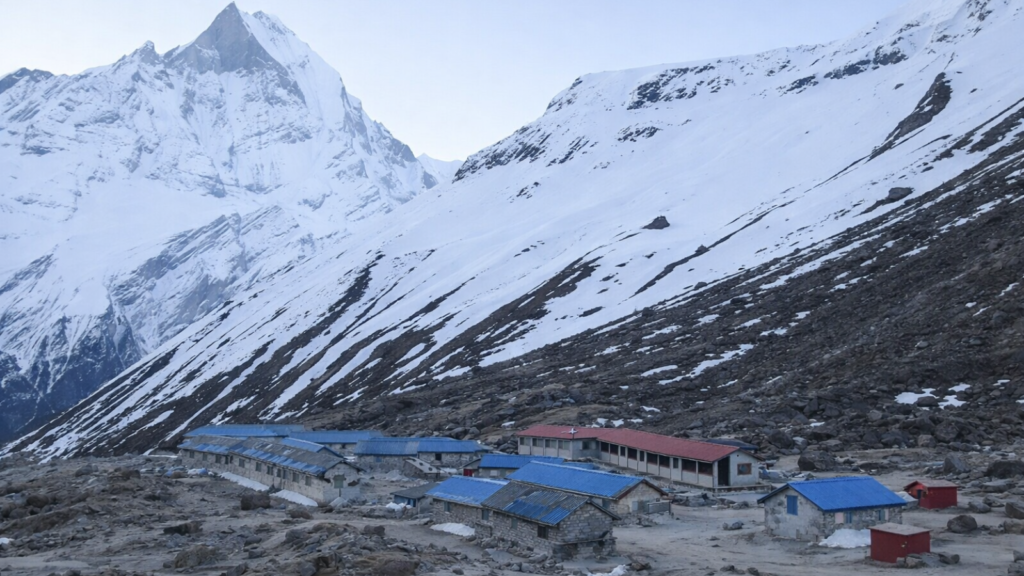
The 10 day Annapurna Base Camp trek starts in Pokhara, ascends through Ghandruk (2,012m), Chhomrong (2,170m), and the Modi Khola valley to reach Annapurna Base Camp (4,130m) on Day 7. The route covers approximately 110–130 kilometers round trip with a total elevation gain of 4,200 meters across 8 active trekking days. Days 8–10 complete the descent via Jhinu Danda hot springs before returning to Pokhara and Kathmandu.
The following itinerary represents the standard routing used by licensed trekking agencies. Elevations reflect GPS-verified data from the Nepal Tourism Board.
Day 1–2: Arrival in Kathmandu and Drive to Pokhara
- Day 1 Kathmandu (1,400m): Arrive at Tribhuvan International Airport, collect permits, and attend a pre-trek briefing with your guide. Use the afternoon to organize gear, exchange currency, and rest. Kathmandu’s altitude at 1,400 meters provides mild, helpful pre-acclimatization for the trek ahead.
- Day 2 Kathmandu to Pokhara (822m): Travel to Pokhara by tourist bus (7–8 hours, approximately $7–10) or domestic flight (25 minutes, approximately $80–120). Most trekkers choose the scenic bus route through the Prithvi Highway for the first visit. Arrive in Pokhara, confirm your equipment, and prepare for the trail start the following morning.
What most itineraries skip: Spend 30 minutes at the Pokhara Trekking Agency or Nepal Tourism Board office to verify your ACAP permit has the correct entry date, permit officers at Birethanti checkpoint turn back trekkers with date discrepancies.
Day 3–4: Pokhara to Ghandruk and Chhomrong
- Day 3 Pokhara to Ghandruk (2,012m): Drive 1.5 hours by jeep to Nayapul or Kimche. Trek 4–5 hours through tiered rice paddies, subtropical forest, and ascending trails to Ghandruk, a traditional Gurung village with panoramic views of Annapurna South and Machhapuchhre. Walking distance: 8km. Elevation gain: +1,100m from Nayapul.
Ghandruk is the cultural heart of the Annapurna region. The Gurung Museum here documents 300 years of community history in the Himalayas. Spend the evening in a teahouse with mountain views.
- Day 4 Ghandruk to Chhomrong (2,170m): A 5–6 hour trek descending into the Kimrong Khola valley and climbing back up to Chhomrong. Walking distance: 7km. Elevation change: -400m descent, +550m ascent.
Chhomrong is the last large settlement before the Annapurna Sanctuary. ATMs and reliable cell service end here, carry sufficient cash in Nepalese Rupees for the remaining days. Teahouse rooms cost approximately NPR 300–700 per night; meals range from NPR 400–800 per dish.
Day 5–6: Chhomrong to Deurali via the Modi Khola Valley
- Day 5 Chhomrong to Dovan/Bamboo (2,310m): Descend the famous Chhomrong stone staircase (2,500+ steps), cross the Chhomrong Khola bridge, and ascend through bamboo and rhododendron forest to Sinuwa (2,360m). Continue to Bamboo or Dovan. Walking distance: 10km. Duration: 6–7 hours.
This section of the trail passes through ACAP checkpoint at Chhomrong, carry your ACAP permit for inspection here and at Sinuwa.
The Modi Khola gorge narrows dramatically above Bamboo. The trail becomes steeper, cooler, and more densely forested. Waterfalls cross the path in multiple places. Above Dovan, watch for yak herds in the upper grazing areas between November and April.
- Day 6 Dovan to Deurali (3,230m): Trek 4–5 hours through Himalaya (2,920m) and Hinku Cave (3,170m) to Deurali. Walking distance: 7km. Elevation gain: +920m.
Deurali sits at the edge of the upper Annapurna Sanctuary and marks the beginning of high-altitude terrain. Above 3,000 meters, the 3 common acclimatization symptoms to monitor are: persistent headache, nausea, and unusual fatigue. These 3 symptoms appearing together require rest, do not push to higher altitude until they resolve.
Overnight temperatures at Deurali drop below 0°C between October and April. A sleeping bag rated to -10°C is essential from this point forward.
Day 7: The Ascent to Annapurna Base Camp (4,130m)
- Day 7 Deurali to Annapurna Base Camp via MBC (4,130m): The defining day. Trek from Deurali to Machhapuchhre Base Camp (4,000m) in 2–3 hours, then continue 45 minutes to Annapurna Base Camp. Total walking distance: 9km. Duration: 5–6 hours.
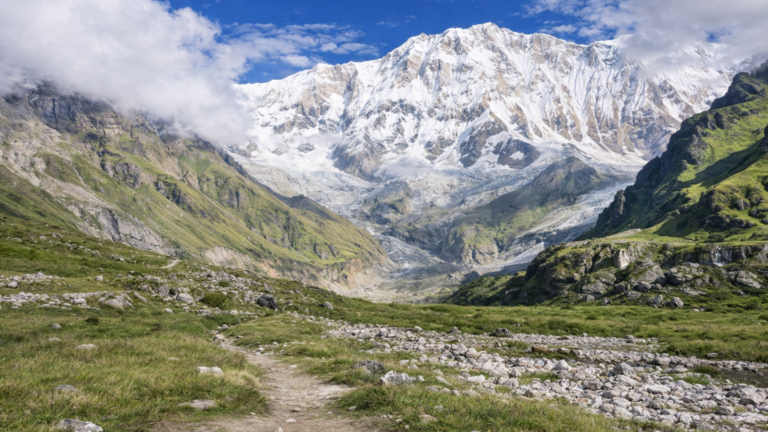
The terrain above Deurali opens dramatically. The valley widens, moraine fields appear, and the full Annapurna massif comes into view. At Machhapuchhre Base Camp, you stand directly below the sacred “Fish Tail” peak, Nepal has never issued a summit permit for Machhapuchhre, and it remains unclimbed as of 2026.
Annapurna Base Camp at 4,130 meters is a flat, glacier-morraine plateau enclosed by the highest peaks in the Annapurna Sanctuary. On clear mornings, most likely between 6:00 and 9:00 AM, all 360 degrees of the surrounding peaks are visible. The view is best described in terms that photographs struggle to capture: scale, silence, and the precise texture of glaciated rock at very close range.
Spend the afternoon and evening at base camp. Most trekkers wake before dawn on the following morning for the sunrise alpenglow on Annapurna I, a phenomenon where the peak transitions from deep purple through orange to full gold as the sun rises over the eastern ridgeline.
Day 8–10: Descent, Pokhara Rest, and Return to Kathmandu
- Day 8 Annapurna Base Camp to Bamboo/Sinuwa: Descend from base camp via the same route, reaching lower elevations by afternoon. The descent moves faster, 5–6 hours to Bamboo or Sinuwa. The knees absorb significant stress on the Chhomrong stone staircases; trekking poles reduce this load substantially.
- Day 9 Sinuwa to Jhinu Danda and Pokhara: Trek to Jhinu Danda (1,780m), where natural hot springs beside the Modi Khola provide recovery for tired legs. A 20-minute soak here is not optional, it is practically medicinal after 8 days of trekking. Drive or trek to Nayapul, then drive back to Pokhara. Arrive by afternoon for a rest evening in Pokhara.
- Day 10 Pokhara to Kathmandu: Return to Kathmandu by bus or flight. Most trekkers spend the evening in a Thamel restaurant, where a celebratory meal costs $8–15. Your trek completion certificate, issued by your trekking agency, documents the full route.
Permits, Costs, and Logistics for the 10 Day ABC Trek in 2026
Every trekker on the Annapurna Base Camp route requires two mandatory permits in 2026: the Annapurna Conservation Area Permit (ACAP) and the Trekkers’ Information Management System (TIMS) Card, obtained in Kathmandu or Pokhara before the trek. The total cost of the 10 day ABC Trek ranges from $700 for a budget-style independent trek to $1,400 for a fully guided package, depending on group size and services included. A licensed guide is legally required as of 2023 and adds $25–35 per day to the overall budget.
Required Permits: ACAP and TIMS
Every foreign trekker entering the Annapurna Conservation Area requires two mandatory permits:
1. Annapurna Conservation Area Permit (ACAP)
Fee: NPR 3,000 per person (~$23 USD in 2026)
Issued by: Nepal Tourism Board offices in Kathmandu or Pokhara, or through a registered trekking agency
Valid for: Single entry into the Annapurna Conservation Area
2. Trekkers’ Information Management System (TIMS Card)
Fee (2026 updated price):
- NPR 2,000 per person (~$15 USD) for organized trekkers with a guide
- NPR 1,000 for SAARC nationals
Issued by:
- Nepal Tourism Board (NTB)
- Trekking Agencies Association of Nepal (TAAN)
- Registered trekking agencies
Purpose:
The TIMS system records trekkers in a national safety database used for route monitoring, emergency rescue coordination, and trekking statistics.
Documents required for both permits:
- Passport copy
- 2 passport-size photos
- Completed application form
Note: Permits should be obtained in Kathmandu or Pokhara before starting the trek, as checkpoints may charge additional fees or delay entry if permits are missing.
Full Cost Breakdown: Budget vs. Comfort Trekking
The 10 day Annapurna Base Camp trek costs between $700 and $1,400 per person depending on travel style, group size, and the services included. Below is a realistic breakdown across 3 travel styles.
Budget Independent Trek (~$700–850 total):
| Expense | Estimated Cost (USD) |
| ACAP permit | $21 |
| TIMS | NPR 2,000 (~$15) |
| Kathmandu–Pokhara bus (return) | $15–20 |
| Pokhara–Nayapul jeep (return) | $20–25 |
| Teahouse accommodation (8 nights on trail) | $50–70 |
| Meals on trail (3 meals/day × 8 days) | $100–140 |
| Meals in Pokhara/Kathmandu | $40–60 |
| Guide fee (mandatory since 2023) | $25–30/day × 8 days = $200–240 |
| Porter (optional but recommended) | $18–22/day × 8 days = $144–176 |
| Miscellaneous (charging, hot water, Wi-Fi) | $30–50 |
Guided Package Trek (~$900–1,200 per person): Package treks with a registered Nepali trekking agency include permits, licensed guide, porter, teahouse accommodation, meals during the trek, and ground transportation from Pokhara. Solo trekkers pay $999–$1,299 because shared costs are not distributed across a group. Groups of 4–6 typically pay $850–$1,100 per person.
What affects the final number most: Whether you carry your own pack (no porter, lowest cost) versus hiring a porter (adds $144–176 but protects your knees and energy for the full 10 days). Experienced guides consistently recommend hiring a porter for trekkers who have not done multi-day high-altitude trekking before.
Carry cash in Nepalese Rupees. No ATMs operate above Pokhara on the ABC route. Withdraw NPR 40,000–55,000 (approximately $275–380) before leaving Pokhara to cover all on-trail expenses.
Guided vs. Independent Trekking: What Nepal’s Guide Mandate Means in 2026
Nepal’s Department of Tourism formalized the licensed guide requirement for Annapurna Base Camp and other major trekking routes in 2023. As of 2026, trekking the ABC route without a registered guide is not permitted by Nepali law. Checkpoint authorities enforce this at Birethanti and Chhomrong.
A registered guide provides 4 concrete benefits beyond regulatory compliance:
- Checkpoint management: Guides carry all permit documentation and handle checkpoint registration efficiently
- Medical response: Licensed guides complete wilderness first aid and altitude sickness protocols as part of certification
- Cultural interpretation: Gurung and Magar village customs, monastery protocols, and trail etiquette require local knowledge
- Route accuracy: The ABC trail has 6 junction points where trail markings are unclear, wrong turns add 1–3 hours in poor weather
Guide costs: $25–35 per day for a licensed trekking guide. A good guide makes the difference between a functional trek and an exceptional one. Verify your guide’s license number through the Nepal Tourism Board website before departure.
How to Get from Kathmandu to the Trailhead
The 4 transportation routes to the ABC trailhead:
- Kathmandu to Pokhara by tourist bus: NPR 1,500–2,000 (~$10–14), 7–8 hours
- Kathmandu to Pokhara by local bus: NPR 700–900 (~$5–6), 8–9 hours
- Kathmandu to Pokhara by domestic flight: $80–120 USD, 25 minutes (Buddha Air, Yeti Airlines)
- Pokhara to Nayapul/Kimche by jeep or shared vehicle: NPR 1,500–3,000 (~$10–21) depending on group size
Most trekkers fly to Pokhara to save energy and maximize time. The extra cost is recoverable through better performance on the trail’s first trekking day.
Essential Preparation: Gear, Fitness, and Altitude Safety
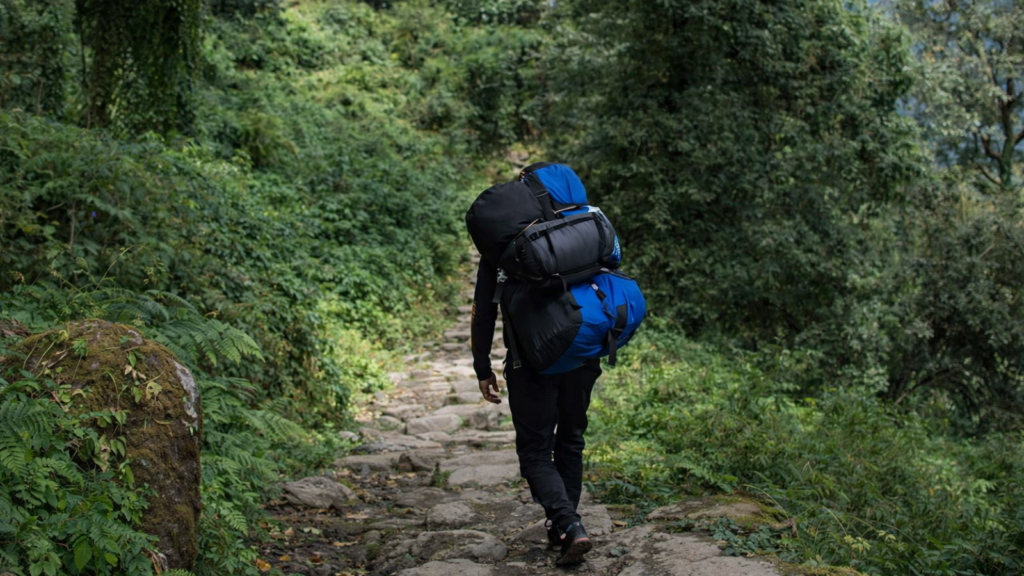
The 10 day ABC Trek requires 12 core gear items, including a -10°C down jacket, waterproof shell, trekking poles, and a -10°C sleeping bag, to manage 3 distinct climate zones from subtropical lowlands to high alpine terrain. Trekkers with 12 weeks of consistent aerobic training complete the route at the same success rate as experienced hikers, making fitness preparation the single most controllable risk factor. Acute Mountain Sickness (AMS) affects 30–40% of trekkers above 3,500 meters and is prevented through controlled ascent pace, 3–4 liters of daily hydration, and immediate descent if symptoms worsen.
Packing List for the 10 Day Annapurna Base Camp Trek
Pack for 3 distinct climate zones: subtropical lowlands (hot, humid), forested mid-elevations (cool and wet), and high alpine terrain (cold, dry, intense UV).
The 12 non-negotiable items for the ABC Trek:
- Down jacket (-10°C rated minimum) for above 3,000 meters
- Waterproof shell jacket and pants: monsoon weather arrives without warning even in October
- Trekking poles: critical for the Chhomrong stone staircases on descent
- Sleeping bag (-10°C rated): teahouse blankets at base camp are insufficient
- Trekking boots: waterproof, broken in before the trek (never new boots on day 1)
- Merino wool base layers (2 sets): wicks moisture and controls odor over multiple days
- Trekking socks (4–5 pairs, wool): wool manages blisters and temperature regulation better than synthetic
- Headlamp with spare batteries: power cuts are standard; early morning departures require reliable light
- Sunscreen SPF 50+ and UV-blocking sunglasses: UV intensity at 4,000+ meters causes burns within 20 minutes
- Water purification tablets or a SteriPen: reduce plastic waste and cut costs on bottled water (NPR 100–200 per bottle at altitude)
- Altitude sickness medication: acetazolamide (Diamox) requires a prescription; carry 10 tablets minimum
- First aid kit with blister treatment, anti-inflammatory medication, and oral rehydration salts
Gear rental is available in Kathmandu’s Thamel district and in Pokhara’s Lakeside area. Quality sleeping bags and down jackets rent for approximately $2–4 per day, a cost-effective option for one-time trekkers.
Physical Fitness Requirements and Training Tips
The ABC Trek demands approximately 45–65 hours of walking across 10 days, covering 110–130 kilometers round trip with a cumulative elevation gain of approximately 4,200 meters.
The 3-month training approach that experienced trekkers use:
- Month 1 Cardio base: 4 sessions per week of sustained aerobic activity, running, cycling, or swimming for 40–60 minutes per session. Build to consistent exercise without stopping.
- Month 2 Elevation simulation: Begin stair climbing and hill walking with a loaded pack (10–12kg). Add 2 weekend hikes of 4–6 hours duration.
- Month 3 Specificity: Replicate trekking conditions, back-to-back days of hiking, long descents on hard surfaces, and 1 overnight hike if possible.
Trekkers who complete 12 or more weeks of consistent training before the ABC Trek report significantly lower rates of altitude sickness, knee pain, and early exit compared to those who begin training 4–6 weeks out.
Altitude Sickness on the ABC Trek: Symptoms and Prevention
Annapurna Base Camp at 4,130 meters sits above the threshold where acute mountain sickness (AMS) risk becomes significant. Approximately 30–40% of trekkers report mild AMS symptoms above 3,500 meters.
The 5 early symptoms of AMS to recognize on the trail:
- Persistent headache not relieved by ibuprofen or hydration
- Nausea or loss of appetite
- Dizziness or lightheadedness when standing
- Insomnia, specifically, an inability to sleep despite physical exhaustion
- Unusual fatigue that doesn’t respond to short rest
The prevention protocol used by licensed guides on the ABC Trek:
- Ascend no more than 300–500 meters of sleeping elevation per day above 3,000 meters
- Hydrate 3–4 liters of water per day, urine should remain pale yellow or clear
- Avoid alcohol above 3,000 meters, it disrupts oxygen processing and sleep quality
- Walk slowly on ascent days, “pole, pole” (slowly, slowly) as Himalayan guides say
- Descend immediately if symptoms worsen, do not sleep at a higher elevation than where symptoms began
Helicopter evacuation from Annapurna Base Camp costs $1,500–$3,000 USD without insurance. Travel insurance covering helicopter rescue is not optional, it is the single most important financial protection for this trek.
Travel Insurance and Emergency Evacuation
Every trekker on the ABC route requires travel insurance that explicitly covers:
- Trekking above 4,000 meters
- Helicopter medical evacuation
- High-altitude rescue operations
- Medical evacuation back to home country
Policies covering these 4 requirements cost approximately $50–150 USD for a 14-day period, depending on the provider and the trekker’s home country. Budget policies that exclude helicopter rescue leave trekkers with $1,500–$3,000 bills for emergency evacuation, or worse, delayed evacuation while coverage is verified.
Recommended practice: Print your insurance policy emergency number and policy number and carry it separately from your passport. Give a copy to your guide. Emergency calls in the Annapurna region connect through the Nepal Tourism Board rescue coordination center in Pokhara.
Accommodation, Food, and Trail Experience
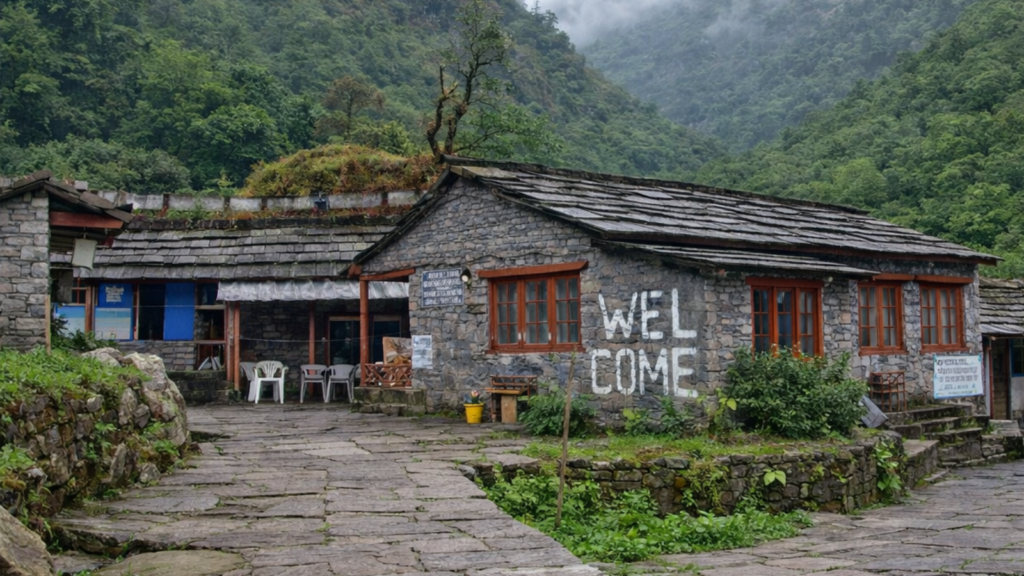
The ABC route operates entirely on a teahouse system, family-run lodge-restaurants providing accommodation and meals at every major camp from Nayapul to Annapurna Base Camp, with no camping equipment required. Room costs range from NPR 300 at lower elevations to NPR 1,500 at base camp, and are frequently waived when trekkers eat all meals at the same teahouse. The trail passes through living Gurung and Magar villages, offering cultural depth that separates the ABC Trek from purely scenic mountain routes.
Tea House Trekking on the Annapurna Trail: What to Expect
The ABC route operates on a teahouse system, family-run lodge-restaurants that provide accommodation and meals at each camp. No tents or camping equipment are required. This infrastructure covers the entire route from Nayapul to Annapurna Base Camp, with teahouses at every major stopping point.
Teahouse room costs by elevation:
- Nayapul to Ghandruk: NPR 300–700 per room ($2–5 USD)
- Chhomrong to Deurali: NPR 500–1,000 per room ($3.50–7 USD)
- Machhapuchhre Base Camp and Annapurna Base Camp: NPR 700–1,500 per room ($5–10 USD)
An important dynamic that most first-time trekkers misunderstand: teahouse rooms are often free or deeply discounted when you eat all meals at the same establishment. The teahouse business model earns its margin through food, not beds. Order your meals from the teahouse where you sleep, and room charges are commonly waived or reduced. Arriving at a teahouse for accommodation only and cooking your own food creates friction, it’s against the unwritten trail economy.
Room types include basic twin rooms (most common), dormitory beds at busier teahouses, and, at higher-end lodges in Ghandruk and Chhomrong, attached bathrooms with hot showers (NPR 200–400 extra per shower at altitude).
Food and Nutrition on the ABC Route
The teahouse menu is a Dal Bhat world, and this is not a limitation, it is an advantage. Dal Bhat, Nepal’s staple lentil soup with rice, vegetables, and pickled condiments, provides a nutritionally complete, high-calorie meal that replenishes electrolytes and carbohydrates after long trekking days. Most Nepali teahouses offer unlimited rice refills with Dal Bhat, a genuine competitive advantage for a multi-day high-output trek.
Common menu items across all teahouses: Dal Bhat (NPR 550–1,000), Sherpa stew, pasta, momo (dumplings), porridge, pancakes, Tibetan bread, and fried rice. The further you ascend, the higher the prices, this follows directly from logistics costs.
What experienced trekkers carry: 10–15 energy bars or gels for summit day snacking, 2–3 sachets of electrolyte powder, and 200g of trail mix per person. These supplement teahouse meals on summit day when appetite often decreases with altitude.
Avoid raw vegetables and tap water above Chhomrong. Stick to boiled water, tea, and bottled or purified water for the entire trek.
Cultural Encounters: Gurung and Magar Villages on the Trail
The villages of Ghandruk, Chhomrong, Landruk, and Jhinu Danda are home to the Gurung and Magar communities, indigenous Himalayan peoples with distinct languages, animist-Buddhist traditions, and a documented history of service in the British and Indian Gurkha regiments.
The Gurung Museum in Ghandruk presents 300 years of community history through photographs, traditional costume, and oral history transcripts. Entry costs NPR 200. It takes 45 minutes to visit and provides context that transforms the rest of the trek from a scenic walk into a culturally grounded journey.
Etiquette in Gurung and Magar villages: walk clockwise around mani stones and chortens (Buddhist stupas), remove footwear before entering gompas (monasteries), ask before photographing people, and use Namaste as your greeting, it works at every elevation and in every village on the trail.
The landscape above Chhomrong shifts into territory associated with the Annapurna Sanctuary mythology, a high valley considered sacred by local communities, where the upper Modi Khola gorge was historically restricted to outsiders. This context deepens the experience of arriving at base camp.
Mobile Connectivity, Charging, and Wi-Fi on the Trail
- Mobile network coverage: NTC (Nepal Telecom) SIM cards maintain 3G–4G signal from Nayapul to approximately Dovan (2,505m). Above Dovan, coverage becomes intermittent. At Annapurna Base Camp, no reliable data signal exists, voice calls occasionally connect on NTC. Ncell SIM cards perform similarly.
- Wi-Fi: Most teahouses from Ghandruk to Machapuchare Base Camp offer paid Wi-Fi (NPR 200–500 for 12 hours of access). Speed is adequate for messaging and light browsing but insufficient for video calls above Chhomrong.
- Device charging: All teahouses offer device charging for NPR 100–400 per charge, often using solar power. Bring a power bank rated at 20,000mAh or higher, at base camp, charging availability and reliability are not guaranteed.
- Practical tip: Download offline maps via Maps.me or Google Maps Offline for the Annapurna region before leaving Pokhara. GPS tracking works without mobile signal.
Common Mistakes to Avoid on the 10 Day ABC Trek
The 3 most damaging mistakes on the ABC Trek are rushing the itinerary below 10 days, underestimating the physical toll of the descent, and arriving with insufficient cash or gear. Compressing the schedule below 8 days eliminates the acclimatization buffer that prevents AMS at 4,130 meters, the single most preventable cause of early trek exit. Proper preparation across gear, fitness, permits, and travel insurance eliminates the majority of risks that turn a successful trek into an emergency.
1. Rushing the Itinerary Without Acclimatization
The most common mistake on the ABC Trek: compressing the itinerary from 10 days to 8 or 7 to “save time.” This decision lands trekkers at Annapurna Base Camp with splitting headaches, skipped sunrises, and the memory of feeling terrible at the best viewpoint in Nepal.
The acclimatization logic is direct: ascending too fast limits your body’s red blood cell production response to altitude. The result is AMS. The cure for AMS is descent. A compressed 7-day itinerary eliminates the buffer days that allow gradual acclimatization above 3,000 meters.
If your total trip time is limited, spend fewer days in Kathmandu before the trek, not fewer days on the trail.
2. Underestimating the Descent
The descent from Annapurna Base Camp covers the same elevation it took 7 days to gain, compressed into 2 days. The Chhomrong stone staircase descends 900 meters in approximately 3 kilometers of trail. Without trekking poles, quadriceps and knee tendons absorb the full eccentric load on every step.
3 evidence-based actions that reduce descent injury risk:
- Use 2 trekking poles on all downhill sections to distribute weight
- Shorten your step length on steep terrain, your stride should be shorter descending than ascending
- Take the Jhinu Danda hot spring stop on Day 9 seriously, the thermal mineral water reduces inflammation in legs that have descended 4,130 meters
Blisters, knee pain, and lower back tightness are the 3 most common physical complaints on descent. All 3 respond to proper pole technique, appropriate footwear, and planned rest stops.
3. Gear and Preparation Mistakes Most Trekkers Make
5 preparation errors that experienced guides flag repeatedly:
- New boots on Day 1: Waterproof trekking boots require at least 6–8 weeks of breaking in. New boots cause blisters by Day 3. Wear your boots on every training hike before departure.
- Cotton base layers: Cotton retains moisture. In the Modi Khola gorge, where trails pass beneath waterfalls and through dense forest, wet cotton creates rapid chilling at altitude. Use merino wool or synthetic moisture-wicking fabrics exclusively.
- Insufficient cash: NPR 30,000 is not enough for 10 days on the trail. Carry NPR 50,000–60,000 (approximately $345–415) to cover all meals, accommodation, charging, hot showers, and unexpected costs without stress.
- Skipping travel insurance with helicopter coverage: This decision saves $80 upfront and costs $2,500+ in a medical emergency. The math is clear.
- Relying on altitude apps for AMS diagnosis: Apps that estimate acclimatization based on GPS altitude cannot measure your individual physiological response. Listen to your body and your guide’s assessment, not an algorithm.
Plan Your 10 Day Annapurna Base Camp Trek
The 10 day Annapurna Base Camp Trek stands apart from other Himalayan itineraries because it delivers the complete experience, cultural immersion in Gurung villages, the dramatic gorge ascent through the Modi Khola valley, and the sunrise at 4,130 meters, without requiring technical mountaineering skills or excessive risk.
The practical steps to begin: secure your ACAP permit in Kathmandu or Pokhara, book a licensed guide through a government-registered trekking agency, purchase travel insurance covering helicopter rescue, and give yourself 10 weeks of preparation training.
The views from Annapurna Base Camp are not unique to any single season or any type of trekker. They belong to everyone who walks there with preparation and respect for the mountain.
How Difficult Is the 10 Day Annapurna Base Camp Trek?
The 10-day Annapurna Base Camp trek is moderately difficult, requiring no technical climbing, ropes, or glacier travel. Trekkers hike 5–8 hours daily on marked trails, with the steepest section being the 2,500-step staircase between Chhomrong and Sinuwa. Trekkers with good cardiovascular fitness and 10–12 weeks of consistent training can complete it successfully.
What Permits Do I Need for the Annapurna Base Camp Trek in 2026?
Foreign trekkers need two permits for the Annapurna Base Camp Trek in 2026: Annapurna Conservation Area Permit (ACAP): NPR 3,000 (~$23 USD) and Trekkers’ Information Management System (TIMS) Card: NPR 2,000 (~$15 USD). Both permits can be obtained from the Nepal Tourism Board offices in Kathmandu or Pokhara or through a registered trekking agency. Authorities check permits at Birethanti, Chhomrong, and Sinuwa checkpoints.
What Is the Best Time of Year to Do the Annapurna Base Camp Trek?
The best trekking periods are autumn (September–November) and spring (March–May), offering clear skies and stable trails. October provides the most reliable mountain views and daytime temperatures of 10–20°C at mid-elevation. Late November and early December have similarly clear skies with 40–60% fewer trekkers than peak October.
How Much Does the 10 Day Annapurna Base Camp Trek Cost?
The 10-day Annapurna Base Camp trek costs $700–$1,400 per person depending on travel style and services. Budget trekkers spend $700–$850 for permits, meals, accommodation, guide, and transport. Guided package treks cost $900–$1,200 per person, covering permits, guide, porter, accommodation, and meals.
Do I Need a Guide for the Annapurna Base Camp Trek?
A licensed guide is mandatory for the ABC trek as of 2023, enforced at Birethanti and Chhomrong checkpoints. Trekking without a guide is illegal and results in fines or forced return. Guides cost $25–$35 per day and manage permits, monitor altitude sickness, provide cultural insights, and support navigation.
How Do I Prevent Altitude Sickness on the Annapurna Base Camp Trek?
Prevent altitude sickness by ascending no more than 300–500 meters of sleeping elevation per day above 3,000 meters and hydrating 3–4 liters daily. Descend immediately if symptoms worsen and avoid sleeping higher than where symptoms began. Mild AMS affects 30–40% of trekkers above 3,500 meters.
What Should I Pack for the 10 Day Annapurna Base Camp Trek?
Pack insulation, waterproofing, and foot protection: -10°C down jacket, waterproof shell, and well-broken-in waterproof boots. Trekking poles, -10°C sleeping bag, UV sunglasses, SPF 50+ sunscreen, water purification tablets, and NPR 50,000–60,000 in cash are essential for 10 days.
Are There ATMs on the Annapurna Base Camp Trek Route?
No ATMs exist beyond Pokhara. Teahouses accept only Nepalese Rupees in cash. Withdraw at least NPR 50,000 (~$345 USD) before leaving Pokhara for meals, accommodation, showers, charging, and emergencies for 10 days.
What Is the Food Like on the Annapurna Base Camp Trek?
Teahouses serve Dal Bhat (lentils, rice, vegetables, pickles) for high-output trekking. Other options include pasta, fried rice, momo, stew, porridge, and Tibetan bread. Prices range NPR 400–800 at lower elevations and NPR 700–1,200 at higher camps, increasing with altitude.
Do I Need Travel Insurance for the Annapurna Base Camp Trek?
Travel insurance covering helicopter evacuation is essential for the ABC trek. Without it, emergency evacuation costs $1,500–$3,000 USD. Policies must cover trekking above 4,000 meters, helicopter rescue, and medical evacuation to your home country.