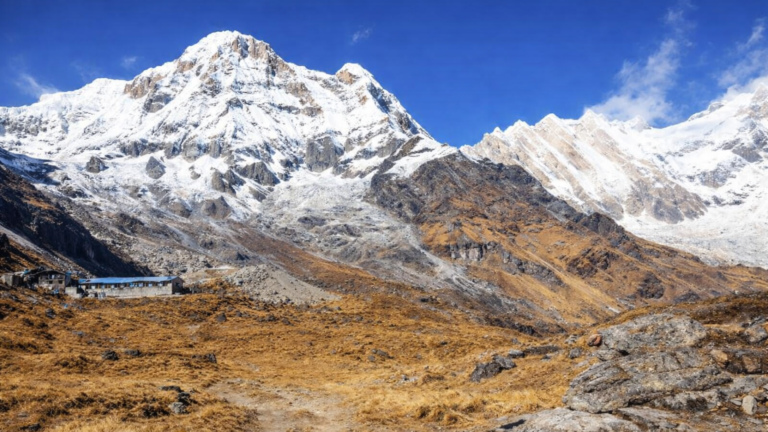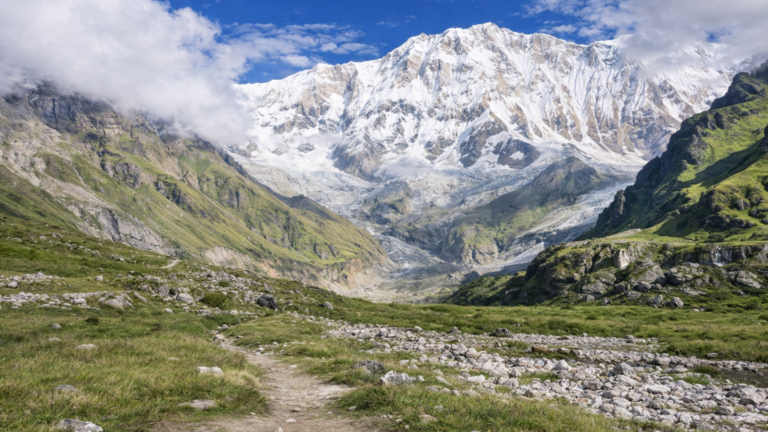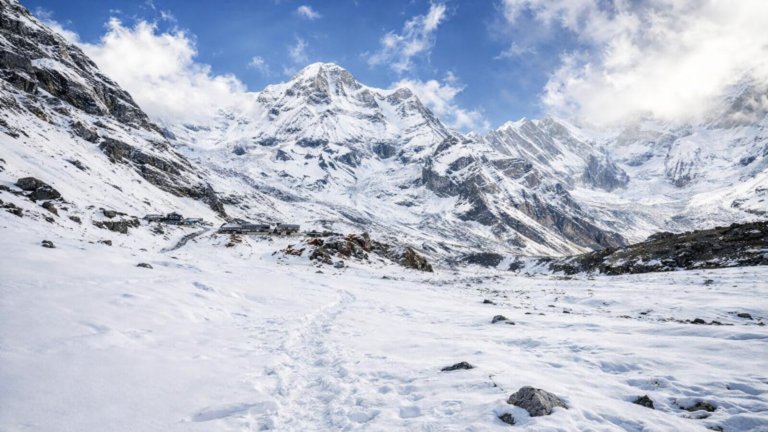
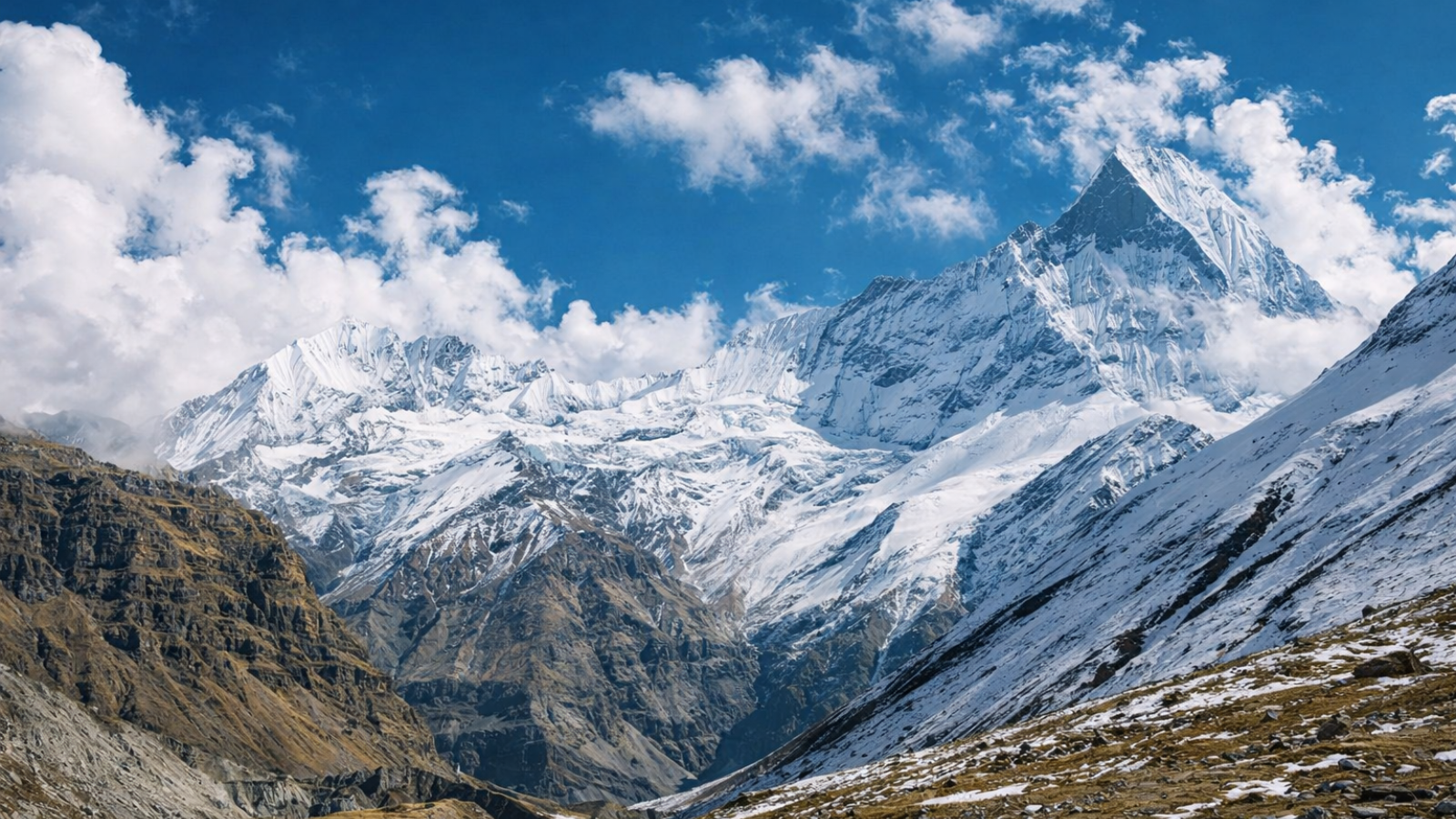

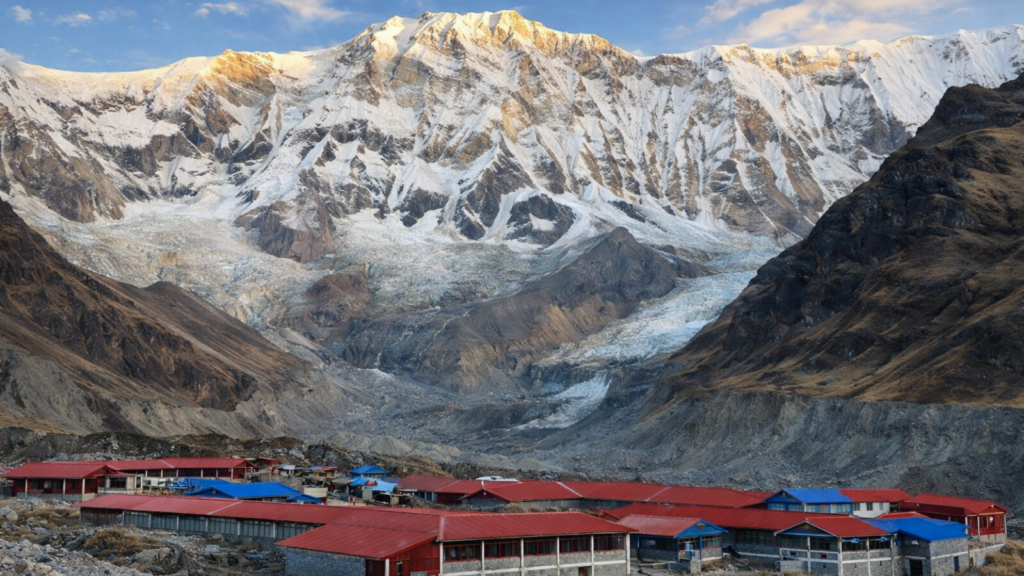
Annapurna Base Camp (ABC), located at 4,130 meters (13,549 feet) in Nepal’s Annapurna Sanctuary, Gandaki Province, is a premier trekking destination offering direct access to the base of Annapurna I (8,091 m), the world’s 10th highest peak. Surrounded by multiple towering Himalayan peaks, including Machapuchare (6,993 m), Hiunchuli (6,441 m), and Annapurna South (7,219 m), the camp sits within a natural amphitheatre in the Annapurna Conservation Area, Nepal’s largest protected region spanning 7,629 square kilometers. Trekkers are drawn to Annapurna Base Camp (ABC) for its non-technical trail, rich biodiversity across four ecological zones, and an achievable 115-kilometer round-trip trek from Nayapul, usually completed in 7 to 12 days, making it one of the most rewarding high-altitude treks in the Himalayas.
Accessing Annapurna Base Camp requires careful planning, starting with an international flight to Tribhuvan International Airport in Kathmandu, followed by a domestic connection or road transfer to Pokhara, and a 42-kilometer drive to Nayapul or Jhinu Danda. The trek itself passes through key acclimatization points, including Tikhedhunga, Ghorepani, Chhomrong, and Machapuchare Base Camp, offering rhododendron forests, alpine meadows, and glacial vistas. Trekkers must secure two mandatory permits, the Annapurna Conservation Area Permit (ACAP) and the Trekkers’ Information Management System (TIMS) card, and prepare for altitude challenges, weather variations, and essential gear requirements. With well-mapped itineraries, teahouse accommodations, and season-specific guidance, Annapurna Base Camp (ABC) remains an accessible yet exhilarating Himalayan adventure for informed and physically prepared travelers.
Annapurna Base Camp and Why Do Trekkers Choose It?
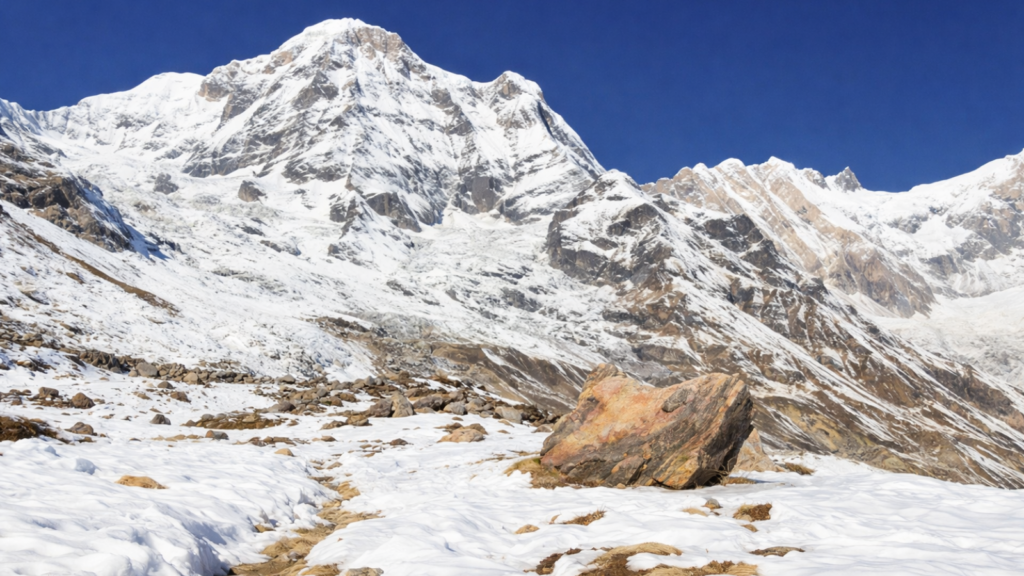
Annapurna Base Camp (ABC) is the high-altitude camp at the foot of Annapurna I (8,091 m), the world’s 10th highest mountain, located inside the Annapurna Conservation Area in Nepal’s Gandaki Province. The camp sits within a natural amphitheatre surrounded by multiple peaks above 6,000 meters, including Machapuchare (6,993 m), Hiunchuli (6,441 m), and Annapurna South (7,219 m).
Trekkers choose Annapurna Base Camp over other Himalayan treks for 3 primary reasons. First, the trail is accessible without technical mountaineering skills. Second, the route passes through 4 distinct ecological zones: subtropical forest, temperate broadleaf forest, subalpine shrubland, and alpine meadow. Third, the total trek distance of 115 kilometers round-trip from Nayapul is achievable in 7 to 14 days depending on fitness level and acclimatization pace.
The Annapurna Conservation Area, established in 1986, covers 7,629 square kilometers and is managed by the National Trust for Nature Conservation (NTNC). It is Nepal’s largest protected area and the world’s first conservation area to combine biodiversity protection with community development.
Annapurna Base Camp is distinct from Annapurna Circuit, which circumnavigates the entire Annapurna Massif over 160 to 230 kilometers. ABC focuses exclusively on the sanctuary approach from the south, making it more direct and less time-intensive.
How Do You Get to Nepal to Start the Annapurna Base Camp Trek?
To reach Nepal for the Annapurna Base Camp trek, fly into Tribhuvan International Airport (TIA) in Kathmandu, then connect to Pokhara by domestic flight (25 minutes) or tourist bus (6 to 8 hours). Pokhara is the gateway city for all Annapurna region treks.
Which International Airports Have Direct Flights to Kathmandu?
Tribhuvan International Airport receives direct flights from several international cities. The 10 busiest origin cities are Delhi, Dubai, Doha, Kuala Lumpur, Bangkok, Singapore, Istanbul, London, Mumbai, and Guangzhou. Airlines operating the route include Qatar Airways, Turkish Airlines, Malaysia Airlines, IndiGo, Air Arabia, and Oman Air.
Average flight durations: Delhi to Kathmandu is 2 hours, Dubai is 4 hours 30 minutes, London is 9 hours 30 minutes (with one stopover), and New York is 16 to 19 hours (with one or two stopovers). Kathmandu’s new Gautam Buddha International Airport in Bhairahawa also accepts international flights and is located 290 kilometers southwest of Kathmandu, serving as an alternative entry point for trekkers coming directly from India.
How Do You Travel from Kathmandu to Pokhara?
Pokhara International Airport is 200 kilometers west of Kathmandu. 3 travel options connect the two cities.
- Domestic flight takes 25 minutes and costs USD 100 to 130 one-way. Airlines operating this route include Buddha Air, Yeti Airlines, and Shree Airlines. Flights depart Kathmandu’s domestic terminal daily with 6 to 10 scheduled departures. Weather cancellations are common between June and September during the monsoon season.
- Tourist bus departs Kathmandu’s Tourist Bus Park in Thamel daily at 7:00 AM and 8:00 AM. Journey time is 6 to 8 hours. Ticket cost is NPR 1,000 to 1,500 (approximately USD 7.50 to 11). Greenline Buses and Prithvi Highway Express operate air-conditioned tourist coaches.
- Private vehicle takes 5 to 6 hours via the Prithvi Highway. A private car or jeep costs USD 60 to 120 depending on vehicle type and negotiation. This option suits groups of 3 or more trekkers sharing the cost.
Pokhara Lakeside, specifically Lakeside Road (Baidam), is the main accommodation and service hub for trekkers. The area contains over 200 guesthouses, 15 licensed trekking equipment rental shops, 8 accredited trekking agencies, and 4 TIMS card-issuing offices.
What Permits Are Required to Trek to Annapurna Base Camp?
To trek to Annapurna Base Camp, trekkers require 2 permits: the Annapurna Conservation Area Permit (ACAP) and the Trekkers’ Information Management System (TIMS) card. Both permits are issued at the Nepal Tourism Board office in Kathmandu or Pokhara.
What Is the Annapurna Conservation Area Permit (ACAP) and What Does It Cost?
The Annapurna Conservation Area Permit (ACAP) is a mandatory entry permit issued by the Annapurna Conservation Area Project (ACAP) under the National Trust for Nature Conservation. It authorizes trekkers to enter the 7,629 square kilometer Annapurna Conservation Area.
ACAP fee for SAARC nationals (Indian, Bangladeshi, Sri Lankan, Pakistani, Bhutanese, and Maldivian citizens): NPR 200 (approximately USD 1.50). ACAP fee for non-SAARC nationals: NPR 3,000 (approximately USD 22.50) as of the 2024-2025 rate. The permit is valid for the entire duration of the trek within the conservation area.
ACAP permits are issued at: Nepal Tourism Board, Pradarshani Marg, Kathmandu; Pokhara Tourism Service Centre, Lakeside (Baidam); and the Annapurna Conservation Area Project office at the Nayapul checkpoint. Carry your original passport and 2 passport-size photographs.
What Is the TIMS Card and Who Needs It?
The Trekkers’ Information Management System (TIMS) card is a safety registration system managed by the Nepal Tourism Board (NTB) and Trekking Agencies’ Association of Nepal (TAAN). It records trekker details for safety and rescue coordination purposes.
Individual trekkers (FIT – Free Independent Trekkers) pay NPR 2,000 (USD 15) for a TIMS card. Trekkers booking through registered Nepal trekking agencies pay NPR 1,000 (USD 7.50). Group trekkers (organized through agencies affiliated with TAAN) pay the same NPR 1,000 rate.
TIMS cards are available at: NTB offices in Kathmandu and Pokhara, and TAAN office in Kathmandu. Both permits combined cost a non-SAARC FIT trekker approximately USD 37.50. Checkpoints along the trail verify permits at Nayapul, Tikhedhunga, and Chomrong.
What Is the Standard Annapurna Base Camp Trek Route and Itinerary?
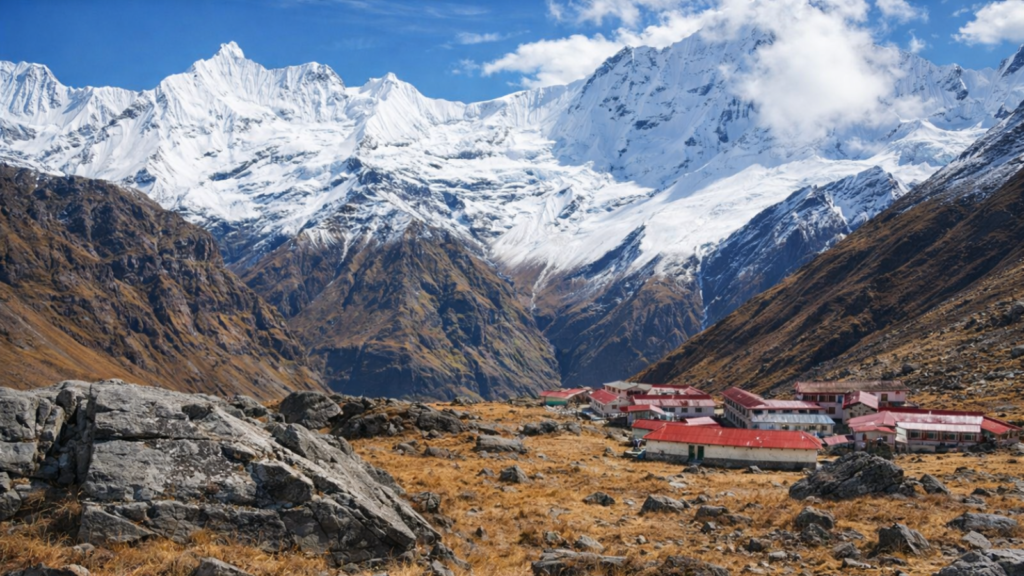
The standard Annapurna Base Camp trek route starts at Nayapul (1,070 m), 42 kilometers from Pokhara, ascends through Tikhedhunga, Ghorepani, Tadapani, Chhomrong, Dovan, Machapuchare Base Camp, and reaches Annapurna Base Camp (4,130 m) in 7 to 9 days of upward trekking. The return to Nayapul takes 4 to 6 additional days.
What Is the Day-by-Day Itinerary from Pokhara to Annapurna Base Camp?
The following 12-day itinerary is the most recommended schedule for safe acclimatization and complete route coverage.
- Day 1: Pokhara to Nayapul to Tikhedhunga (1,480 m) Drive from Pokhara to Nayapul (42 km, 1.5 hours by jeep, NPR 500–800 per person in shared jeep). Trek from Nayapul to Tikhedhunga: 2 hours, 9 kilometers. Elevation gain: 410 meters.
- Day 2: Tikhedhunga to Ghorepani (2,874 m) Trek duration: 5 to 6 hours. Distance: 12 kilometers. Elevation gain: 1,394 meters. The trail climbs a 3,600-step stone staircase through a rhododendron and oak forest. Ghorepani means “horse water” in Nepali, the village was a rest stop for trading horses on the Mustang salt trade route.
- Day 3: Poon Hill Sunrise and Ghorepani to Tadapani (2,630 m) Poon Hill (3,210 m) sunrise hike departs at 5:00 AM, takes 45 minutes from Ghorepani. The viewpoint offers a 180-degree panorama of 20 Himalayan peaks including Dhaulagiri I (8,167 m), Annapurna I (8,091 m), and Machapuchare (6,993 m). After returning to Ghorepani for breakfast, trek to Tadapani: 4 to 5 hours, 10 kilometers.
- Day 4: Tadapani to Chhomrong (2,170 m) Trek duration: 4 to 5 hours. Distance: 10 kilometers. Chhomrong is the last permanent village before the Annapurna Sanctuary. It contains 40 teahouses, 3 trekking equipment shops, a health post, and the main ACAP checkpoint for the inner sanctuary. Elevation loss: 460 meters on descent into the Modi Khola valley.
- Day 5: Chhomrong to Dovan (2,600 m) Trek duration: 5 to 6 hours. Distance: 11 kilometers. Elevation gain: 430 meters. The route descends to the Chhomrong Khola, crosses a suspension bridge, then climbs through Sinuwa (2,360 m), Kuldi (2,500 m), and Bamboo (2,310 m) before reaching Dovan. The trail passes through a bamboo and rhododendron forest ecosystem classified as lower montane forest.
- Day 6: Dovan to Machapuchare Base Camp (3,700 m) Trek duration: 6 to 7 hours. Distance: 14 kilometers. Elevation gain: 1,100 meters. The trail enters the Annapurna Sanctuary proper, an enclosed glacial basin. Machapuchare Base Camp (also called Fish Tail Base Camp) provides the first full view of Machapuchare’s twin-peaked summit. The Modi Khola glacier moraine becomes visible from this point. Himalayan Tahr (Hemitragus jemlahicus) sightings are common above 3,000 meters.
- Day 7: Machapuchare Base Camp to Annapurna Base Camp (4,130 m) Trek duration: 2 to 3 hours. Distance: 5 kilometers. Elevation gain: 430 meters. The final approach crosses alpine meadows and glacial debris. Annapurna Base Camp sits inside a complete amphitheatre of peaks. Spend the afternoon at camp for acclimatization. Overnight temperatures drop to -10°C to -15°C between November and February.
- Days 8–12: Return to Nayapul via Jhinu Danda The descent route adds a visit to Jhinu Danda (1,780 m), a hot spring village 3.5 kilometers below Chhomrong. The natural hot springs (temperature: 40°C to 45°C) provide therapeutic relief after the ascent. Return to Nayapul takes 3 to 4 days via Chhomrong, Jhinu Danda, and New Bridge.
What Are the Key Altitude Checkpoints on the ABC Trek Route?
The ABC trek passes through 9 elevation milestones that mark critical acclimatization points.
| Location | Altitude | Distance from Nayapul | Key Feature |
| Nayapul | 1,070 m | 0 km | Trek start |
| Tikhedhunga | 1,480 m | 9 km | Stone staircase begins |
| Ghorepani | 2,874 m | 21 km | Poon Hill viewpoint |
| Chhomrong | 2,170 m | 41 km | Last permanent village |
| Bamboo | 2,310 m | 52 km | Bamboo forest zone |
| Dovan | 2,600 m | 56 km | Modi Khola gorge |
| Himalaya Hotel | 2,920 m | 63 km | Glacier views begin |
| Machapuchare BC | 3,700 m | 72 km | Inner sanctuary |
| Annapurna BC | 4,130 m | 77 km | Final destination |
What Is the Best Time of Year to Trek to Annapurna Base Camp?
The 2 best seasons to trek to Annapurna Base Camp are pre-monsoon spring (March to May) and post-monsoon autumn (September to November). Spring offers rhododendron blooms and clear pre-dawn views. Autumn offers the most stable weather, driest trails, and highest visibility.
Why Is Autumn the Most Popular Season for the ABC Trek?
Autumn (September to November) is the most reliable season for 4 specific reasons. October records the lowest monthly precipitation in the Annapurna region at 36 millimeters average. Daytime temperatures at 4,000 meters range from 0°C to 8°C, cold but manageable for acclimatized trekkers. Post-monsoon air clarity delivers mountain visibility exceeding 100 kilometers on clear days. Trail conditions are dry with minimal landslide risk.
November remains excellent for trekking but requires warmer sleeping gear as night temperatures at ABC drop to -15°C. Trail congestion peaks in October.
Can You Trek to Annapurna Base Camp in Winter?
Winter trekking (December to February) to ABC is possible but demands additional preparation. Heavy snowfall above 3,000 meters makes sections of the trail between Dovan and MBC hazardous. 3 teahouses at Machapuchare Base Camp remain open year-round. Trekkers require crampons, ice axes (for slopes above 3,500 m in deep snow), and 4-season sleeping bags rated to -20°C.
Winter trekking carries higher avalanche risk above 3,500 meters. Chhomrong remains accessible year-round as its elevation (2,170 m) keeps it below consistent snowline. Winter ABC trekkers experience dramatically fewer crowds, permit numbers drop to under 800 per month in January.
What Makes the Monsoon Season a Risky Time for the Trek?
Monsoon season (June to August) brings 500 to 700 millimeters of monthly precipitation to the Annapurna foothills. Trails above 2,500 meters become muddy and landslide-prone, particularly between Tikhedhunga and Ghorepani. Leeches are active at elevations below 2,000 meters from June through August. The Annapurna Conservation Area still issues permits during monsoon, approximately 2,000 to 3,000 per month, but trail rescues increase 40% compared to the autumn season. Serious trekkers with mountain experience and proper wet-weather gear complete the trek successfully during monsoon, but it requires adjusted expectations on visibility and trail conditions.
What Physical Fitness Level and Gear Do You Need for Annapurna Base Camp?
The Annapurna Base Camp trek requires moderate to high physical fitness, specifically the ability to walk 15 to 20 kilometers per day at elevation with a backpack weighing 8 to 12 kilograms for 7 to 12 consecutive days. No technical climbing skills are needed.
What Is the Recommended Physical Preparation for ABC Trek?
A 90-day pre-trek training plan prepares most non-athletes adequately for the ABC trek. The plan divides into 3 phases.
- Phase 1 (Weeks 1–4): Cardiovascular base building. Walk or run 30 to 45 minutes, 5 days per week. Target heart rate: 65% to 75% of maximum heart rate. Incorporate incline treadmill sessions at 8% to 12% gradient to simulate uphill terrain.
- Phase 2 (Weeks 5–8): Endurance and load training. Hike outdoors with a weighted backpack (6 to 8 kg) for 2 to 4 hours on weekends. Add 2 strength training sessions per week focusing on quadriceps, hamstrings, glutes, and core stability.
- Phase 3 (Weeks 9–12): Elevation simulation and long days. If available, complete multi-day hikes of 20 to 25 kilometers on consecutive days. Altitude simulation masks or altitude training camps (if accessible) benefit trekkers with history of altitude sickness.
What Gear Is Essential for the Annapurna Base Camp Trek?
The essential gear list for ABC covers 8 categories with 32 total items.
- Footwear and Lower Body: 1 pair waterproof trekking boots (ankle support, Vibram sole), 1 pair trekking sandals or camp shoes, 4 pairs moisture-wicking trekking socks (merino wool recommended), 1 pair waterproof trekking trousers, 1 pair trekking shorts.
- Upper Body and Insulation: 3 moisture-wicking base layer shirts, 1 fleece mid-layer jacket (300g weight or higher), 1 down jacket (rated to -10°C), 1 waterproof hardshell jacket (minimum 10,000 mm hydrostatic head rating), 2 pairs trekking gloves (lightweight liner + insulated outer), 1 warm hat, 1 balaclava or buff.
- Shelter and Sleep: 1 sleeping bag rated to -15°C for winter or -5°C for spring/autumn, 1 sleeping bag liner (silk or thermal, adds 5°C warmth), 1 sleeping mat (for teahouses that provide insufficient padding).
- Navigation and Safety: 1 headlamp with spare batteries (minimum 200 lumens), 1 trekking pole pair (adjustable, shock-absorbing), 1 personal first aid kit with altitude medications (Diamox 250 mg tablets, Ibuprofen, oral rehydration sachets, blister treatment, antiseptic).
- Hydration and Nutrition: 2 water bottles (1 litre each) or 2-litre hydration bladder, water purification tablets or portable UV purifier (Steripen), 10 to 15 energy bars or trail snacks for high-altitude days.
- Documents and Money: Original passport, ACAP permit, TIMS card, travel insurance documents, USD 200 to 400 in Nepali Rupees (ATMs available in Ghorepani and Chhomrong but unreliable above those points).
How Much Does It Cost to Trek to Annapurna Base Camp?
A complete Annapurna Base Camp trek costs USD 700 to 1,800 per person depending on travel style, season, and whether a guide and porter are hired. Budget trekkers spending USD 30 to 40 per day on a teahouse trek complete it for USD 700 to 1,000. Guided trekkers with porter support spend USD 1,200 to 1,800.
What Are the Itemized Costs for the ABC Trek?
The following cost breakdown covers all mandatory and optional expenses for a 12-day trek departing from Pokhara.
- Permits: ACAP permit NPR 3,000 (USD 22.50) and TIMS card NPR 2,000 (USD 15) = USD 37.50 total for non-SAARC FIT trekkers.
- Accommodation: Teahouse rooms cost NPR 300 to 800 per person per night (USD 2.25 to 6) below 3,500 meters. Above 3,500 meters (MBC and ABC), room rates rise to NPR 800 to 1,200 (USD 6 to 9). Total accommodation for 11 nights: USD 50 to 100.
- Meals: A teahouse breakfast of porridge, toast, and eggs costs NPR 350 to 600 (USD 2.60 to 4.50). Dal bhat (the traditional Nepali rice, lentil, and vegetable meal) costs NPR 500 to 800 (USD 3.75 to 6). Prices increase 15% to 30% at higher elevations. Total meals for 12 days (3 meals/day): USD 150 to 250.
- Guide fees: A licensed trekking guide charges USD 25 to 35 per day. A 12-day trek costs USD 300 to 420 for guide services. Guides are not legally mandatory for the ABC trek route as of 2026, but Nepal’s government has periodically proposed making them compulsory, check current regulations with the Nepal Tourism Board before departure.
- Porter fees: Porters carry 20 to 25 kilograms maximum and charge USD 15 to 20 per day. Hiring 1 porter for 12 days costs USD 180 to 240. Tipping is standard: USD 5 to 10 per day for guides and USD 3 to 7 per day for porters is the accepted range.
- Transport: Kathmandu to Pokhara domestic flight USD 100 to 130. Pokhara to Nayapul jeep NPR 500 to 800 (USD 3.75 to 6).
Total estimated budget (without international flights):
| Category | Budget Trek (USD) | Guided Trek (USD) |
| Permits | 37.50 | 37.50 |
| Accommodation | 50–100 | 50–100 |
| Meals | 150–250 | 150–250 |
| Guide plus Porter | 0 | 480–660 |
| Transport | 110–140 | 110–140 |
| Gear rental | 50–100 | 50–100 |
| Total | USD 397–627 | USD 877–1,287 |
Add Pokhara pre-trek accommodation (2 nights average: USD 20 to 60), gear purchases if needed (USD 200 to 600 for full kit from Kathmandu’s Thamel gear shops), and Nepal visa fee (USD 30 for 15 days, USD 50 for 30 days on arrival) to reach total trip cost.
What Are the Top Safety Risks and Altitude Sickness Guidelines for ABC?
The 3 primary safety risks on the Annapurna Base Camp trek are acute mountain sickness (AMS), trail avalanches above 3,500 meters, and teahouse fires. AMS affects 25% to 35% of trekkers who ascend above 3,500 meters without proper acclimatization.
How Do You Prevent and Recognize Acute Mountain Sickness on the ABC Trek?
Acute Mountain Sickness (AMS) is a physiological response to reduced atmospheric oxygen pressure at altitude. Symptoms of mild AMS include headache, nausea, dizziness, fatigue, and loss of appetite. Symptoms of severe AMS (High Altitude Pulmonary Edema, HAPE, or High Altitude Cerebral Edema, HACE) include confusion, loss of coordination, persistent cough, frothy or pink sputum, and inability to walk a straight line.
The “climb high, sleep low” rule is the foundational acclimatization principle. Above 3,000 meters, ascend no more than 300 to 500 meters per day in sleeping elevation. The Poon Hill route from Ghorepani (2,874 m) to ABC (4,130 m) covers 1,256 meters of elevation gain over 5 to 6 days, within the safe acclimatization range when the itinerary includes a rest day at Chhomrong (2,170 m).
Acetazolamide (Diamox) at 125 to 250 mg twice daily reduces AMS risk by 75% according to studies published in the Wilderness & Environmental Medicine journal. Begin taking Diamox 24 hours before ascending above 3,000 meters. Common side effects include tingling in hands and feet and increased urination.
The HAPE and HACE emergency protocol is descent of minimum 500 to 1,000 meters immediately upon symptom identification. Helicopter evacuation from Annapurna Base Camp is available, the nearest landing zone is at Chhomrong. Emergency helicopter rescue costs USD 1,500 to 4,000. Travel insurance covering helicopter evacuation and high-altitude trekking is mandatory for responsible ABC trekking.
How Do You Book an Annapurna Base Camp Trek Through a Registered Agency?
To book a guided Annapurna Base Camp trek, select a trekking agency registered with the Trekking Agencies’ Association of Nepal (TAAN) and the Nepal Tourism Board (NTB), verify their license number on the NTB online portal, and confirm the guide holds a licensed trekking guide certificate issued by the Nepal Academy of Tourism and Hotel Management (NATHM).
Registered agencies provide 8 core services: permit acquisition, licensed guide assignment, porter hiring and insurance, teahouse bookings along the route, emergency communication devices (satellite phone or radio), comprehensive gear rental, post-trek airport transfers, and travel insurance coordination.
The cost difference between booking locally in Pokhara versus booking internationally from your home country is USD 300 to 600 for the same 12-day itinerary. Local Pokhara agencies offer the same licensed guides at lower overhead costs. Verify any agency’s registration on the Nepal Tourism Board’s official website (ntb.gov.np) by searching their registered company name or license number.
Confirm that your guide’s license is active and covers the Annapurna region specifically, Nepal’s guide licensing system issues region-specific certifications. A fully equipped, 12-day guided ABC package from a licensed Pokhara agency with guide, porter, all permits, teahouse accommodation, and breakfast/dinner costs USD 900 to 1,400 per person as of 2026 rates.
Annapurna Base Camp Trek: Complete Summary
The journey to Annapurna Base Camp begins with a flight into Kathmandu, a 25-minute domestic connection to Pokhara, and a 42-kilometer road transfer to the trailhead at Nayapul. The trek ascends 3,060 meters over 77 kilometers through 9 elevation checkpoints across 7 to 9 days. 2 permits, ACAP (USD 22.50) and TIMS (USD 15), are mandatory for all trekkers. The safest months are October, November, March, and April. Total trip cost ranges from USD 700 to 1,800 excluding international flights. Altitude sickness affects 25% to 35% of trekkers above 3,500 meters; the prevention strategy is gradual ascent, hydration, and Diamox if medically appropriate.
Annapurna Base Camp delivers a direct, awe-inducing encounter with the world’s 10th highest peak without requiring technical mountaineering skills, making it one of the most rewarding trekking destinations in the Himalayas for prepared and informed trekkers.
How long does it take to trek to Annapurna Base Camp?
The standard Annapurna Base Camp trek takes 7 to 12 days round-trip from Nayapul, depending on fitness level and acclimatization pace. The ascent from Nayapul (1,070 m) to ABC (4,130 m) covers 77 kilometers over 7 to 9 days. A 12-day itinerary is recommended for most trekkers to allow safe altitude adjustment and a rest day at Chhomrong.
Do I need a guide to trek to Annapurna Base Camp?
A licensed guide is not legally mandatory for the Annapurna Base Camp route, but the Nepal government has periodically proposed making it compulsory. Hiring a guide from a TAAN-registered agency costs USD 25 to 35 per day and significantly improves safety, navigation, and emergency response. Solo trekkers without local knowledge face higher risk of route errors above 3,000 meters, especially in poor visibility.
What permits do I need for the Annapurna Base Camp trek?
2 permits are mandatory: the Annapurna Conservation Area Permit (ACAP) and the Trekkers’ Information Management System (TIMS) card. ACAP costs NPR 3,000 (USD 22.50) and TIMS costs NPR 2,000 (USD 15) for non-SAARC nationals. Both permits are issued at Nepal Tourism Board offices in Kathmandu and Pokhara Lakeside.
What is the best time of year to trek to Annapurna Base Camp?
The 2 best seasons are autumn (September to November) and spring (March to May). October delivers the driest trails, clearest skies, and most stable weather across the Annapurna region. Spring adds rhododendron blooms along the Ghorepani trail, while winter (December to February) is possible but requires extra gear for temperatures as low as -15°C at base camp.
How difficult is the Annapurna Base Camp trek?
The ABC trek is rated moderate to strenuous, it requires no technical climbing skills but demands sustained walking of 15 to 20 kilometers per day over 7 to 12 consecutive days. The maximum altitude of 4,130 meters means altitude sickness is a genuine risk for 25% to 35% of trekkers above 3,500 meters. A 90-day pre-trek fitness program including weighted hikes and cardiovascular training prepares most non-athletes adequately.
How much does the Annapurna Base Camp trek cost?
A budget solo teahouse trek costs approximately USD 400 to 630 excluding international flights, covering permits, accommodation, meals, and transport. A fully guided trek with a licensed guide and porter from a registered Pokhara agency costs USD 900 to 1,400 per person for a 12-day package. Additional costs include Nepal visa (USD 30 to 50), gear purchase or rental (USD 200 to 600), and travel insurance covering helicopter evacuation.
What should I pack for the Annapurna Base Camp trek?
Essential gear includes waterproof trekking boots, a down jacket rated to -10°C, a sleeping bag rated to -15°C for winter or -5°C for autumn, and a waterproof hardshell jacket. Carry a personal first aid kit with Diamox (acetazolamide) 250 mg tablets, oral rehydration sachets, and blister treatment. Water purification tablets or a UV purifier (Steripen) are necessary as tap water above 2,000 meters is unsafe to drink untreated.
Is altitude sickness a serious risk on the Annapurna Base Camp trek?
Altitude sickness (AMS) affects 25% to 35% of trekkers who ascend above 3,500 meters without proper acclimatization. Symptoms include headache, nausea, dizziness, and fatigue, severe cases (HAPE or HACE) require immediate descent of 500 to 1,000 meters and emergency helicopter evacuation. The prevention strategy is ascending no more than 300 to 500 meters per day in sleeping elevation above 3,000 meters and taking Diamox 125 to 250 mg twice daily if medically appropriate.
Are teahouses available along the entire Annapurna Base Camp route?
Teahouses operate at every major stop on the ABC route from Nayapul to Annapurna Base Camp itself, providing basic room accommodation and hot meals. Room rates range from NPR 300 to 800 per night below 3,500 meters and NPR 800 to 1,200 at Machapuchare Base Camp and ABC. 3 teahouses at Machapuchare Base Camp and ABC remain open year-round, though electricity and Wi-Fi are unreliable above Chhomrong (2,170 m).
How do I get from Kathmandu to the Annapurna Base Camp trailhead?
From Kathmandu, fly to Pokhara (25 minutes, USD 100 to 130) or take a tourist bus (6 to 8 hours, USD 7.50 to 11). From Pokhara Lakeside, take a shared jeep to Nayapul (42 km, 1.5 hours, NPR 500 to 800 per person), which is the main trailhead for the ABC route. Some trekkers start at Jhinu Danda or Kimche to shorten the drive and begin trekking earlier on Day 1.