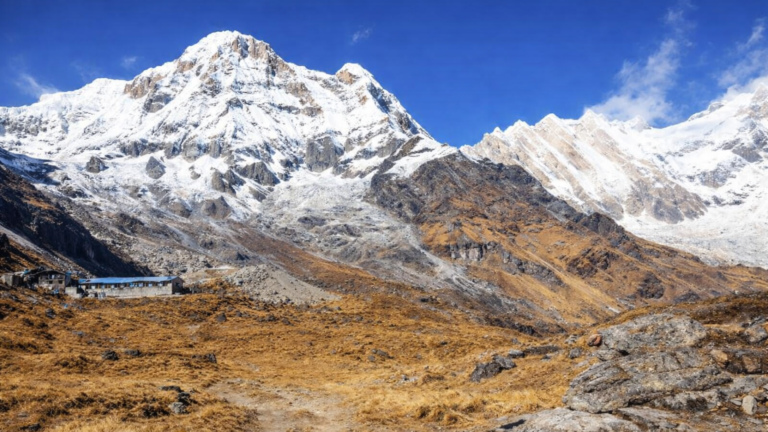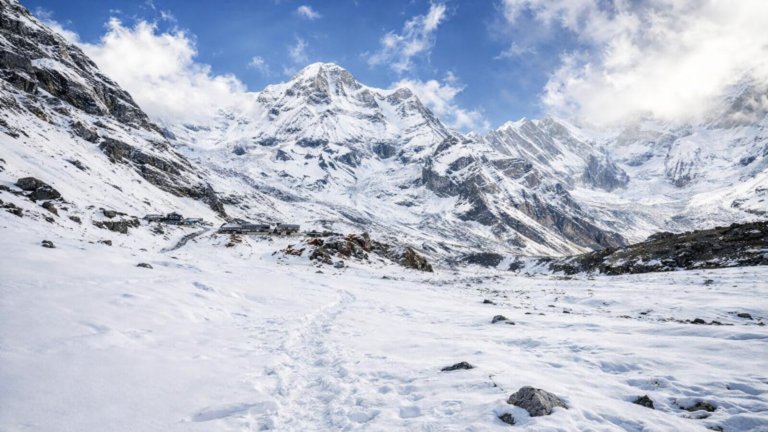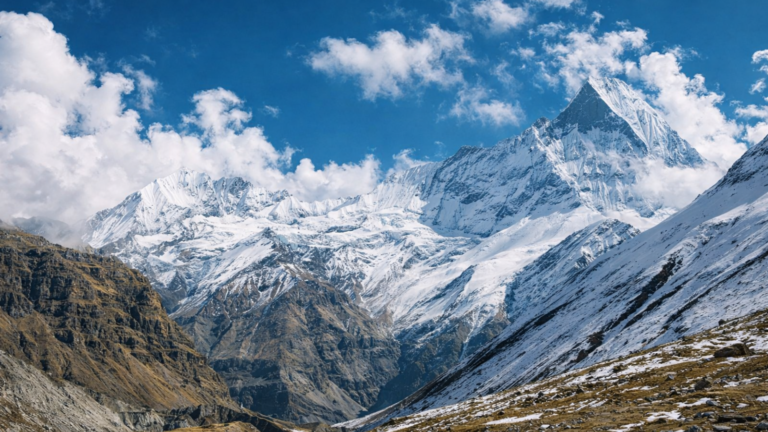
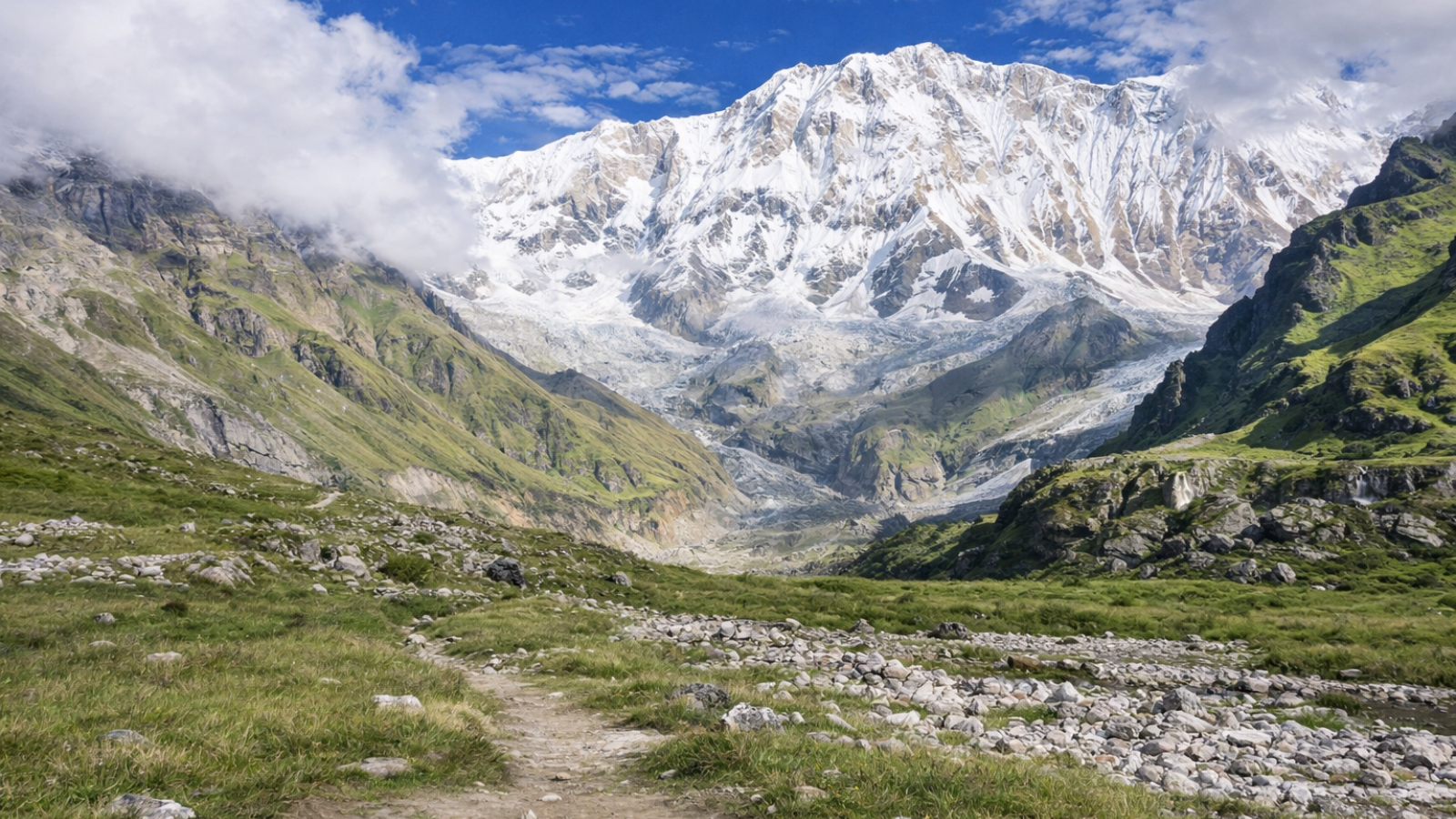

The 15 Day Annapurna Base Camp Trek is a classic Himalayan trekking journey that leads deep into the Annapurna Sanctuary, reaching Annapurna Base Camp at 4,130 meters (13,549 ft) beneath the towering south face of Annapurna I (8,091 m). This route combines high-altitude mountain scenery, traditional Gurung and Magar villages, and diverse ecosystems that shift from subtropical forests to alpine glacial terrain. Over fifteen days, trekkers travel through famous stops such as Ghorepani, Poon Hill, Chhomrong, Machapuchare Base Camp, and finally into the natural amphitheater of the Annapurna Sanctuary, surrounded by peaks including Annapurna South, Hiunchuli, Gangapurna, and Machapuchare. The trek delivers a rare 360-degree Himalayan panorama without requiring technical climbing or mountaineering experience.
A 15 day Annapurna Base Camp itinerary offers the most balanced way to experience the route, combining gradual altitude acclimatization with iconic viewpoints and cultural encounters. The trek includes the celebrated Poon Hill sunrise (3,210 m) overlooking the Annapurna–Dhaulagiri range, the bamboo forests of the Modi Khola valley, and the natural hot springs at Jhinu Danda for post-trek recovery. Daily hikes of about 5–7 hours allow trekkers to adapt safely to elevations above 3,000 meters while fully experiencing the landscapes, teahouse culture, and mountain vistas that define Nepal’s Annapurna region. For trekkers seeking a complete Himalayan experience with manageable difficulty, the 15-day Annapurna Base Camp trek remains one of the most rewarding trekking routes in Nepal.
What Makes the 15 Day Annapurna Base Camp Trek the Perfect Himalayan Adventure?
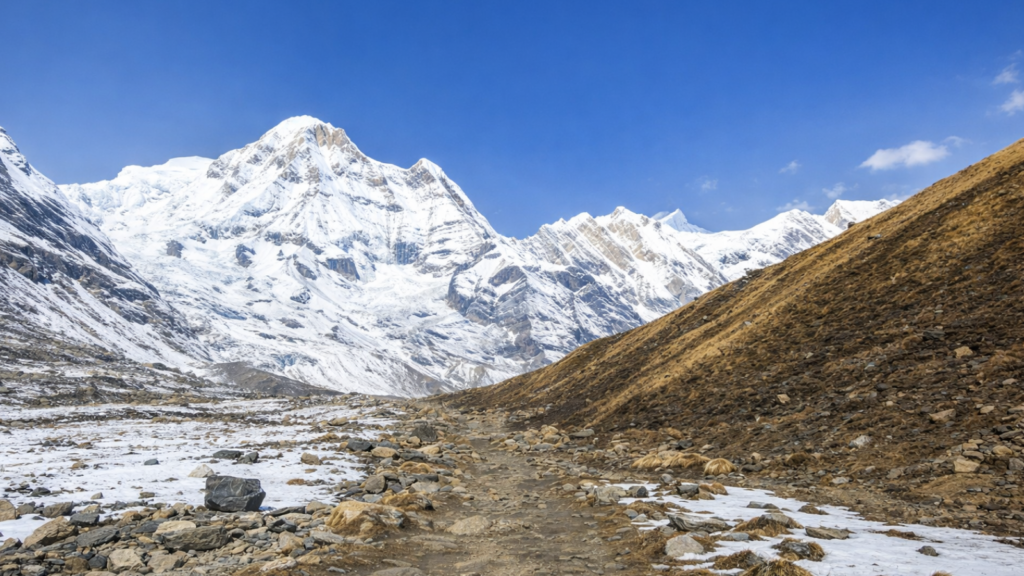
The 15-day Annapurna Base Camp trek stands apart from shorter variations because it includes the iconic Poon Hill sunrise viewpoint, full sanctuary acclimatization, natural hot spring recovery, and ample time in Pokhara, without the rush that turns a mountain experience into a checklist.
Most trekkers who attempt the 7- or 10-day versions report the same frustration: they sprint through segments that deserve attention, skip the side experiences, and arrive at base camp fatigued rather than energized. The 15-day format resolves all of this. You walk at a pace your body respects, your lungs adjust gradually, and the mountain rewards you with clarity, both in the sky and in the experience.
Annapurna Base Camp at 4,130 Meters
Annapurna Base Camp sits at 4,130 meters (13,549 feet) above sea level inside the Annapurna Sanctuary, a glacially carved highland basin enclosed by a horseshoe of peaks that include Annapurna I (8,091m), Annapurna South (7,219m), Machapuchare (6,993m), Hiunchuli (6,441m), and Gangapurna (7,455m).
The Annapurna Sanctuary is not simply a base camp. It is a protected high-altitude bowl accessible through a single gorge cut by the Modi Khola river. Entry involves crossing dense bamboo and rhododendron forests, passing through the constricted canyon below Machapuchare Base Camp at 3,700 meters, and emerging into open glacial terrain. The dramatic shift from forest canopy to ice-scarred rock happens within 2 kilometers, one of the most cinematic transitions in Himalayan trekking.
Annapurna I, the destination’s guardian peak, is the 10th highest mountain on earth and holds one of the highest fatality-to-summit ratios in mountaineering history, a fact that makes simply arriving at its base camp feel earned. The mountain’s south face, the wall you face at base camp, rises more than 4,000 vertical meters above you in a near-unbroken sweep of ice and granite.
Why 15 Days Is the Ideal Duration for the ABC Trek
A 15-day itinerary solves 3 core problems that shorter ABC treks create:
- Acclimatization depth. Above 3,000 meters, ascending more than 300–400 vertical meters per day dramatically increases altitude sickness risk. The 15-day schedule reaches Annapurna Base Camp on Day 10, giving the body 7 trekking days to climb from 1,070 meters (Nayapul) to 4,130 meters, a controlled rate of gain that the body processes efficiently.
- Experience completeness. The 15-day route includes Poon Hill (3,210m), which a strict ABC-only itinerary omits. Poon Hill provides the widest panoramic view of the entire Annapurna-Dhaulagiri corridor, a 180-kilometer ridge of summits visible from a single hillside viewpoint at sunrise. Removing this from your schedule removes the single best mountain panorama accessible without technical climbing on the Annapurna trail.
- Recovery and re-entry. Jhinu Danda’s natural hot springs, placed on Day 12 of this itinerary after the descent from base camp, allow muscle recovery before the final road sections. Trekkers who skip this suffer the consequences: stiff legs, sore knees, and a Pokhara arrival that feels like limping rather than returning triumphant.
Who Is Best Suited for the 15 Day Annapurna Base Camp Trek?
The 15-day Annapurna Base Camp trek suits trekkers with moderate physical fitness who can walk 5–7 hours per day on uneven mountain terrain. Prior high-altitude experience is beneficial but not required. The trek does not involve technical climbing, fixed ropes, or glacier crossings.
The real challenge is not difficulty but consistency. Eight consecutive days of 5–7 hour walks, repeated ascents and descents over stone staircases, and trekking on tired legs after the novelty wears off, these are the conditions that distinguish comfortable trekkers from those who struggle. Anyone who walks regularly, exercises 3–4 times per week, and has no unmanaged cardiovascular conditions is capable of completing this trek with proper preparation.
Trekkers aged 16 to 65 complete this route every season. The youngest successfully documented solo trekkers are in their teens; the oldest guided trekkers are in their late 70s. Age is not a barrier. Preparation is.
Complete Day-by-Day 15-Day Annapurna Base Camp Trek Itinerary
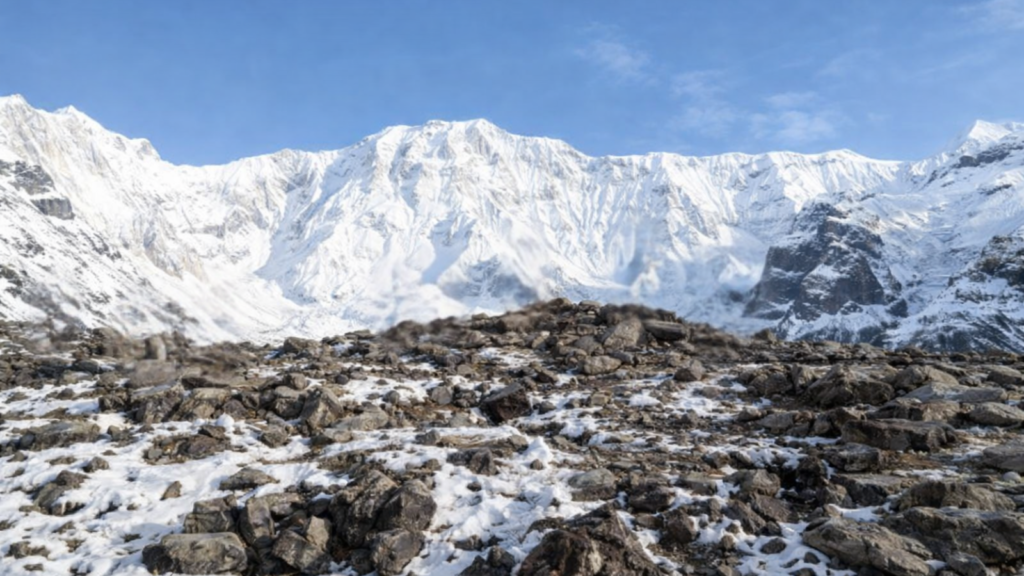
The 15-day Annapurna Base Camp itinerary begins in Kathmandu, flies to Pokhara, and follows the classic Ghorepani-Poon Hill approach before entering the Annapurna Sanctuary through the Modi Khola gorge. The route reaches base camp on Day 9–10, descends through Jhinu Danda’s hot springs on Day 12, and returns to Kathmandu by Day 15. Each day averages 5–7 hours of walking with controlled elevation gain designed to support safe acclimatization above 3,000 meters.
Days 1–2: Arrival in Kathmandu and Flight to Pokhara
- Day 1: begins with arrival at Tribhuvan International Airport (TIA) in Kathmandu at 1,400 meters. Your guide meets you at the airport and transfers you to your hotel in Thamel. The afternoon is yours for rest, acclimatization walks around Thamel, and gear checks. A pre-trek briefing with your guide covers permit status, weather forecasts, and daily expectations.
- Day 2: involves a morning flight to Pokhara (822m), a 25-minute aerial journey that reveals the entire Annapurna Himal from the plane window, a first glimpse of where you’re heading. In Pokhara, explore Lakeside, visit the International Mountain Museum, and confirm your final equipment with your guide. Overnight in a hotel by Phewa Lake.
What most trekkers overlook: Kathmandu sits at 1,400 meters. Your 2 days here begin the acclimatization process before you reach trail altitude. This physiological head-start, while subtle, matters at higher elevations.
Days 3–5: Pokhara to Ghorepani via Tikhedhunga and Ulleri
- Day 3: begins with a 1-hour drive from Pokhara to Nayapul (1,070m), where the trek officially starts. Your ACAP permit and TIMS card are checked at the Birethanti checkpoint as you enter the Annapurna Conservation Area. The trail follows the Modi Khola river valley through subtropical farmland and Magar villages to Tikhedhunga (1,540m). Walking time: 3–4 hours. Distance: 7 km.
- Day 4: is the trek’s first real test. From Tikhedhunga, the trail ascends a relentless stone staircase, reportedly more than 3,000 stone steps, through the Magar village of Ulleri (2,073m) before easing into rhododendron and oak forest. The forest above Ulleri holds Nepal’s finest concentration of red, pink, and white rhododendrons, blooming in March and April with a density that turns the trail into a floral corridor. Destination: Ghorepani (2,750m). Walking time: 5–6 hours. Elevation gain: 1,210 meters.
- Day 5: is the Poon Hill morning. Wake at 4:30 AM and hike 45 minutes by headlamp to Poon Hill summit (3,210m). At sunrise, the full Annapurna-Dhaulagiri panorama ignites in alpenglow, Annapurna I, Annapurna South, Annapurna III, Dhaulagiri I (8,167m), Tukuche Peak, Nilgiri, and the distant spike of Machapuchare. This view is unique: it presents two 8,000-meter giants separated by the 6,000-meter-deep Kali Gandaki Gorge within a single visual sweep. After sunrise, descend to Ghorepani for breakfast and continue trekking to Tadapani (2,590m) through dense ridgeline forest. Walking time: 5–6 hours.
Days 6–7: Poon Hill Descent and Trek to Chhomrong
- Day 6: drops from Tadapani through lush rhododendron and oak forest to Chhomrong (2,340m), the last large Gurung village before the sanctuary gorge. Chhomrong’s stone-paved main street, terraced fields, and direct views of Annapurna South and Machapuchare make it one of the most photogenic stops on the entire route. Walking time: 5–6 hours.
- Day 7: begins with a steep descent to the Chhomrong Khola suspension bridge, followed by a stiff climb to Sinuwa (2,340m). The trail then enters the bamboo forest zone, a magical, mist-filled section where giant bamboo towers over the path, giant musk deer occasionally cross the trail, and the Modi Khola rumbles unseen in the valley below. Destination: Himalaya Hotel (2,900m). Walking time: 5–6 hours.
What competitors miss: The descent-ascent-descent-ascent terrain between Chhomrong and the sanctuary is the route’s most knee-intensive section. Trekking poles are not optional here, they reduce knee joint impact by up to 25% on steep descents.
Days 8–10: Entering the Annapurna Sanctuary, Chhomrong to ABC
- Day 8: continues through bamboo and rhododendron to Dovan (2,600m) and then Machapuchare Base Camp (MBC) at 3,700 meters, a dramatic open plateau where Machapuchare’s perfect pyramid towers directly overhead. MBC is where most trekkers take their first real look at what lies ahead: the final gorge, the snow-dusted approach trail, and the ring of peaks guarding the sanctuary. Overnight at MBC. Walking time: 5–6 hours.
- Day 9: is the summit day of the trek. From MBC, the trail crosses snow patches in spring and frost-dusted rock in autumn, ascending 430 vertical meters in 3 hours to reach Annapurna Base Camp at 4,130 meters. Arrival at base camp delivers the trek’s defining moment: a 360-degree panorama of 13 peaks above 6,000 meters, 3 peaks above 7,000 meters, and Annapurna I’s immense south face dominating the northern skyline. Sunrise from ABC the following morning, with the Annapurna range catching the first light while the sanctuary remains in pre-dawn shadow, rivals any mountain sunrise accessible by walking. Walking time from MBC: 3 hours.
- Day 10: full day at Annapurna Base Camp (4,130m). Sunrise photography, exploration of the sanctuary perimeter, and recovery. This day allows the high-altitude experience to settle: the thin air, the silence broken only by wind and occasional ice-fall, the altitude-induced clarity of perception that veteran trekkers consistently describe as one of trekking’s profound gifts. Rest and acclimatize fully before the descent begins on Day 11.
Days 11–12: Return Trek from ABC to Jhinu Danda Hot Springs
- Day 11: reverses the ascent, descending from ABC through MBC (3,700m), Dovan, and back to Bamboo (2,310m), a 1,820-meter descent that takes approximately 6 hours. The downward route feels dramatically different from the ascent: the peaks reveal new faces as the angle shifts, and the forest returns quickly, softening the landscape from alpine austerity to subtropical warmth within a single afternoon.
- Day 12: completes the descent to Chhomrong and then continues to Jhinu Danda (1,780m). Fifteen minutes below the village, 3 natural hot spring pools fed by geothermally heated water sit at the Modi Khola riverbank, the perfect recovery for legs that have trekked 100+ kilometers over 9 days. Soaking time is unconstrained. Overnight at Jhinu Danda. Walking time: 5–6 hours.
The hot springs are one of the most commonly skipped elements of ABC treks operated on tight schedules. In a 15-day format, they are a centerpiece recovery experience, not an afterthought.
Days 13–15: Pokhara Sightseeing and Kathmandu Departure
- Day 13: involves a morning walk from Jhinu Danda to Siwai, where a jeep drive returns you to Pokhara (822m). Afternoon free for Pokhara exploration: Phewa Lake boating, Devi’s Fall, Gupteswar Cave, paragliding above the valley.
- Day 14: in Pokhara, rest, shopping for local crafts and trekking souvenirs, optional visit to the Annapurna Museum in Lakeside, afternoon evening flight or drive to Kathmandu.
- Day 15: final morning in Kathmandu. Thamel exploration, last-minute souvenir shopping, and transfer to Tribhuvan International Airport for departure.
What Permits Do You Need for the 15-Day Annapurna Base Camp Trek in 2026?
The 15-Day Annapurna Base Camp Trek requires two mandatory permits in 2026: the Annapurna Conservation Area Permit (ACAP) and the Trekkers’ Information Management System (TIMS) card. The ACAP permit costs NPR 3,000 for foreign nationals (approximately $23 USD) and NPR 1,000 for SAARC nationals. The TIMS card costs NPR 2,000 for foreign trekkers trekking through agencies and NPR 1,000 for SAARC nationals. These permits are checked at major trail entry checkpoints such as Birethanti, Ghorepani, and Chhomrong to monitor trekkers entering the Annapurna Conservation Area. All foreign trekkers must also trek with a licensed government-registered guide under Nepal’s trekking regulations.
ACAP and TIMS Permits: Mandatory Documents for the ABC Trek
The Annapurna Conservation Area Permit (ACAP) and the Trekkers’ Information Management System (TIMS) card are the two permits required for trekking to Annapurna Base Camp in 2026.
ACAP Permit
- Cost: NPR 3,000 for foreign nationals
- NPR 1,000 for SAARC nationals
- Issued by the National Trust for Nature Conservation (NTNC)
- Funds conservation programs, trail maintenance, and community projects across the 7,629 km² Annapurna Conservation Area
TIMS Card (Trekkers’ Information Management System)
- Cost: NPR 2,000 for foreign trekkers through registered agencies
- NPR 1,000 for SAARC nationals
- Issued by the Nepal Tourism Board (NTB) and Trekking Agencies’ Association of Nepal (TAAN)
- Used to track trekkers for safety monitoring and emergency rescue coordination
Both permits must be carried as printed copies during the trek and may be checked at Birethanti, Ghorepani, Chhomrong, and other trail checkpoints. Trekking agencies typically arrange these permits before the trek begins.
Mandatory Guide Regulation: What Changed in 2023
Nepal’s government issued a directive effective April 1, 2023, requiring all foreign trekkers in regulated high-altitude areas, including the Annapurna region, to trek with a licensed government-registered guide. Solo independent trekking without a guide is no longer legally permitted on the ABC route.
This regulation serves 3 purposes: trekker safety and emergency documentation, economic support for Nepal’s guide community, and environmental enforcement along protected trails. Licensed guides carry verifiable credentials issued by the Nepal Tourism Board and must complete government-approved training in wilderness first aid and mountain safety.
For trekkers booking through a registered trekking agency, guide compliance is automatic, the agency arranges licensed guide services as part of the package. Solo trekkers hiring independently must verify guide credentials with the Nepal Tourism Board before departure.
How and Where to Obtain ACAP and TIMS Permits
ACAP permits and TIMS cards can both be obtained at the following official locations:
Kathmandu: Nepal Tourism Board office at Bhrikutimandap, open daily 9 AM–5 PM except Saturdays. Process time is typically 5 minutes. Documents required: valid passport, 2 passport-sized photographs, completed permit application form, and NPR 3,000 in cash.
Pokhara: Damside Tourist Office (located inside the Immigration Office), open daily including Saturdays, 9 AM–5 PM. The Pokhara office is more convenient for trekkers who fly directly to Pokhara without stopping in Kathmandu.
Registered trekking agencies handle permit acquisition on behalf of clients using a passport photocopy and digital photo, no in-person visit required. This is the fastest and most reliable method for first-time trekkers.
Important for 2026: Digital copies of permits are often rejected at trail checkpoints due to connectivity limitations. Always carry printed hard copies of your ACAP permit throughout the trek.
How Much Does the 15-Day Annapurna Base Camp Trek Cost in 2026?
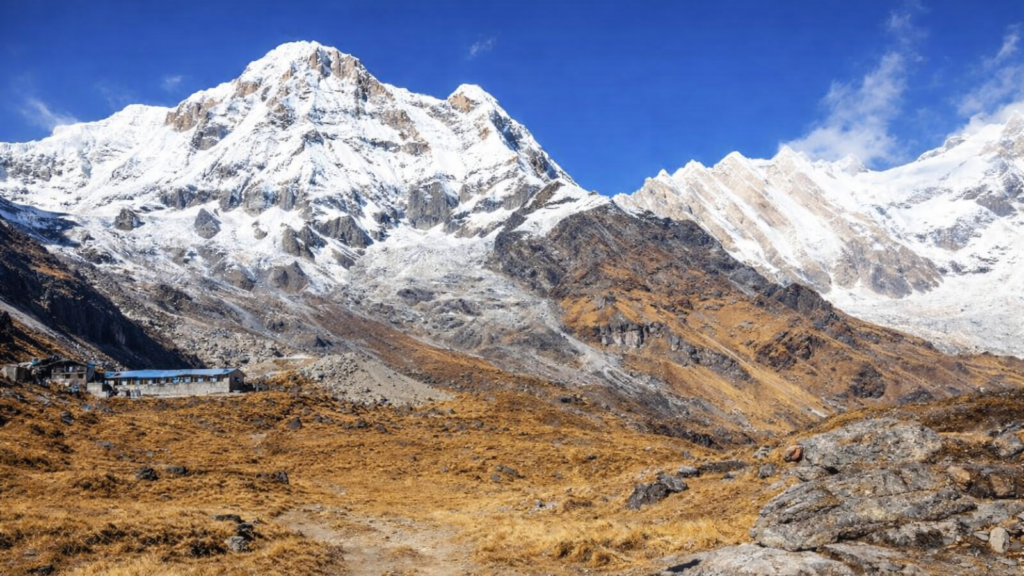
The 15-day Annapurna Base Camp trek costs between $700 and $1,500 USD per person depending on package type, group size, and daily trail spending. Budget packages covering basic teahouses, a licensed guide, and permits start at approximately $500–$800, while standard packages with a private guide and porter fall between $800–$1,200. Hidden costs including hot showers, battery charging, staff tips, and specialized high-altitude travel insurance consistently add $200–$400 beyond the advertised package price.
Budget, Standard, and Premium Package Breakdown
- Budget package ($500–$800 per person): Covers basic teahouse accommodation in shared rooms, simple dal bhat-focused meals, ACAP permit, licensed guide, and shared jeep transportation. Suitable for solo travelers joining small groups. Sleeping bag and down jacket are typically rented, not provided. No porter included in the base price.
- Standard package ($800–$1,200 per person): The most common choice for trekkers. Includes upgraded teahouse accommodation (where available) on a twin-sharing basis, broader menu options, private guide, 1 porter for 2 trekkers, ACAP permit, and private jeep to/from trailhead. Hot showers and battery charging at teahouses are usually self-funded extras.
- Premium package ($1,200–$1,500+ per person): Includes best available teahouse rooms, private transport throughout, personal guide-porter ratio of 1:1, all meals, and often a helicopter return from ABC to Pokhara, turning the return trek into a 15-minute flight. The helicopter option (approximately $200–$250 per person one way) is increasingly popular among trekkers with time constraints or knee conditions.
Group size directly affects per-person cost. A group of 6 typically pays 15–20% less per person than a group of 2. The most significant cost reduction comes from sharing porter fees and private transport costs across more participants.
Daily Spending on the Trail: What to Expect
Teahouse accommodation along the Annapurna route costs $5–$15 per person per night depending on altitude and season. Rooms at Chhomrong and below tend to be larger and more comfortable; rooms at MBC and ABC are smaller, more basic, and priced at the higher end due to the difficulty of supply logistics.
Meals cost $4–$12 per dish at teahouse restaurants. Dal bhat, lentil soup, rice, curried vegetables, and pickle, is the best value option at any altitude and is served with unlimited refills. It is also the most nutritionally dense option for sustained trekking energy. Budget approximately $20–$30 per day for 3 full meals at mid-range teahouses.
Water on the trail costs $0.50–$3 per liter for bottled water, with prices increasing with altitude. Carrying a quality water filter or purification tablets, such as a Lifestraw personal filter or Aquatabs iodine tablets, eliminates plastic bottle purchases entirely, saves $15–$30 over the full trek, and removes a significant source of trail plastic waste.
Hidden Costs Most Trekkers Overlook
5 expenses consistently surprise first-time ABC trekkers:
- Hot showers: Most teahouses charge $2–$5 per shower. Over 12 nights, this amounts to $25–$60.
- Battery charging and device power: Teahouses charge $1–$3 per device per hour for electrical charging. A solar charging panel eliminates this expense entirely.
- Staff tips: Tipping guides and porters is culturally expected and genuinely important. The standard for a 15-day trek is $10–$15 per day for the guide and $5–$8 per day for the porter, paid at the end of the trek. Budget approximately $150–$225 for guide tipping and $75–$120 for porter tipping on a 15-day itinerary.
- Travel insurance: High-altitude trekking above 3,000 meters requires specialized insurance that covers helicopter evacuation. Standard travel insurance does not cover this. Dedicated trekking insurance from providers specializing in Himalayan coverage costs approximately $60–$120 for a 15-day policy.
- Nepal visa: A 15-day tourist visa on arrival at Tribhuvan International Airport costs $25 USD. A 30-day visa costs $40 USD. Most trekkers opt for the 30-day visa to allow flexibility without risking overstay.
What Is the Best Time for the 15-Day Annapurna Base Camp Trek?
Spring (March to May) and autumn (September to November) are the two optimal trekking windows for the 15-day Annapurna Base Camp route. Spring delivers blooming rhododendron forests with 33 species in color from 1,200 to 3,800 meters, while October produces the clearest mountain skies of the year with exceptional visibility across the full Annapurna-Dhaulagiri range. Monsoon and winter trekking remain possible for experienced trekkers but involve persistent cloud cover, slippery trails, or heavy snowfall above 3,500 meters.
Spring Trekking (March to May): Rhododendrons and Warm Days
Spring on the Annapurna trail means rhododendron forests in full bloom, a visual spectacle with 33 species of rhododendron represented in the Annapurna Conservation Area, flowering from 1,200 to 3,800 meters. March and April transform the Ghorepani-Tadapani section into one of the world’s most naturally colorful trekking corridors.
Temperatures in spring range from 15–22°C at lower elevations and -5 to 5°C at ABC during the day. Nights at base camp drop to -10°C and below in March. The pre-monsoon atmospheric haze begins building in late April and intensifies through May, reducing mountain visibility compared to the crystal clarity of autumn. March offers the best balance of bloom season, clear skies, and manageable crowds.
Spring is also Nepal’s peak trekking season. Teahouses along popular sections, particularly around Chhomrong, MBC, and ABC, fill to capacity during March and early April. Advance booking of teahouses, especially for popular dates, is strongly recommended.
Autumn Trekking (September to November): Crystal Skies and Peak Visibility
Autumn delivers the cleanest mountain views of the year. The monsoon system retreats by mid-September, leaving freshly washed skies with exceptional atmospheric transparency. October is universally considered the premium month for ABC trekking, stable weather, minimal precipitation, brilliant visibility, and moderate temperatures.
Daytime temperatures in October range from 10–18°C at lower elevations and -2 to 8°C at ABC. Night temperatures at base camp in October drop to -5°C to -12°C. The absence of snow on the lower trail (below MBC) in October makes walking faster and more technically straightforward than the snow-possible conditions of spring.
November extends the good weather window with colder nights and increased high-altitude snowfall probability, an acceptable tradeoff for the uncrowded trails and exceptional mountain clarity that late season delivers.
Monsoon and Winter: What Happens If You Trek Off-Season
Monsoon trekking (June–August): The Annapurna trail remains open during monsoon, and the route sees a small number of dedicated trekkers who accept persistent rain, slippery trail sections, leeches below 2,500 meters, and frequent cloud cover obscuring mountain views. The compensation: lush green landscapes at their most vivid, dramatically reduced crowds, and the lowest teahouse prices of the year.
Winter trekking (December–February): The ABC route is accessible in winter for properly equipped trekkers. The sanctuary above MBC receives heavy snow, and the approach gorge can be completely blocked by snowfall, requiring either retreat or an extended wait. Average temperatures at ABC in January reach -15°C to -20°C overnight. The trail below Ghorepani remains relatively clear. Winter trekking is not recommended for first-time ABC trekkers without prior cold-weather mountain experience.
Essential Preparation: Fitness, Gear, and Altitude Safety for the 15-Day ABC Trek
Begin a structured 8–12 week training program targeting cardiovascular endurance, leg strength, and load-bearing capacity, prioritizing long hikes with a weighted pack, staircase training, and VMO-strengthening exercises that protect the knees during the 1,820-meter descent from ABC. A down jacket rated for -10°C, trekking poles, ankle-supporting waterproof boots, and a water filter are the four pieces of gear that most directly determine comfort and safety. Acute Mountain Sickness affects 25–40% of trekkers who ascend too rapidly above 3,500 meters, descend immediately if two or more AMS symptoms appear, regardless of how close you are to base camp.
Physical Training Plan for the 15-Day ABC Trek
Begin a structured training program 8–12 weeks before departure targeting cardiovascular endurance, leg strength, and load-bearing capacity.
The most effective training activities for ABC preparation: long-distance hiking with elevation gain (preferred), staircase training with a weighted daypack (25–35% of your body weight), cycling for sustained aerobic base-building, and yoga or pilates for hip flexibility and core stability that protects the lower back on uneven terrain.
Weekly training targets for the 6 weeks before departure: 3 aerobic sessions of 45–60 minutes at elevated heart rate, 2 strength sessions focusing on quadriceps, glutes, and calves, and 1 long walk of 15–25 kilometers with a 7–10 kg pack.
The single most common physical complaint among ABC trekkers is knee pain during descent, specifically the 1,000-meter descent from ABC to Bamboo on Day 11. Strengthening the vastus medialis oblique (VMO), the inner quadriceps muscle that stabilizes the kneecap, through step-ups and wall-sit exercises directly reduces this risk.
Complete Gear and Packing List for Annapurna Base Camp
Essential gear for the 15-day ABC trek:
- Trekking boots: waterproof, ankle-supporting, with at least 200km of break-in before the trek
- Trekking poles: 2 poles, adjustable, with rubber tips for stone and metal tips for ice
- Layering system: moisture-wicking base layer, insulating mid-layer (fleece or down), and waterproof outer shell
- Down jacket: minimum 600-fill-power for ABC nights (temperatures to -15°C)
- Sleeping bag: rated to -10°C (most teahouses provide blankets, but at higher altitudes the bag is essential)
- Daypack: 25–30 liters for daily carries; larger pack (60–70L) for porter carry
- Headlamp: essential for Poon Hill predawn hike and teahouse corridor navigation
- Water filter or purification tablets: Lifestraw Go or Sawyer Squeeze systems both work reliably on Himalayan water sources
- Sun protection: SPF 50+ sunscreen, UV-blocking sunglasses (category 3 or 4 lenses), wide-brimmed sun hat
- First aid essentials: blister care, ibuprofen for inflammation, diamox tablets (acetazolamide) for altitude sickness prevention
Leave at home: heavy casual clothing, hairdryers, more than 3 days of non-trek clothing, and any non-essential electronics over 500g.
Altitude Sickness Prevention and Recognition on the ABC Route
Acute Mountain Sickness (AMS) affects an estimated 25–40% of trekkers who ascend above 3,500 meters too rapidly. The ABC route, when followed on the 15-day schedule, incorporates natural acclimatization through gradual ascent and the Poon Hill detour, both of which significantly reduce AMS risk compared to direct ascent itineraries.
The 3 cardinal symptoms of AMS: persistent headache, nausea or vomiting, and extreme fatigue disproportionate to exertion. Any 2 of these symptoms appearing above 3,000 meters warrant immediate descent, not rest-and-wait, but actual downward movement to lower altitude.
Acetazolamide (Diamox) at 125–250mg twice daily, started 24 hours before ascending above 3,000 meters, is clinically proven to reduce AMS incidence by approximately 50%. Consult a physician before departure about prescription and dosage. It is not a substitute for proper acclimatization pacing.
Pulse oximeters are widely used by guides and experienced trekkers at altitude. A resting oxygen saturation (SpO2) reading below 75–80% at MBC or ABC, combined with symptoms, indicates the need for descent. Most experienced guides carry portable pulse oximeters and check trekkers’ readings twice daily above 3,500 meters.
The golden rule above 3,000 meters: descend immediately if symptoms worsen, regardless of summit proximity. No view, no checkpoint, no teahouse reservation justifies pushing through worsening AMS.
Accommodation, Food, and Culture Along the 15-Day Route
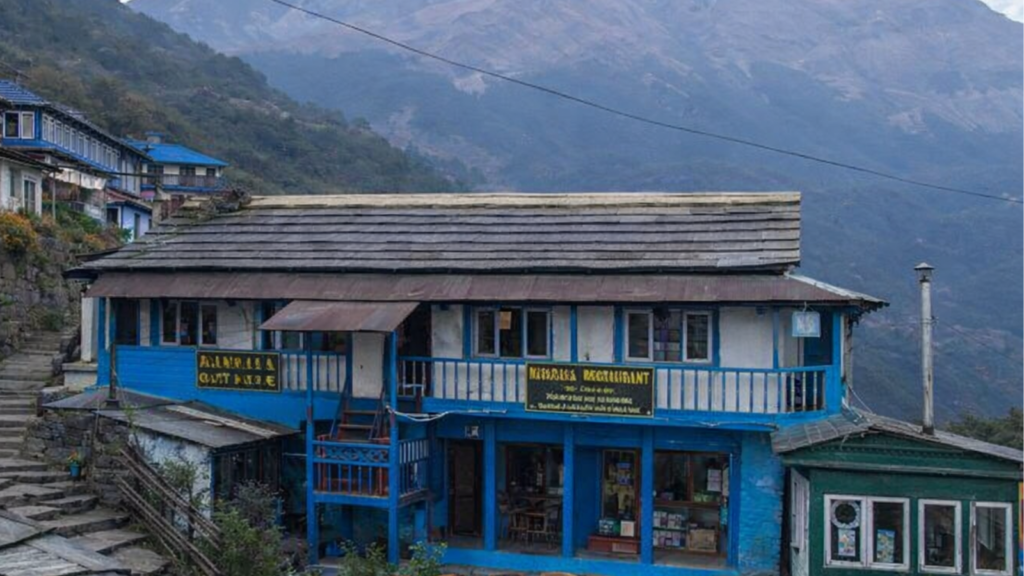
The entire 15-day ABC route is serviced by teahouses that provide accommodation, food, and electricity, no camping equipment is required at any point. Dal bhat, Nepal’s calorie-dense national meal of lentil soup, rice, curried vegetables, and pickle, served with unlimited refills, is the most nutritionally efficient and cost-effective food choice for sustained trekking. The route passes through the historic homelands of the Gurung and Magar peoples, whose slate-roofed stone villages, Buddhist-Hindu syncretism, and working grain mills offer authentic cultural experiences that extend well beyond scenery.
Teahouse Experience: What to Expect Along the Annapurna Trail
Teahouses (locally called “bhattis” or “lodges”) operate along the entire ABC route at every overnight stop. They provide accommodation, food, electricity, and social gathering space in a single building. Room quality varies significantly by altitude and establishment age.
At lower elevations, Tikhedhunga, Ghorepani, Tadapani, Chhomrong, teahouses range from basic family-run lodges with shared squat toilets to well-maintained guesthouses with attached bathrooms, WiFi, and wood-burning stoves in dining rooms. At higher elevations, Dovan, Himalaya Hotel, MBC, and ABC, rooms are smaller, less insulated, and more basic. Attached bathrooms are rare above 3,000 meters.
The teahouse economic model creates an important dynamic: teahouse owners subsidize accommodation costs (often priced at $3–$8) in exchange for guests eating meals in their dining room. Refusing to eat at your teahouse after taking a cheap room is considered deeply discourteous and economically harmful to families operating on thin mountain margins. The unwritten social contract of ABC trekking: book cheap rooms, eat generously.
Food on the ABC Trek: Nutrition and Local Cuisine
Dal bhat, the Nepali national meal of lentil soup, steamed rice, curried vegetables, achaar pickle, and sometimes a boiled egg, is the optimal trail food for 3 reasons: it is calorie-dense (approximately 600–800 calories per serving), it is cooked fresh at each teahouse using local ingredients, and it is served with unlimited refills that allow trekkers to match consumption to exertion.
Beyond dal bhat, teahouse menus at lower elevations offer pasta, fried rice, vegetable noodles, tibetan bread, pancakes, porridge, and an array of hot beverages including Nepali milk tea, ginger-honey-lemon, and Tibetan butter tea.
Above 3,500 meters, appetite suppression from altitude is a consistent physiological response. Force eating above MBC even without hunger, prioritizing carbohydrate-rich foods for energy availability, is one of the most important high-altitude nutrition strategies.
Garlic soup, widely available at teahouses above 3,000 meters, is traditionally credited by both guides and returning trekkers with reducing headache intensity at altitude. While the evidence is anecdotal rather than clinical, the soup’s warming properties and hydration contribution make it a reasonable supplement at MBC and ABC.
Gurung and Magar Culture: Authentic Village Life on the Route
The 15-day Annapurna Base Camp trek passes through the historical homeland of 2 of Nepal’s most distinctive ethnic communities: the Gurung people, who dominate the middle hills from Ghandruk to Chhomrong, and the Magar people, concentrated in the lower valleys around Ulleri and Tikhedhunga.
Gurung villages, particularly Ghandruk and Chhomrong, are architecturally distinctive, with slate-roofed stone houses, communal water taps carved from single blocks of granite, and temple courtyards where Buddhist prayer flags and Hindu shrines coexist in the syncretic tradition of Nepal’s hill communities. Ghandruk hosts the Gurung Museum, which documents traditional dress, military history (the Gurung are the primary source of Nepal’s internationally renowned Gurkha soldiers), and community farming practices.
Magar cultural expression differs: their villages emphasize agricultural terracing, traditional grain storage structures, and shamanic practices that predate Hinduism’s arrival in the region. The Magar communities near Tikhedhunga maintain stone-grinding mills powered by the Bhurungi Khola stream, still functional, still in daily use.
Travelers who engage respectfully, learning 5–10 Nepali phrases before departure, accepting offered tea without deflection, and photographing people only with explicit permission, consistently report more meaningful cultural exchanges than those who treat villages as scenic backdrops.
Ready to Plan Your 15-Day Annapurna Base Camp Trek?
The 15-day Annapurna Base Camp trek is one of the world’s genuinely exceptional trekking experiences, not because of marketing, but because the route delivers 3 things simultaneously that most treks offer one at a time: dramatic mountain scenery, cultural authenticity, and physical challenge calibrated for non-technical trekkers.
The 15-day duration gives the experience room to breathe. You stand at Poon Hill and understand scale. You walk through the sanctuary gorge and understand isolation. You arrive at base camp at 4,130 meters and understand why people return to Nepal again and again.
The best time to start planning your trek is now. Autumn permits are already being booked by agencies handling international bookings; spring departures in March and April fill rapidly from January onward. Organizing permits, insurance, guide arrangements, and gear at least 8–12 weeks before your departure date puts you in the best position for a smooth, safe, and unforgettable 15-day Annapurna Base Camp experience.
Is the 15-Day Annapurna Base Camp Trek Suitable for Beginners?
The 15-day Annapurna Base Camp trek is suitable for beginners with moderate fitness who can walk 5–7 hours per day on uneven mountain trails. The route requires no technical climbing, ropes, or glacier travel. Most beginners succeed after completing 8–12 weeks of cardiovascular and leg-strength training before departure.
How Difficult Is the Climb to Annapurna Base Camp at 4,130 Meters?
The climb to Annapurna Base Camp at 4,130 meters is a moderate-to-strenuous non-technical trek that requires no mountaineering skills. The steepest section occurs between Tikhedhunga and Ghorepani, where trekkers climb about 1,210 vertical meters including the 3,000-step Ulleri stone staircase. The final ascent from Machapuchare Base Camp gains 430 meters.
Do I Need a Guide for the 15-Day Annapurna Base Camp Trek in 2026?
Foreign trekkers must hire a licensed guide for the Annapurna Base Camp trek under Nepal’s April 2023 trekking regulation. Independent solo trekking without a guide is no longer permitted in the Annapurna region. Licensed guides hold Nepal Tourism Board certification and provide route navigation, altitude monitoring, and emergency response support.
What Is the Maximum Altitude Reached on the 15-Day ABC Trek?
The maximum altitude on the 15-day Annapurna Base Camp trek is 4,130 meters at Annapurna Base Camp inside the Annapurna Sanctuary. Trekkers usually stay overnight at Machapuchare Base Camp at 3,700 meters before the final ascent. Altitudes above 3,000 meters increase the risk of Acute Mountain Sickness and require gradual acclimatization.
How Many Kilometers Is the Full 15-Day Annapurna Base Camp Route?
The full 15-day Annapurna Base Camp route covers approximately 110–120 kilometers from Nayapul trailhead to Siwai endpoint. The trek includes about 4,500 meters of cumulative elevation gain and a similar descent. Daily walking distances range from 7 kilometers on shorter days to 15–18 kilometers on longer trekking days.
What Is Included in a Standard 15-Day ABC Trek Package?
A standard 15-day Annapurna Base Camp trek package includes a licensed guide, one porter per two trekkers, ACAP permit, teahouse accommodation, breakfast and dinner, and jeep transport to the trailhead. Trekkers typically pay separately for lunches, hot showers, battery charging, bottled water, and staff tips ranging from $150–$340.
Can I Do the Annapurna Base Camp Trek Without Prior Himalayan Experience?
The Annapurna Base Camp trek requires no prior Himalayan experience and serves as a common first high-altitude trek in Nepal. Many first-time trekkers complete the route each year with basic trekking fitness and proper gear. Booking with a licensed trekking agency improves safety, logistics, and altitude management.
What Happens If I Experience Altitude Sickness on the ABC Trek?
Descend immediately if altitude sickness symptoms appear above 3,000 meters during the Annapurna Base Camp trek. Common symptoms include persistent headache, nausea, and severe fatigue. Guides monitor oxygen saturation using pulse oximeters, and readings below 75–80% SpO₂ at rest require descent. Helicopter evacuation from base camp to Pokhara takes about 15–20 minutes.
How Far in Advance Should I Book the 15-Day Annapurna Base Camp Trek?
Book the 15-day Annapurna Base Camp trek 8–12 weeks before departure for autumn trekking and 10–14 weeks before spring departures in March or April. October and early November dates fill fastest with licensed agencies. Early booking also allows time for fitness training, gear preparation, insurance purchase, and Nepal visa processing.
Is the Annapurna Base Camp Trek Safe for Solo Female Trekkers?
The Annapurna Base Camp trek is considered one of Nepal’s safest trekking routes for solo female trekkers due to dense teahouse networks and active local communities along the trail. Nepal’s 2023 regulation requiring licensed guides adds structured safety. Female trekkers increase safety by booking registered agencies and maintaining daily itinerary communication.