
Tea houses on the Annapurna Base Camp trek are family-run mountain lodges that provide shelter, hot meals, and rest stops from Nayapul (1,070 m) to the high-altitude Annapurna Base Camp (ABC) at 4,130 m. Operated mainly by Gurung and Magar communities, these lodges are the backbone of trekking in the Annapurna region. Unlike hotels, tea houses earn primarily from meals, not rooms, and offer basic twin-share bedrooms, shared bathrooms, and charging points. Above 3,500 m, facilities simplify due to altitude logistics, but each stop remains vital for safe acclimatization, nutrition, and rest.
More than just accommodation, Annapurna tea houses connect trekkers to local culture and sustainable tourism. Managed under the Annapurna Conservation Area Project (ACAP), lodges fund trail maintenance, waste management, and community development. From the rhododendron forests of Chhomrong to the alpine expanse of Machhapuchhre Base Camp, tea houses support every stage of the trek with altitude-adjusted meals like garlic soup and dal bhat, safe rest spaces, and practical advice. Staying in a tea house means supporting Gurung and Magar livelihoods while experiencing the Annapurna trek in its most authentic and secure form.
What Are Tea Houses on the Annapurna Base Camp Trek?
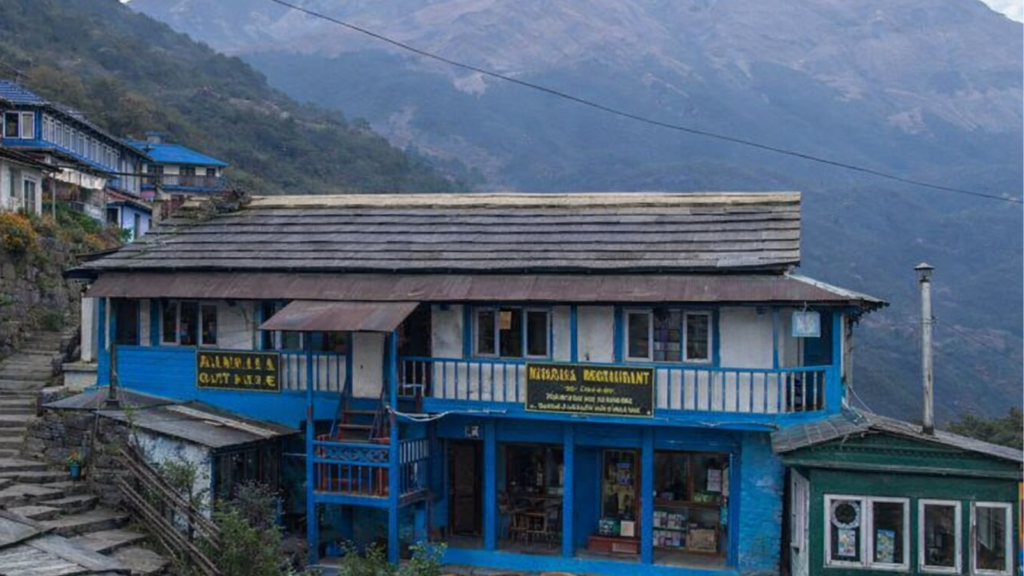
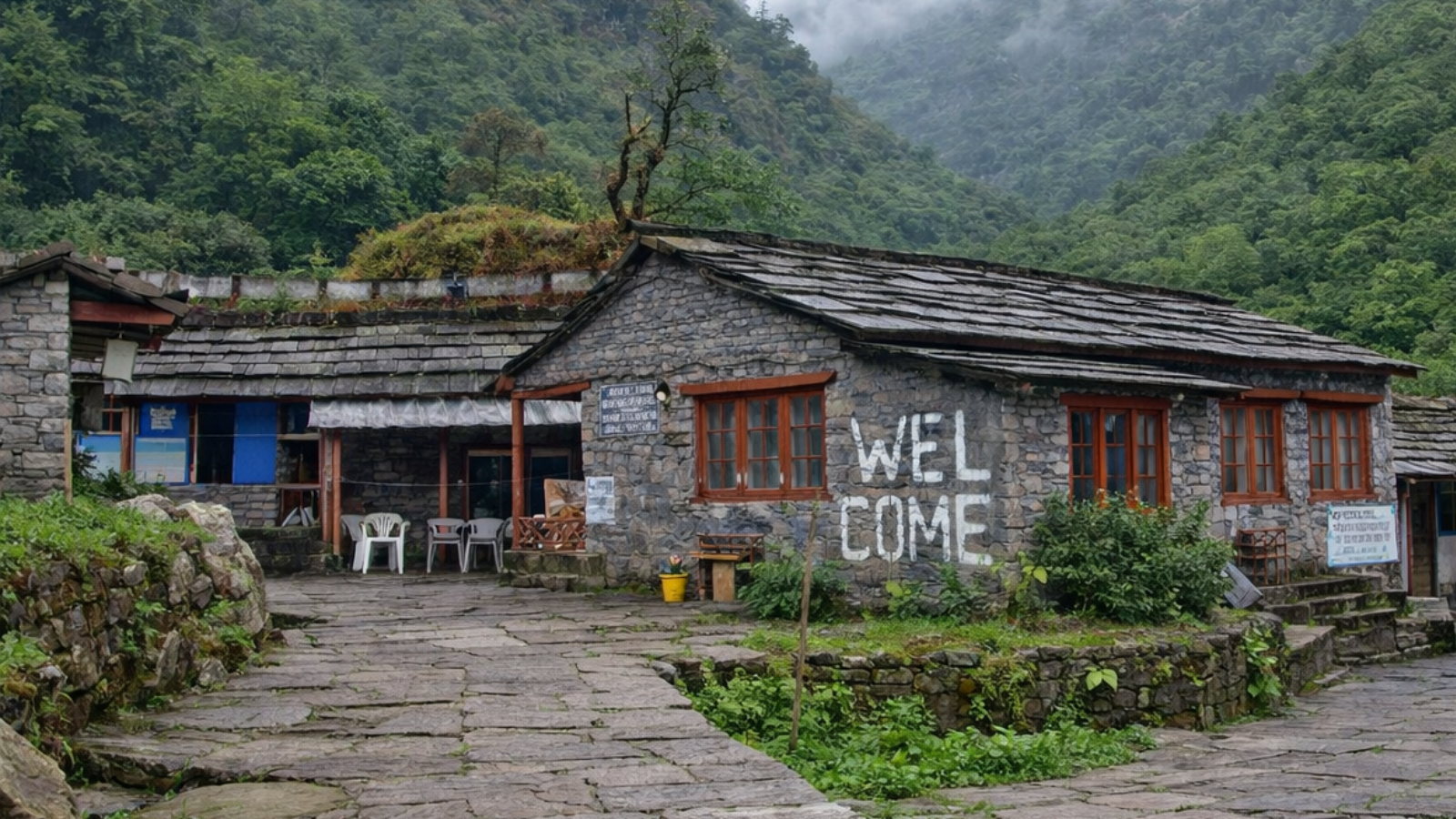
Tea houses on the Annapurna Base Camp trek are simple, family-operated mountain lodges built along trekking routes. They provide twin-share bedrooms, shared bathrooms, and a dining room serving hot meals. Most are owned and run by Gurung or Magar families who have lived in the Annapurna region for generations.
The term “tea house” traces to the original Himalayan trading routes. Tibetan and Gurung merchants crossing high mountain passes stopped at small stone shelters to warm themselves with butter tea and rest their yaks overnight. As mountaineering and trekking tourism grew in Nepal from the 1950s onward, these shelters evolved into proper lodges with dedicated sleeping rooms and kitchens.
How Tea Houses Differ from Hotels and Guesthouses
A tea house differs from a hotel in 4 specific ways:
- Ownership: A tea house is family-run, not corporate-owned. The cook, the host, and the cleaner are often the same person.
- Revenue model: Tea house profit comes from meals, not rooms. Rooms are priced at NPR 400–2,000 (USD 3–17). Trekkers are expected to eat every meal in the lodge where they sleep.
- Facilities: Tea houses offer basic twin beds with foam mattresses and blankets. Private bathrooms are rare above 2,500 meters. Shared squat or sit-down toilets are standard.
- Location: Tea houses sit directly on the trekking trail, not in towns with road access. Supplies arrive by porter or donkey caravan, and above 3,500 meters, by helicopter.
Understanding this model matters. When a tea house owner asks you to eat dinner there, they are not being pushy. They are running a business with no other income stream.
The Cultural Significance of Tea Houses for Gurung and Magar Communities
The Gurung and Magar peoples are the 2 primary ethnic communities managing tea houses along the Annapurna Base Camp route. Their villages, Chhomrong, Sinuwa, Ghorepani, Ghandruk, have structured their entire economies around trekking tourism since the 1980s.
The Annapurna Conservation Area (ACA), established in 1986 and covering 7,629 km², is the first and largest protected area in Nepal. The National Trust for Nature Conservation (NTNC) manages it through an integrated conservation and development programme that directly funds community-level infrastructure, including tea house upgrades and waste management systems.
ACAP permit fees, NPR 3,000 (USD 23) per foreign trekker, flow back into the conservation area and support the local communities who run these lodges. When you stay in a tea house, you directly fund the Gurung family that built it, the ACAP conservation programme, and the trail infrastructure you walk on.
How Tea Houses Evolved from Trading Shelters to Trekking Infrastructure
Nepal’s tourism history begins formally with Maurice Herzog’s first ascent of Annapurna I on June 3, 1950. The trail to Annapurna Base Camp opened to trekking permits in the 1970s. By FY 2018/19, 183,357 foreign trekkers entered the Annapurna region annually, the pre-COVID record.
COVID-19 collapsed arrivals to near zero in 2020 and 2021. The recovery was dramatic. By 2022, numbers returned. By 2023, the Annapurna region recorded 191,558 foreign trekkers, exceeding the pre-pandemic peak. By 2024, that number reached 244,045, a 33% increase over the 2018/19 record.
Tea houses expanded in step with this growth. Lodges that offered 4 rooms in 2010 now offer 12. Stone buildings replaced wooden ones. Solar panels appeared on rooftops. Flush toilets replaced pit latrines at lower elevations. The tea house of 2026 is a fundamentally different structure than the tea house of 1990, though above 3,500 meters, the basics remain unchanged.
Tea House Route: Every Settlement from Nayapul to Annapurna Base Camp
The Annapurna Base Camp trek passes through 8 primary tea house settlements across 70–110 km round trip. Each settlement sits at a distinct altitude, from 1,070 meters at Nayapul to 4,130 meters at Annapurna Base Camp itself. Room availability, facility quality, and food variety decrease progressively with altitude.
The standard route ascends through Nayapul → Tikhedhunga → Ghorepani → Tadapani → Chhomrong → Sinuwa → Bamboo → Dovan → Deurali → Machhapuchhre Base Camp → Annapurna Base Camp. Descents retrace the same path. Total trekking days: 7–12 days depending on fitness and acclimatization schedule.
Lower-Altitude Tea Houses: Tikhedhunga, Ghorepani, and Chhomrong (1,070–2,170 m)
Tikhedhunga (1,495 m), Ghorepani (2,860 m), and Chhomrong (2,170 m) represent the most developed tea house settlements on the route. These 3 villages have road access or mule track connections to Pokhara, which means fresh vegetables, eggs, and bottled goods arrive regularly.
At this altitude band, trekkers find:
- Private bathrooms available in premium rooms at NPR 1,000–1,500 extra per night
- WiFi: slow but functional, typically NPR 200–300 per day
- Hot showers: included in most lodges below 2,500 meters
- Charging stations: standard wall outlets in rooms or dining areas
- Menu variety: pasta, pizza, momos, pancakes, eggs, and Nepali dal bhat available
Ghorepani is a detour point on the standard ABC route, visited for the Poon Hill sunrise at 3,210 meters. Trekkers who include Poon Hill add 1 overnight there. The village has over 30 tea houses, the highest concentration on the entire route.
Chhomrong sits at the gateway to the Annapurna Sanctuary and is the last substantial settlement with reliable supply chains. Stock up on any supplies here. The lodges at Chhomrong offer the best facility-to-price ratio on the entire trek.
Mid-Altitude Tea Houses: Sinuwa, Bamboo, and Dovan (2,310–2,600 m)
Sinuwa (2,310 m), Bamboo (2,310 m), and Dovan (2,600 m) form the middle corridor of the route, inside the steep Modi Khola gorge that funnels trekkers toward the Annapurna Sanctuary.
The Modi Khola gorge is a defined entity: a deep glacial river valley carved by the Modi Khola river, surrounded by rhododendron and bamboo forest. The trail descends from Chhomrong into this gorge and climbs steeply out the other side toward higher tea house settlements.
At this altitude band:
- Tea house count drops to 3–6 lodges per settlement
- Hot showers are available but cold water is more common in budget rooms
- Menu choice narrows to dal bhat, noodle soup, rice with vegetables, eggs, and basic pasta
- WiFi is unreliable; purchase a local SIM (NCell or Nepal Telecom) before entering the gorge
- Electricity is solar-powered; charging phones costs NPR 100–200 per device
Dovan at 2,600 meters sits at the boundary between bamboo forest and the transition zone. The lodges here are smaller, typically 4–8 rooms, and fill quickly during peak season (October–November and March–May).
Book ahead or arrive before 3:00 PM during peak season. Tea houses in the gorge do not turn trekkers away in emergencies, but the alternative sleeping arrangement is a mattress in the dining room.
High-Altitude Tea Houses: Deurali and Machhapuchhre Base Camp (3,230–3,700 m)
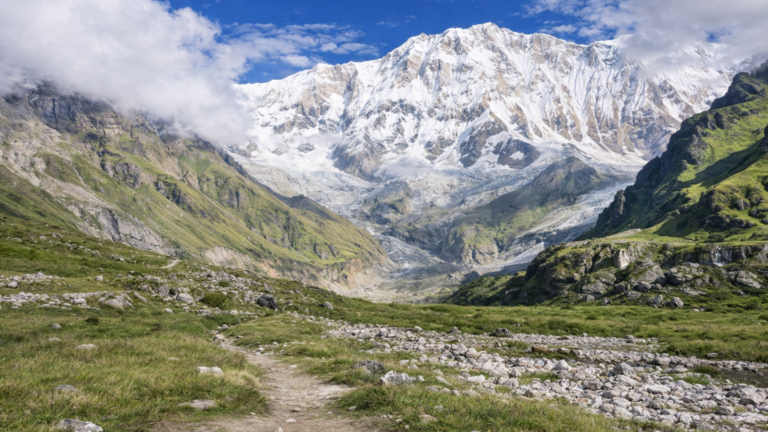
Deurali (3,230 m) and Machhapuchhre Base Camp (3,700 m) mark the entry into the Annapurna Sanctuary and the transition from forest to open alpine terrain.
Deurali at 3,230 meters (10,598 feet) is the last point where rhododendron forest provides wind shelter. Tea houses here are stone-built with tin roofs. The trail beyond Deurali crosses open glacial moraines exposed to Annapurna’s weather systems.
At Deurali:
- Rooms: twin beds with 2 heavy blankets; no heating
- Bathrooms: shared outdoor toilets; no hot running water
- Hot showers: available at NPR 500–700 (USD 4–5) per shower
- Food: dal bhat, noodle soup, tsampa porridge, garlic soup (critical at altitude), hot drinks
- Altitude risk: trekkers first feel the effects of altitude at Deurali; rest if any symptoms appear
MBC at 3,700 meters (12,140 feet) is the penultimate overnight stop before Annapurna Base Camp. It offers some of the most dramatic mountain views on the entire route, Machhapuchhare (Fishtail Mountain, 6,997 m) towers directly above the tea houses.
At MBC:
- Room count: 3–4 tea houses with 6–12 rooms each
- No private bathrooms: shared pit toilets only
- No hot showers: bucket warm water available for NPR 400–600
- Menu: narrowed to garlic soup, dal bhat, noodles, porridge, boiled eggs, and hot drinks
- Temperature: drops to -5°C to -15°C at night; sleeping bags rated to -10°C are essential
Annapurna Base Camp Tea House at 4,130 m: What to Expect
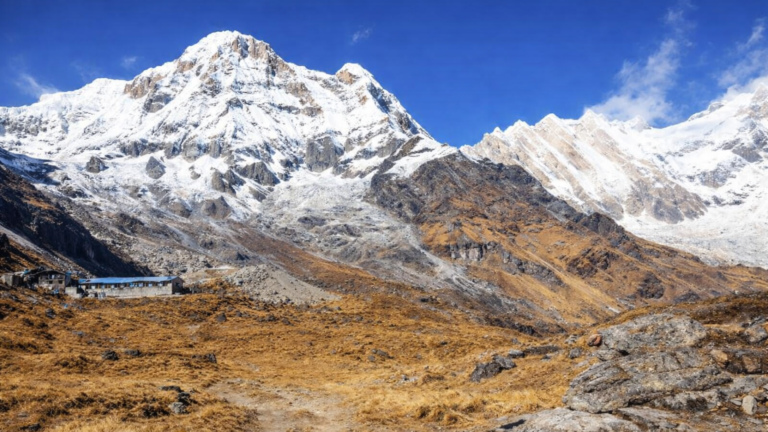
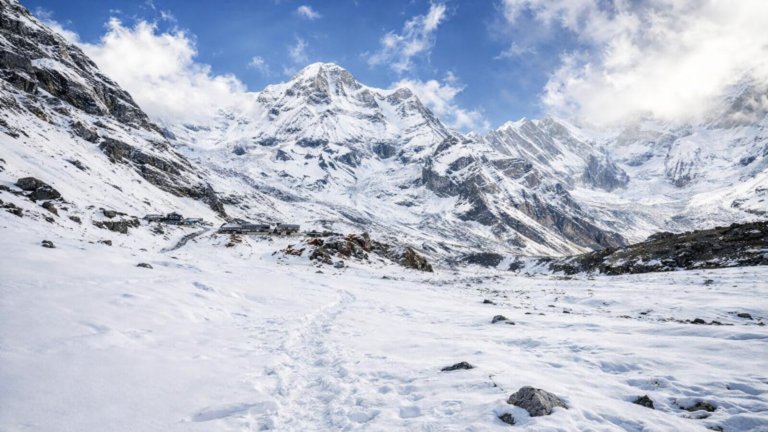
Annapurna Base Camp (ABC) at 4,130 meters (13,550 feet) has 2 tea house clusters, the Annapurna Basecamp Hotel and 2–3 adjacent lodges, surrounded by Annapurna I (8,091 m), Annapurna III (7,555 m), Hiunchuli (6,441 m), and Machhapuchhare (6,997 m) on all sides.
This is the highest tea house on the Annapurna trek. Trekkers arrive after a 4–5 hour walk from MBC through open moraine and snow-dusted terrain. The experience of stepping into the ABC tea house dining room, with panoramic glacier views through every window, is unlike any other lodge on any other Himalayan trek.
At ABC:
- Rooms: small twin rooms with 2–3 heavy blankets; no mattress padding beyond 5 cm foam
- No showers: none available at this altitude; wet wipes are your hygiene kit
- No WiFi: satellite phones exist for emergencies only
- Charging: solar charging available but slow; NPR 300–500 per device
- Food: garlic soup, instant noodles, dal bhat, hot chocolate, ginger lemon honey tea, porridge
- Temperature: drops to -10°C to -20°C in October and November nights; cold weather gear is non-negotiable
All supplies at ABC arrive by helicopter or by porter from Chhomrong, a 2-day walk below. This supply chain explains why a plate of dal bhat that costs USD 2 at the trailhead costs USD 10 at 4,130 meters.
What Do Tea Houses Offer? Facilities, Food, and Amenities at Every Altitude
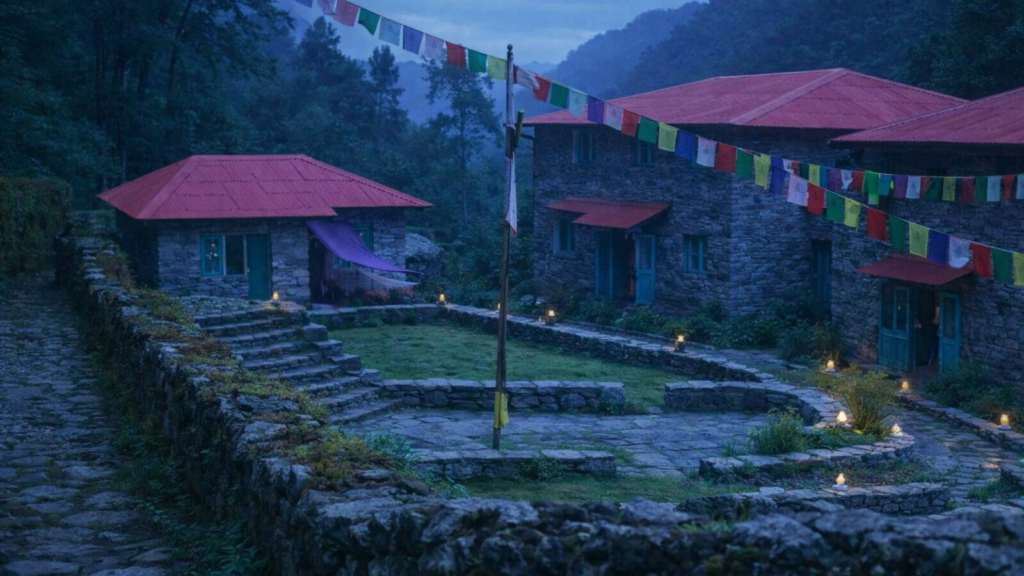
Tea houses on the Annapurna Base Camp route offer 4 core services: a room, 3 meals per day, hot drinks, and basic hygiene facilities. Facility quality and food variety decrease with altitude. Below 2,500 m, WiFi, hot showers, and flush toilets are standard. Above 3,500 m, none of these are guaranteed.
Room Types, Bedding, and Bathroom Facilities Along the ABC Trail
Tea house rooms follow 1 of 2 configurations along the Annapurna Base Camp trail:
Standard Twin Room: 2 single beds with foam mattresses, 2 blankets, a small table, and a hook on the wall. No wardrobe. No locking drawer. This configuration accounts for approximately 80% of all tea house rooms on the route.
Double Room with Attached Bathroom: Available only below 2,500 meters in more developed settlements like Chhomrong and Ghorepani. Costs NPR 500–1,000 more than a standard twin. Offers a private flush toilet and cold-water shower.
Sleeping bags are essential from Deurali upward. Tea house blankets are heavy but not designed for -15°C nights. Carry a sleeping bag rated to at least -10°C for high-altitude stops.
Tea House Menus: Dal Bhat, Western Options, and Altitude-Adjusted Meals
The standard tea house menu includes 22–35 items at lower elevations and narrows to 8–12 items above 3,500 meters. The 5 dishes available at every tea house on every section of the route are: dal bhat, vegetable noodle soup, boiled potatoes, fried rice, and garlic soup.
Dal bhat deserves a specific note. Dal bhat is the national dish of Nepal: steamed rice served with lentil soup (dal), seasonal vegetable curry (tarkari), and pickle (achar). Most tea houses offer unlimited refills on dal bhat, a critical value for trekkers burning 3,000–4,000 calories per day. The cost ranges from NPR 250 (USD 2) at lower altitudes to NPR 1,200 (USD 10) near Annapurna Base Camp.
Garlic soup is medically relevant on this route, not just culinary. Garlic dilates blood vessels and supports circulation at altitude. Tea house menus list it specifically because experienced Himalayan guides recommend it from Deurali upward as an acclimatization aid.
WiFi, Electricity, Hot Showers, and Charging at Every Elevation
The table below defines what each altitude band provides:
| Altitude Band | WiFi | Hot Shower | Charging | Flush Toilet |
| Below 2,000 m | Standard | Free | Wall outlet | Standard |
| 2,000–2,500 m | Often available | Included or NPR 200 | Wall outlet | Shared |
| 2,500–3,000 m | Unreliable | NPR 300–500 | Solar NPR 100–200 | Shared |
| 3,000–3,500 m | Rare | Bucket NPR 400–700 | Solar NPR 200–300 | Pit toilet |
| 3,500–4,130 m | None | None | Slow solar NPR 300–500 | Outdoor pit |
Power cuts are frequent at all elevations in the evening. Carry a power bank with at least 20,000 mAh. Charge all devices during daylight dining hours.
How Food Quality and Variety Change as You Ascend Higher
Food quality on the Annapurna Base Camp trail follows a clear pattern: every 500 meters of altitude gained reduces menu variety by approximately 30% and increases individual dish prices by 20–40%.
Below 2,000 meters: fresh salads, eggs in multiple preparations, pasta, pizza, apple pie, pancakes, and freshly baked bread are available. Ingredients arrive daily from Pokhara via road.
At 2,500–3,000 meters: fresh vegetables remain available but variety narrows. Trekkers eat more rice and noodle-based dishes. Salads disappear. Fresh fruit disappears. Eggs remain consistent throughout the route at all elevations.
Above 3,500 meters: menus reflect the helicopter supply chain. Packaged noodles, dry lentils, canned goods, and shelf-stable staples dominate. Tea houses at MBC and ABC prioritize calorie-dense hot food over variety. Eat what is on the menu, the kitchen is working with what arrived last week by porter or by air.
Tea House Costs and Budget Breakdown for the Annapurna Base Camp Trek
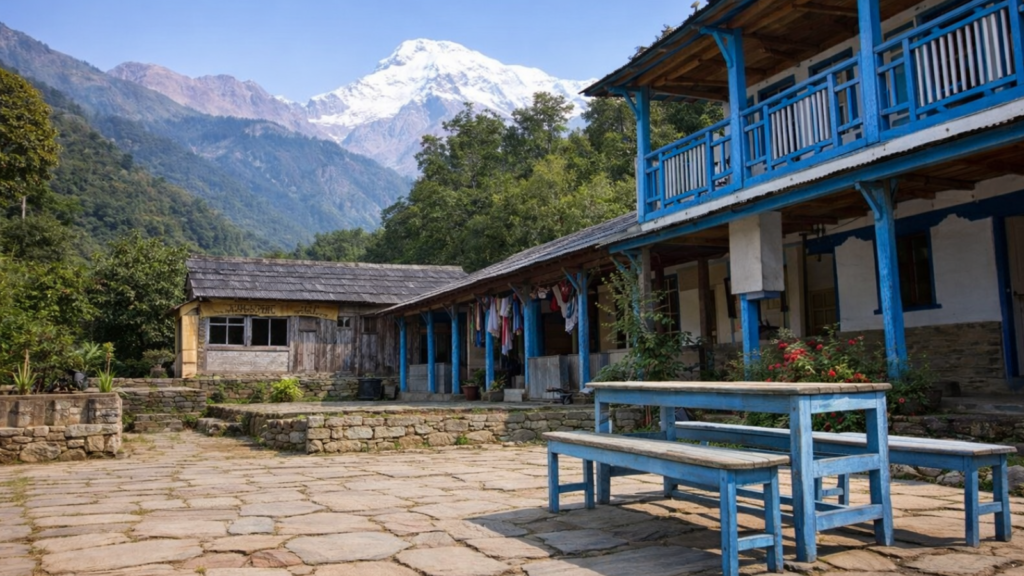
The complete tea house cost for an Annapurna Base Camp trek is USD 350–600 for accommodation and meals over 7–12 days, averaging USD 30–50 per day. Rooms cost NPR 400–2,000 (USD 3–17) per night. Meals cost NPR 250–1,200 (USD 2–10) per dish, with prices increasing sharply above 3,500 meters.
How Much Does a Tea House Room Cost Per Night in 2026?
Tea house room prices follow altitude, not star rating:
- NPR 400: standard twin room at any elevation; the base price that applies at the majority of tea houses from Tikhedhunga to Deurali
- NPR 600–1,000: twin room with shared bathroom at mid-altitude settlements; Chhomrong, Sinuwa, Bamboo
- NPR 1,000–1,500: attached bathroom room at lower-altitude premium lodges; Ghorepani, Chhomrong
- NPR 1,500–2,000: high-altitude tea houses at Deurali, MBC, and ABC, where supply logistics drive up operational costs
The NPR 400 base rate appears consistently across the Annapurna Circuit and ABC trails. Tea house owners set this rate collectively through informal agreement among lodge owners in each settlement. The real revenue comes from meals, which is why the house rule at every tea house is: eat where you sleep.
Average Daily Budget on the Annapurna Base Camp Route
A realistic daily budget for tea house trekking on the ABC route:
| Expense Category | Budget Trekker | Mid-Range Trekker |
| Room (twin share) | NPR 400 | NPR 800–1,200 |
| Breakfast | NPR 250–400 | NPR 400–600 |
| Lunch | NPR 300–500 | NPR 500–800 |
| Dinner | NPR 400–700 | NPR 700–1,200 |
| Hot drinks & snacks | NPR 200–400 | NPR 300–600 |
| Charging / WiFi | NPR 200–300 | NPR 300–500 |
| Daily Total | NPR 1,750–2,700 | NPR 3,000–4,900 |
Add guide and porter fees, ACAP permit, TIMS card, and travel insurance for the complete trip budget. Most trekkers from our agency spend USD 600–1,200 total for a 10-day ABC trek including all services.
Peak vs. Off-Season Pricing at Annapurna Tea Houses
Tea house prices do not officially change between peak and off-season on the Annapurna route. The NPR 400 room rate applies year-round. However, 3 real differences exist between seasons:
- Peak season (October–November, March–May): Tea houses are full. Dining rooms are crowded. Popular settlements like Ghorepani and Chhomrong run at 100% capacity. Trekkers who arrive late get the worst rooms. Menu items run out by evening.
- Off-season (June–September, December–February): Monsoon (June–September) brings leeches, muddy trails, and cloud-blocked mountain views. Winter (December–February) brings snow above 3,000 meters and near-freezing temperatures in tea house dining rooms. Tea houses stay open year-round but run at 30–50% capacity. Trekkers get first choice of rooms and personal attention from hosts.
The practical advice: trek in late October or early April for optimal mountain views, stable weather, and manageable tea house crowding.
The Tea House Business Model: Why Rooms Are Cheap but Meals Cost More
The tea house business model operates on 1 core principle: rooms subsidize the trekker relationship; meals generate the profit.
A tea house owner rents a room for NPR 400 (USD 3) per night. The operational cost of that room, blankets, cleaning, structural maintenance, exceeds NPR 400 when calculated over the low-occupancy monsoon months. Room rentals alone do not sustain the business.
The meal margin compensates. A bowl of noodle soup costs NPR 60–80 in raw ingredients and sells for NPR 350–500. Dal bhat costs NPR 80–120 to produce and sells for NPR 350–800. The markup on meals at altitude ranges from 300% to 900% depending on elevation and supply chain complexity.
This is not exploitation. This is logistics. Porters carrying a 30 kg load from Chhomrong to ABC earn NPR 3,000–5,000 per trip, and the cost of those porters is built into every dal bhat at 4,130 meters.
Permits, Regulations, and Sustainable Trekking at Annapurna Tea Houses
The Annapurna Base Camp trek requires two permits in 2026: the Annapurna Conservation Area Permit (ACAP) and the Trekkers’ Information Management System (TIMS) card. The ACAP permit costs NPR 3,000 (~USD 23) for foreign nationals, while the TIMS card costs NPR 2,000 (~USD 15) for trekkers trekking with a licensed guide through a registered trekking agency. Both permits are mandatory for most trekkers entering the Annapurna Conservation Area and help fund conservation, trekking safety monitoring, and local community infrastructure.
ACAP Permit: Cost, Where to Buy, and What It Covers
The Annapurna Conservation Area Permit is issued by the Nepal Tourism Board (NTB). Purchase it at:
- NTB office in Kathmandu (Bhrikutimandap, Pradarshani Marg)
- NTB office in Pokhara (Damside, near the airport)
- ACAP checkpoint at Nayapul: cost doubles to NPR 6,000 if purchased on-trail
ACAP fees by nationality:
- Foreign nationals: NPR 3,000 (~USD 23)
- SAARC nationals (India, Bangladesh, Bhutan, Sri Lanka, Pakistan, Maldives): NPR 1,000 (~USD 8)
- Nepali citizens: NPR 100 (~USD 0.80)
ACAP permit revenue funds trail maintenance, waste management programmes, conservation education, and community development in the 7,629 km² Annapurna Conservation Area. Over 1,000 lodges and tea houses operate within ACAP boundaries, the permit funds the infrastructure that makes all of them viable.
TIMS Card: Cost, Purpose, and Registration
The Trekkers’ Information Management System (TIMS) card is a trekking safety registration system jointly managed by the Nepal Tourism Board (NTB) and the Trekking Agencies’ Association of Nepal (TAAN). It records trekker movement in major trekking regions so authorities can locate trekkers during emergencies, natural disasters, or search-and-rescue operations.
TIMS card prices in 2026:
| Trekker Type | TIMS Cost |
| Foreign trekkers (with guide through agency) | NPR 2,000 (~USD 15) |
| SAARC trekkers | NPR 1,000 (~USD 8) |
| Nepali trekkers | NPR 300 |
Trekkers usually obtain the TIMS card through their trekking agency when booking the trek, or directly from TAAN or Nepal Tourism Board offices in Kathmandu or Pokhara.
The TIMS system serves three main purposes:
- Trekker safety monitoring in remote mountain regions
- Search and rescue coordination in case of emergencies
- Tourism data collection for sustainable trekking management
Together, the ACAP permit and TIMS card ensure trekkers are registered, protected, and contributing to conservation and local communities in the Annapurna region.
Solo Trekking Ban (2023): Why Every Trekker Needs a Licensed Guide
The Nepal Tourism Board implemented a mandatory licensed guide requirement effective April 1, 2023. All foreign trekkers in all national parks and conservation areas in Nepal, including the Annapurna Conservation Area, must hire a licensed guide through a government-registered trekking agency.
The 4 reasons the government implemented this ban:
- Safety: 9 foreign trekkers died or went missing in the Annapurna region in 2022, many trekking solo in bad weather
- Economic distribution: Solo trekkers using digital maps bypassed local guide and porter employment, concentrating spending at tea houses only
- Environmental monitoring: Licensed guides receive training on Leave No Trace protocols and are responsible for their group’s waste
- Emergency response: Guides carry communication devices and know evacuation routes; solo trekkers without guides delayed search-and-rescue operations
A licensed guide for the Annapurna Base Camp trek costs USD 25–35 per day from a registered agency. This is non-negotiable as of 2023. ACAP checkpoints verify guide credentials alongside permit cards.
Environmental Impact of Tea Houses on the Annapurna Conservation Area
Tea houses generate concentrated environmental impact at high altitude, an environment with limited self-repair capacity. A trekking group of 15 people generates approximately 15 kg of non-biodegradable waste over 10 days in the Annapurna region. That is 1 kg per person per trip, multiplied by 244,045 trekkers per year.
ACAP manages this through 3 mechanisms:
- Regulated waste collection points at major tea house settlements
- Porter and mule train waste removal from settlements above road access
- Incentivized lodge certification: ACAP grades tea houses on waste management compliance and rewards compliant lodges with preferred listings
Trekkers contribute to waste reduction through 3 specific actions: carrying out all non-organic waste, refusing single-use plastic water bottles (refill stations exist at major settlements for NPR 50–80 per liter), and using biodegradable soap and shampoo.
Waste Management and Green Practices at High-Altitude Tea Houses
Above 3,000 meters, no road or vehicle access exists. Waste removal from MBC and ABC relies on porter carries, the same supply chain that brings food up carries waste down. Tea houses at these elevations charge NPR 50–100 extra for hot water to discourage excessive use, and compost all organic kitchen waste.
ACAP’s regulated zones require tea houses to maintain rubbish pits for burnable waste and segregated bins for non-biodegradable materials. Inspections occur quarterly. Tea houses that fail inspection face permit suspension, a strong economic incentive for compliance.
The solar panel adoption rate at Annapurna tea houses above 2,500 meters exceeds 70%, reducing dependence on wood and kerosene for heating and cooking. This is a measurable conservation win driven by ACAP subsidy programmes for lodge owners.
Best Time to Stay at Annapurna Base Camp Tea Houses and Practical Tips
The best time to stay at Annapurna Base Camp tea houses is October to November for autumn clarity and March to April for spring rhododendron bloom. These 4 months offer stable weather, clear mountain views, and fully operational tea house services at all elevations. Tea houses operate year-round but service quality varies significantly by season.
Spring vs. Autumn: When Tea Houses Are at Their Best
Autumn (October–November): The post-monsoon atmosphere delivers the clearest mountain views of the year. Skies are deep blue. The Annapurna massif reflects perfectly in morning light. Tea house occupancy peaks in mid-October, the most popular 4 weeks on the Himalayan trekking calendar globally.
October temperatures at Annapurna Base Camp (4,130 m): daytime highs of 2°C to 8°C, nighttime lows of -10°C to -15°C. Tea house dining rooms are heated by wood stoves. Bring a -10°C sleeping bag and a down jacket.
Spring (March–May): Rhododendron forests below 3,500 meters bloom in red, pink, and white from late February through April, the most photographed landscape on the Annapurna route. Mountain views are clear in the morning and frequently cloud-covered by afternoon. Pre-monsoon weather brings occasional snow above 3,500 meters in March.
March–April temperatures at ABC: daytime highs of 5°C to 12°C, nighttime lows of -8°C to -12°C. Warmer than autumn but with more variable weather. Tea houses are slightly less crowded than October, a practical advantage for room availability.
How to Secure a Room at Busy Tea Houses in Peak Season
Tea houses on the Annapurna route operate on a first-arrival basis. There is no online booking system for the majority of lodges. Room securing follows 3 reliable methods:
- Method 1: Arrive before 2:00 PM. Trekkers who reach their overnight settlement by early afternoon have first choice of rooms. This means starting the day’s walk by 6:30–7:00 AM.
- Method 2: Ask your guide to call ahead. Licensed guides carry local SIM cards with connections to tea house owners throughout the route. A 2-minute phone call at lunch can reserve 2–4 rooms at the next settlement. This is standard practice, and one of the practical benefits of hiring a licensed guide.
- Method 3: Use our agency’s pre-booked tea house programme. For October and April treks, we pre-book rooms at key settlements, Chhomrong, Deurali, MBC, and ABC, 2–4 weeks in advance through our local network. Trekkers on our guided packages never arrive to a full lodge.
What to Pack Knowing Tea House Facilities Are Minimal
Tea house facilities above 3,000 meters offer rooms with foam beds and blankets, nothing else. The 10 essential items to carry knowing tea house amenities are minimal:
- Sleeping bag: rated to -10°C minimum; essential from Deurali upward
- Down jacket: for evening dining rooms and dawn summit views at ABC
- Headlamp with spare batteries: power cuts are frequent after 9:00 PM
- Power bank (20,000 mAh minimum): solar charging is slow above 3,500 m
- Wet wipes: no showers above 3,500 m; a 5-day supply for post-ABC camps
- Water purification tablets or filter: refill at tea house boiled water stations for NPR 50–80 per liter
- Electrolyte sachets: hydration management at altitude; tea houses do not stock these
- Biodegradable soap and shampoo: ACAP-aligned practice; regular products are restricted near water sources
- Trekking poles: steep descents from Deurali to Chhomrong are knee-intensive; poles reduce joint strain
- Spare Nepali cash (NPR): ATMs do not exist above Pokhara on this route; carry all cash needed from the start
Acclimatization Strategy: Using Tea House Rest Days Effectively
The Annapurna Base Camp trek does not require technical acclimatization days the way Everest Base Camp or Kanchenjunga treks do, but altitude sickness is still a real risk above 3,000 meters. Acute Mountain Sickness (AMS) symptoms include headache, nausea, dizziness, fatigue, and loss of appetite. These 5 symptoms indicate insufficient acclimatization.
The standard acclimatization protocol for ABC adds 1 rest day at Chhomrong (2,170 m) or Deurali (3,230 m), slowing the ascent rate to 400–500 meters of altitude gain per day above 3,000 meters. Tea houses support this with:
- Garlic soup: served at all tea houses above Chhomrong; supports circulation at altitude
- Abundant hot drinks: hydration is the single most important acclimatization tool; drink 3–4 liters per day
- Rest areas: tea house dining rooms serve as warm recovery spaces; trekkers experiencing mild AMS sit at lower altitude in the dining room while their group ascends
The rule: climb high, sleep low. Tea houses at MBC (3,700 m) allow day-hikes to ABC (4,130 m) and a return descent for trekkers with strong AMS symptoms. This option saves the trek. It is available because the tea house network provides an intermediate sleeping option at every 400–700 meter interval.
Why Annapurna Tea Houses Are the Foundation of This Trek
Tea houses on the Annapurna Base Camp route are not just accommodation. They are the infrastructure that makes the trek possible, safe, and culturally authentic. Without the 1,000+ lodges operating inside the Annapurna Conservation Area, the 244,045 trekkers who walked these trails in 2024 would have no route to follow.
Nepal’s travel and tourism sector contributes 6.6% of national GDP (USD 2.7 billion) and supports 1.19 million total jobs, 15.2% of national employment. A significant portion of that economic engine runs through the tea house network on routes like Annapurna Base Camp.
When you choose a tea house on this route, you choose a Gurung or Magar family’s livelihood. You choose the ACAP conservation programme. You choose a trekking model built on community benefit rather than resort extraction. That choice matters, and understanding the tea house system from bottom to top makes you a better trekker, a better guest, and a more informed traveller in one of the most extraordinary mountain landscapes on Earth.
Our agency books Annapurna Base Camp tea house treks year-round with ACAP-permitted, TIMS registration, licensed guides and pre-booked accommodation at all key settlements. Contact us to plan your trek with the confidence of knowing every lodge, every altitude, and every overnight stop before you set foot on the trail.
Are Tea Houses Open Year-Round on the Annapurna Base Camp Route?
Tea houses at all elevations on the ABC route operate year-round. Service quality and menu variety peak from September to November and February to May, while monsoon season (June–August) and deep winter (December–January) see reduced operations at high-altitude settlements above 3,500 meters. Confirm operational status with your licensed guide before trekking in December or January, as MBC and ABC lodges occasionally close during extreme cold snaps.
Do I Need to Book Tea Houses in Advance for the Annapurna Base Camp Trek?
Advance booking is not required below 3,000 meters but is strongly recommended above it during peak season. Deurali (3,230 m), Machhapuchhre Base Camp (3,700 m), and Annapurna Base Camp (4,130 m) each hold only 30–60 beds total, and these fill by 2:00 PM daily in October and April. Our agency pre-books all 3 high-altitude settlements 2–4 weeks in advance for peak-season departures.
Can I Get Vegetarian Food at All Tea Houses on the ABC Route?
Every tea house on the Annapurna Base Camp route serves vegetarian food at all elevations. Dal bhat, vegetable curries, fried rice, noodle soup, and egg dishes are available from Nayapul (1,070 m) to Annapurna Base Camp (4,130 m). Vegan trekkers request dairy-free preparation explicitly, kitchen staff add butter and milk to dishes by default above 3,000 meters for extra caloric density.
Is the Water Safe to Drink from Tea House Taps or Rivers on the Trail?
Tap water, river water, and stream water on the Annapurna trail are not safe to drink without treatment. Every tea house sells boiled water for NPR 50–80 per liter, and water purification tablets or a SteriPen filter provide a lower-waste alternative. Carry a refillable 1-liter bottle and avoid purchasing single-use plastic bottles, ACAP refill stations exist at every major settlement on the route.
What Is the Coldest Tea House on the Annapurna Base Camp Trek?
The tea house at Annapurna Base Camp (4,130 m) is the coldest overnight stop, with nighttime temperatures dropping to -10°C to -20°C in October and November. Bedrooms are unheated, only the dining room has a wood or kerosene stove running from 6:00 PM to 9:00 PM. Carry a sleeping bag rated to -10°C as a minimum; a -15°C bag is the recommended standard for peak-season trekkers.
How Many Tea Houses Are There on the Annapurna Base Camp Trek Route?
The Annapurna Base Camp route passes through 8 primary settlements with approximately 80–120 individual tea houses in total from Nayapul to ABC. Ghorepani (2,860 m) holds the highest concentration with 30+ lodges, while Annapurna Base Camp (4,130 m) has only 2–3 tea house clusters at the summit. The full Annapurna Conservation Area hosts over 1,000 lodges across all trekking routes, with the ABC trail accounting for roughly 10–12% of that infrastructure.
Is There Mobile Network Coverage at Tea Houses Along the ABC Route?
NCell and Nepal Telecom networks provide 4G coverage up to Chhomrong and intermittent 2G/3G up to Deurali (3,230 m), above that, no civilian mobile signal exists. MBC and ABC have zero mobile coverage; licensed guides carry satellite communication devices for emergencies. Purchase a NCell tourist SIM in Pokhara for NPR 500 and download offline maps (Maps.me or Gaia GPS) before leaving Chhomrong.
Can I Trek to Annapurna Base Camp Without Prior Trekking Experience?
Annapurna Base Camp is accessible to physically fit trekkers without prior Himalayan experience, the route involves no technical climbing, glaciers, or fixed ropes. Tea houses supply all food and shelter, so trekkers carry only a daypack on guided treks. The mandatory licensed guide requirement (effective April 2023) ensures every first-time trekker has a professional managing pacing, altitude monitoring, and emergency response throughout the trek.
What Payment Methods Do Annapurna Tea Houses Accept?
All tea houses on the Annapurna Base Camp route operate on a cash-only basis, no ATMs exist above Pokhara on this route. Withdraw all necessary NPR in Pokhara before the trek starts, calculating NPR 1,750–4,900 per day and carrying an emergency reserve of NPR 5,000–10,000 (USD 40–75) for unexpected costs. Carry small denominations (NPR 100, 200, 500 notes) as tea house owners at remote settlements rarely hold change for NPR 1,000 notes.