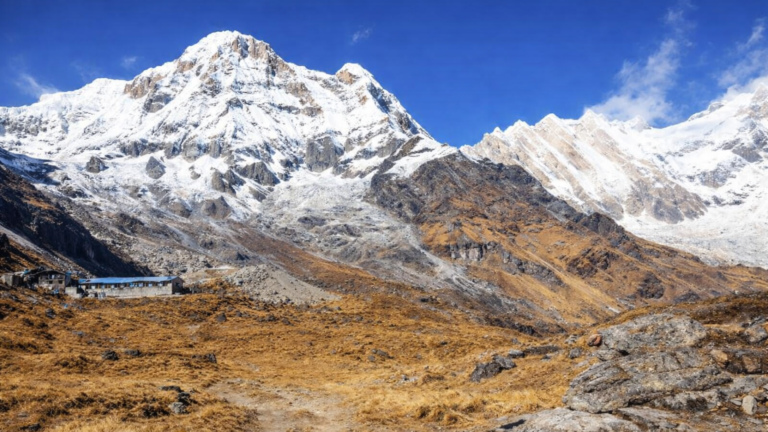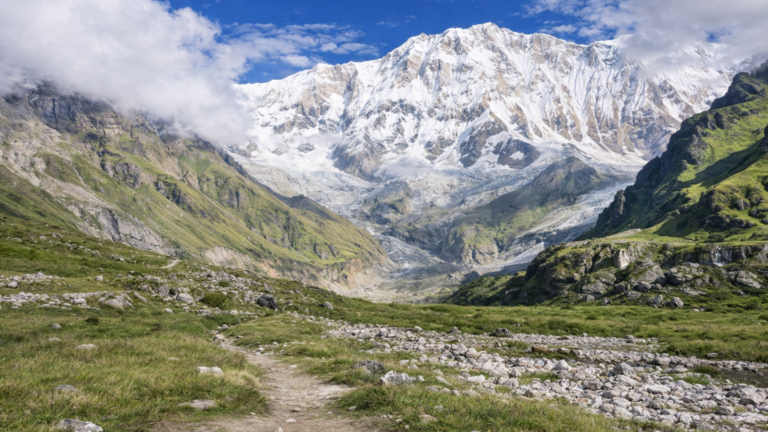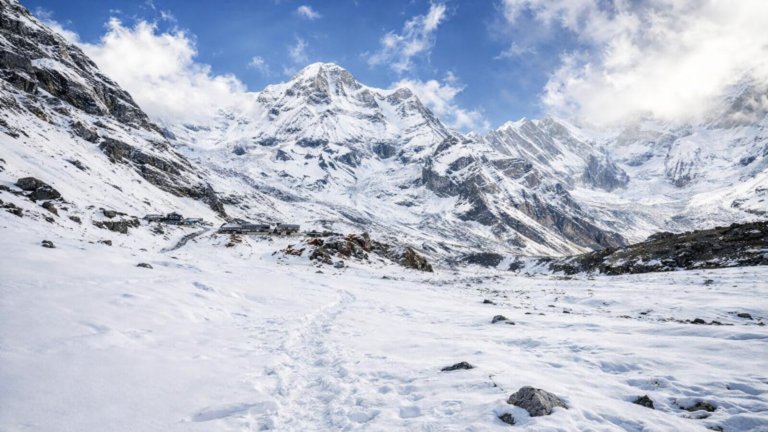
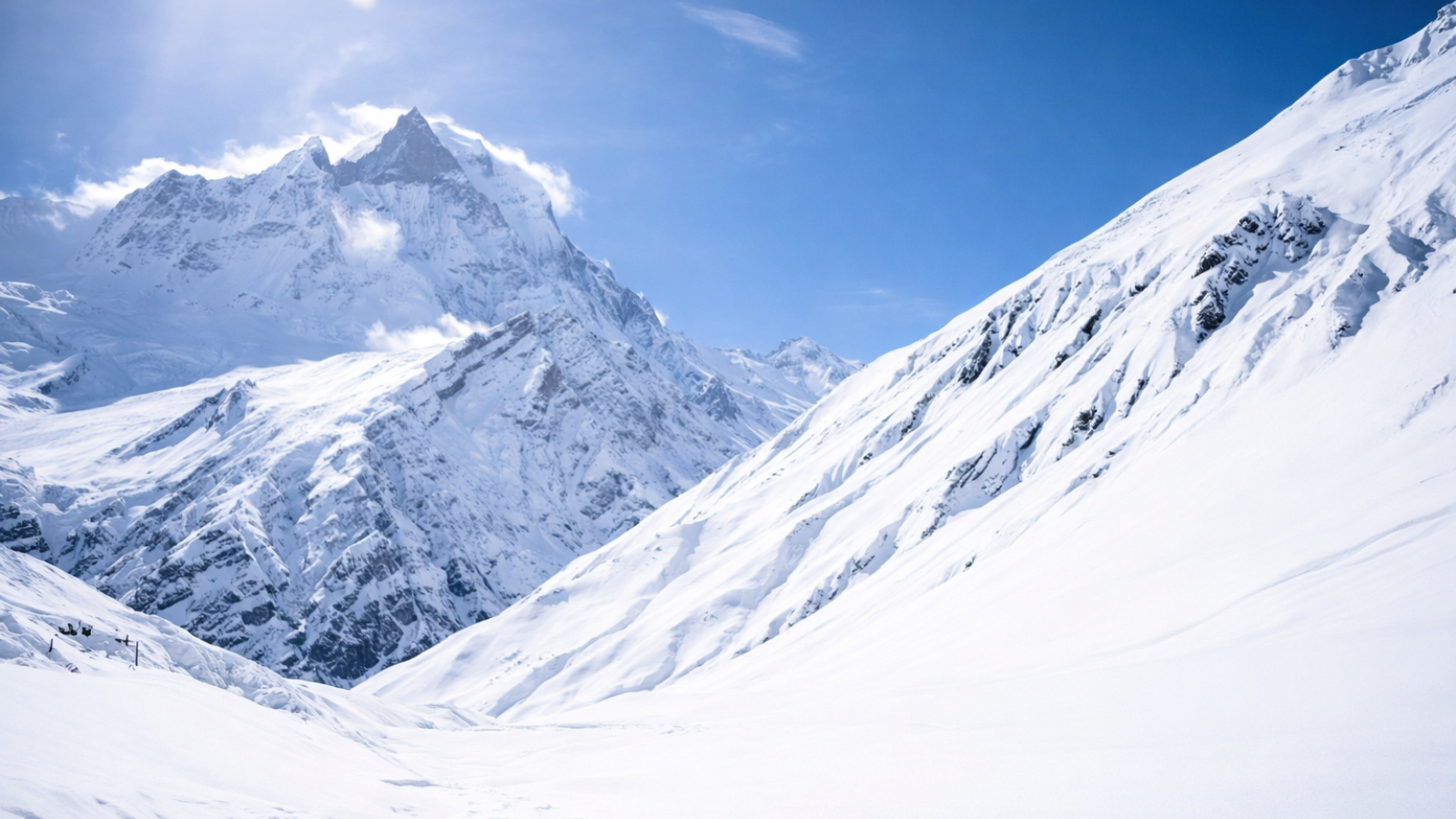

The 7 Day Annapurna Base Camp Trek is a fast-paced Himalayan journey to 4,130 m inside the Annapurna Sanctuary, a high glacial basin in central Nepal. This short Annapurna Base Camp (ABC) itinerary covers approximately 65 km in six active trekking days, linking the lakeside city of Pokhara with the base of Annapurna I (8,091 m), the world’s 10th highest mountain. The route places trekkers face-to-face with a 360-degree wall of Himalayan peaks, including Machhapuchhre, Annapurna South, and Hiunchuli, without requiring technical climbing. Designed for trekkers with limited time but strong cardiovascular fitness, the 7-day version condenses the classic 10–14 day Annapurna Base Camp itinerary into a high-efficiency ascent with longer daily walking hours and tighter acclimatization management.
This guide explains permits, licensed guide regulations, altitude risk management, seasonal weather patterns, detailed daily distances, and realistic budget ranges between USD 500 and USD 1,200. The trek requires the Annapurna Conservation Area Permit (ACAP) and Trekkers’ Information Management System (TIMS) card, compliance with the mandatory licensed guide rule enforced across the Annapurna region. October offers the most stable post-monsoon visibility, while March–April delivers rhododendron blooms along the lower trail. Trekkers who prepare with structured cardio training, descend cautiously on the 2,300 m return day, and monitor Acute Mountain Sickness above 3,000 m gain one of the most efficient and visually concentrated Himalayan experiences available within a single week.
What Is the 7 Day Annapurna Base Camp Trek and Is It Right for You?
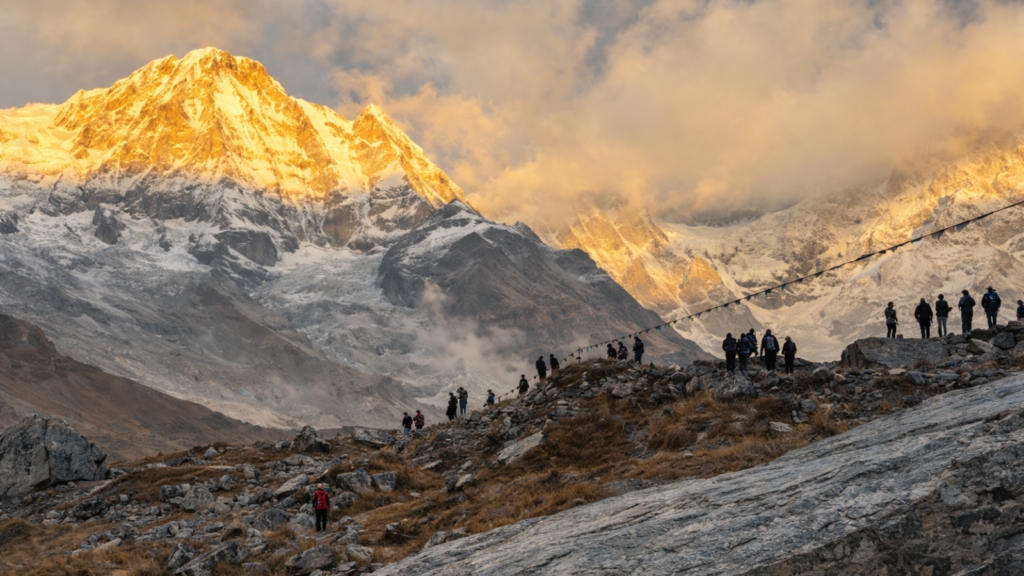
The 7 day Annapurna Base Camp trek is a compressed version of the classic 10–14 day ABC itinerary, designed for trekkers with limited time who maintain a good level of cardiovascular fitness. It reaches the same destination, the Annapurna Sanctuary at 4,130 m, but covers the trail at a faster pace, with longer daily walking sections and fewer rest days.
The trek is right for you if:
- You have 7–10 days available in Nepal, including travel days
- You can walk 5–7 hours continuously on hilly terrain
- You have completed at least one multi-day trek above 2,000 m before
- You are comfortable with moderate altitude (above 3,000 m)
The trek is not ideal if:
- You have never trekked above 2,500 m and experience altitude sensitivity
- You are looking for a leisurely pace with cultural stops
- You have chronic respiratory or cardiovascular conditions without medical clearance
For first-time trekkers or those who prefer a slower acclimatization schedule, the 12–14 day Annapurna Base Camp itinerary is the safer and more rewarding choice.
What Makes the Annapurna Base Camp Trek Different From Other Himalayan Treks?
The Annapurna Base Camp trek is distinct for 3 specific reasons: proximity to giant peaks, ecological diversity, and accessibility.
- Proximity to peaks: No other base camp trek in Nepal places you this close to multiple 8,000 m mountains without technical climbing. At the Annapurna Sanctuary, Annapurna I (8,091 m), Annapurna South (7,219 m), Gangapurna (7,455 m), Hiunchuli (6,441 m), and Machhapuchhre (6,993 m) form a 360-degree mountain wall around you.
- Ecological diversity: The trail passes through 4 distinct ecological zones, subtropical lowlands with rice paddies and rhododendron forests, mid-altitude mixed forests with oak and magnolia, bamboo groves, and the high alpine Annapurna Sanctuary. No other 7-day trek in Nepal covers this range.
- Accessibility from Pokhara: The trailhead at Nayapul is a 1.5-hour drive from Pokhara’s lakeside. This means no domestic flight and no extra acclimatization day in a transit city.
7 Day Annapurna Base Camp Trek: Day-by-Day Itinerary (2026)
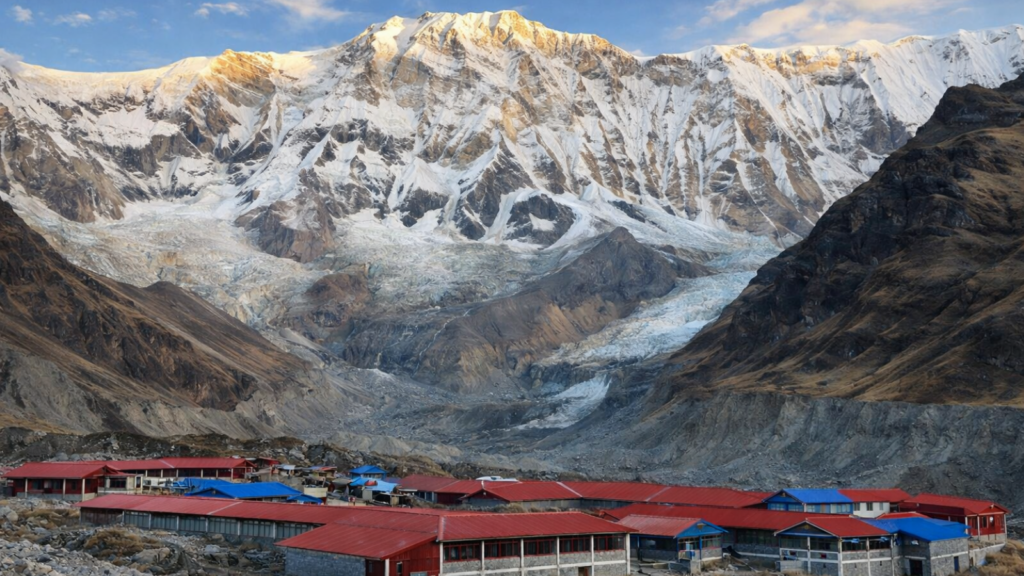
This itinerary uses the most current trail access points as of 2026. Road access improvements have shifted the starting point from Nayapul to Jhinu Danda on some shorter routes, reducing the first day’s walking load significantly.
Day 1: Pokhara to Ghandruk (1,940 m)
Drive: Pokhara (822 m) → Nayapul (1,070 m), approximately 1.5 hours by private vehicle.
From Nayapul, the trail climbs steadily through terraced farmland and stone-paved paths to the Gurung village of Ghandruk, the largest village on the ABC route. The walk takes 4–5 hours and gains 870 m in elevation. Ghandruk’s stone houses, a local Gurung museum, and first views of Machhapuchhre (Fishtail) and Annapurna South make this village one of the most photographed stops on the entire route.
Daily stats: 10 km | 4–5 hours | Elevation gain: 870 m
What most guides skip: The permit checkpoint is at Birethanti, just before Nayapul. Get your permit stamped here at the start of the trek, rangers cross-reference entries with the online permit database, and skipped checkpoints can trigger fines at higher stations.
Day 2: Ghandruk to Chhomrong (2,170 m)
The trail descends from Ghandruk to a river crossing before climbing the famous stone staircases up to Chhomrong. This village sits on a steep ridge at 2,170 m and is the last major settlement before the Annapurna Sanctuary. It has the best-equipped teahouses, a medical post, and reliable phone signal. Stock up on cash, snacks, and any medication here, no ATMs exist beyond this point.
Daily stats: 10 km | 5–6 hours | Net elevation gain: 230 m
Critical logistics note: Prices for meals, hot showers, and phone charging increase significantly beyond Chhomrong. Budget NPR 200–500 extra per service at higher altitude teahouses. Bring at least NPR 10,000–15,000 in cash before leaving Chhomrong.
Day 3: Chhomrong to Bamboo/Sinuwa (2,310–2,360 m)
This day begins with a long descent to Chhomrong Khola (1,900 m) before a sustained ascent through dense rhododendron and bamboo forest to Sinuwa (2,360 m) and then Bamboo (2,310 m). The Annapurna Sanctuary Conservation Area begins after Chhomrong, no wood fires are permitted from this point forward.
Daily stats: 8–9 km | 5–6 hours | Net elevation: relatively flat with steep descent and ascent
Altitude note: Bamboo sits below 2,500 m, so acute mountain sickness (AMS) is unlikely here. This day is physically demanding not because of altitude but because of the descent-ascent combination, which stresses knee joints significantly. Trekking poles are not optional on this section, they reduce knee strain by an estimated 25–30% on steep descents.
Day 4: Bamboo to Deurali (3,230 m)
The trail passes through Dovan (2,600 m), the hamlet of Himalaya (2,900 m), where the treeline ends and Fishtail suddenly dominates the skyline, before reaching Deurali (3,230 m), the gateway to the Sanctuary. This is the first night above 3,000 m. AMS symptoms including headache, mild nausea, and disrupted sleep can appear here.
Daily stats: 9 km | 5–6 hours | Elevation gain: 920 m
AMS management: Drink 3–4 litres of water throughout this day. Avoid alcohol at dinner. Walk the “climb high, sleep low” principle where possible. If you experience a headache by evening, treat it with 500–1,000 mg of paracetamol before escalating to Diamox. Inform your guide immediately if symptoms include vomiting, loss of coordination, or extreme fatigue, these require immediate descent.
Day 5: Deurali to Annapurna Base Camp (4,130 m) via Machhapuchhre Base Camp (3,700 m)
This is the summit day of the trek. The trail climbs from Deurali through the glacial moraine to Machhapuchhre Base Camp (MBC) at 3,700 m, a flat, wind-exposed plateau with dramatic views of Fishtail, and continues for 2 more hours up a boulder-strewn path to Annapurna Base Camp at 4,130 m (13,550 ft).
The Annapurna Sanctuary at the top is a high glacial basin. Annapurna I, the world’s 10th highest peak, fills the northern wall. On a clear day, 13 peaks above 6,000 m are visible simultaneously from the camp.
Daily stats: 9 km | 5–6 hours | Elevation gain: 900 m
Sunrise timing strategy: Reach ABC by mid-afternoon to rest before the next day’s sunrise. The first light of dawn hits Annapurna South and Hiunchuli before spreading across the full amphitheatre, this 20-minute window between 6:00 and 6:30 AM is the single most photographically spectacular moment of the entire 7-day trek.
Weather reality check: Afternoon cloud build-up obscures peaks from approximately 11:00 AM–3:00 PM most days. The clearest skies are between 5:30 AM and 10:00 AM. Plan your summit arrival and departure windows around this.
Day 6: Annapurna Base Camp to Jhinu Danda (1,760 m)
The descent from ABC retraces the ascent route but moves significantly faster downhill. Most trekkers complete the Bamboo-to-Jhinu Danda section by late afternoon. Jhinu Danda’s natural hot springs, located 20 minutes below the village, provide the best reward at the end of a hard trekking week: mineral-rich thermal pools with mountain views.
Daily stats: 18 km | 6–7 hours | Elevation descent: 2,370 m
Knee protection on descent: Long downhill days cause more injuries than ascent days. Use trekking poles, engage your quadriceps deliberately on each step, and avoid rushing. Most evacuation incidents on the ABC route occur on the descent due to fatigue-related slips on wet stone steps.
Day 7: Jhinu Danda to Pokhara
A short 2–3 hour walk from Jhinu Danda returns you to the road at Siwai, from where transport drives back to Pokhara. Arrive in Pokhara by early afternoon with time for a lakeside lunch and a visit to the International Mountain Museum, a world-class facility covering Himalayan expedition history, before your onward travel.
Daily stats: 3–4 km walk + 2-hour drive
What Are the Required Permits for the 7 Day ABC Trek in 2026?
The Annapurna Base Camp trek requires the Annapurna Conservation Area Permit (ACAP) and historically required the Trekkers’ Information Management System (TIMS) card. As of 2026, most Annapurna checkpoints primarily verify the ACAP permit, but TIMS still exists as a trekking registration system used by agencies and some regional offices.
ACAP Permit: Cost, Validity, and Where to Get It
The ACAP permit grants legal access to the entire Annapurna Conservation Area, managed by the National Trust for Nature Conservation (NTNC). The permit has no time limit and covers all routes within the Annapurna region.
| Nationality | ACAP Fee (2026) |
| Foreign nationals | NPR 3,000 (~USD 22) |
| SAARC nationals | NPR 1,000 |
| Nepali citizens | NPR 300 |
| Children under 10 | Free (permit still required) |
Where to obtain ACAP:
- Nepal Tourism Board, Bhrikutimandap, Kathmandu (open Sunday–Friday, 9 AM–5 PM)
- Immigration Office, Damsite, Pokhara (open including Saturdays)
- Online: epermit.ntnc.org.np (foreign nationals, credit card accepted plus 2.9% gateway fee)
Critical warning: If you fail to obtain permits in Kathmandu or Pokhara, ACAP is available at checkpoints in Chhomrong and Birethanti, but at double the fee (NPR 6,000). Always arrange permits before entering the trail.
TIMS Card: Is It Required in 2026?
The Trekkers’ Information Management System (TIMS) card was introduced by the Trekking Agencies’ Association of Nepal (TAAN) and the Nepal Tourism Board to track trekkers for safety and rescue management.
As of 2026, most checkpoints along the Annapurna Base Camp route primarily verify the ACAP permit, and TIMS is not consistently enforced on this trail. However, many trekking agencies still arrange a TIMS card for administrative and safety tracking purposes.
TIMS Card Cost (2026)
| Trekker Type | TIMS Fee |
| Foreign Independent Trekkers | NPR 2,000 (~USD 15) |
| Organized Group Trekkers | NPR 1,000 (~USD 7) |
| SAARC Trekkers | NPR 1,000 |
| Nepali Trekkers | NPR 300 |
Where to Obtain TIMS
- Nepal Tourism Board Office – Kathmandu
- TAAN Office – Kathmandu
- TAAN Office – Pokhara
- Through a licensed trekking agency
In practice, ACAP remains the only permit strictly checked along the Annapurna Base Camp trekking route, but carrying a TIMS card can still help with trek registration and emergency coordination.
Licensed Guide Requirement: 2026 Update
As of April 1, 2023, the Nepal Government made hiring a licensed guide mandatory for all trekking routes in the Annapurna region. This regulation remains fully in force in 2026. Solo trekking without a registered guide is prohibited and can result in permit revocation at checkpoints.
Your guide must be registered with the Trekking Agencies’ Association of Nepal (TAAN) or a TAAN-affiliated agency. All permit applications now verify guide registration, this is cross-checked at the first checkpoint you enter.
How Much Does the 7 Day Annapurna Base Camp Trek Cost in 2026?
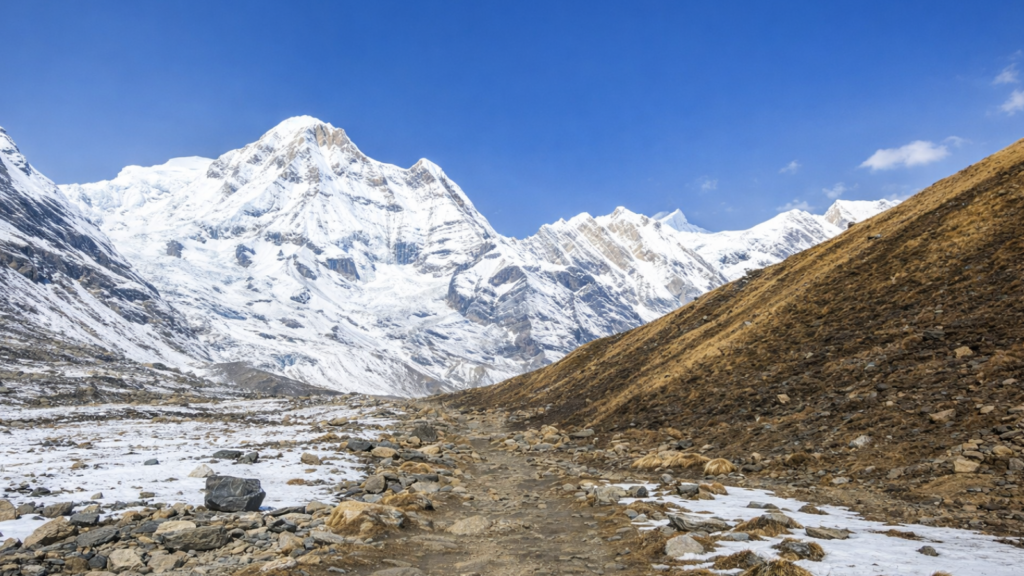
The total cost of a 7 day Annapurna Base Camp trek ranges from USD 500 to USD 1,200 depending on the service level, group size, and agency used.
7 Day ABC Trek Cost Breakdown Table
| Expense Item | Budget Estimate (USD) | Mid-Range (USD) |
| ACAP Permit | ~22 | ~22 |
| Guide fee (7 days) | 175–210 | 245–280 |
| Porter fee (7 days, optional) | 140–175 | 175–210 |
| Teahouse accommodation (6 nights) | 60–90 | 120–180 |
| Meals (6 trekking days) | 120–150 | 180–240 |
| Pokhara–trailhead transport | 20–30 | 30–50 |
| Total (excluding guide packages) | ~540–677 | ~772–982 |
Package deals from licensed trekking agencies typically range from USD 499 to USD 800 per person for guided group treks of 2 or more trekkers, covering all of the above including permits.
Additional costs to budget for:
- Travel insurance with helicopter evacuation cover: USD 80–150
- Hot shower and device charging at high altitudes: NPR 200–500 per session
- Tips for guide (recommended USD 10–15/day) and porter (USD 8–12/day)
- Personal gear purchases or rentals in Pokhara: USD 30–80
What Is the Best Time of Year for the 7 Day Annapurna Base Camp Trek?
The 7 day ABC trek operates across 4 seasons, but 2 windows deliver the best conditions: spring (March–May) and autumn (September–November).
Spring (March to May): Best for Rhododendron Forests and Warmer Days
Spring is the most visually spectacular season. Rhododendron forests between Ghandruk and Chhomrong bloom in red, pink, and white from late March through April. Daytime temperatures at base camp reach 5–10°C. Some snow patches remain above 3,500 m in early March but clear by mid-April. Trail visibility is excellent until mid-May, when pre-monsoon haze builds.
March–April is the optimal spring window for the 7-day itinerary.
Autumn (September to November): Best for Crystal-Clear Skies
Post-monsoon autumn delivers the clearest skies and most stable weather of the year. October is the peak trekking month, mountain views from ABC are at their sharpest, and temperatures are cooler but manageable (0–5°C at base camp at night). By late November, overnight temperatures at Deurali and ABC drop to -5°C to -10°C, adding a cold-management challenge.
October is the single best month for the 7-day ABC trek based on weather reliability, visibility, and trail conditions.
Winter (December to February): Possible But Cold
Winter trekking to ABC is achievable for experienced cold-weather trekkers. Trails above Deurali frequently have ice and snow. Teahouses at Machhapuchhre Base Camp and above may close from December to February. If you trek in winter, bring a 4-season sleeping bag, insulated trekking boots, and microspikes.
Monsoon (June to August): Not Recommended for 7-Day Itinerary
Monsoon brings heavy rain, leeches on lower trails, frequent trail closures due to landslides, and near-zero mountain visibility above 3,000 m. The compressed 7-day schedule leaves no buffer for weather delays, a 2-day trail closure eliminates any chance of reaching ABC. The 12–14 day itinerary is the safer choice for monsoon trekkers.
How Difficult Is the 7 Day Annapurna Base Camp Trek?
The 7 day Annapurna Base Camp trek is moderately difficult by international trekking standards. The classification reflects 3 specific factors: daily distance, altitude gain, and the absence of technical terrain.
Physical Demands
Daily trekking distances average 9–10 km with 5–7 hours of active walking. The trail involves continuous ascent and descent on stone-paved and natural paths. The most physically demanding single day is Day 4 (Bamboo to Deurali), which gains 920 m in elevation, and Day 6 (ABC to Jhinu Danda), which descends over 2,300 m on tired legs.
Fitness benchmark: You are adequately prepared if you can jog 4 km in under 35 minutes or complete 60 minutes of continuous uphill hiking with a loaded daypack.
Recommended preparation exercises:
- Stair climbing with a 7–10 kg pack, 30 minutes, 3 times per week
- Downhill walking on steep terrain to condition the quadriceps and knee joints
- Cardiovascular training (running, cycling) for 45 minutes, 4 times per week, starting 8 weeks before the trek
Altitude Challenges
The trek crosses above 3,000 m on Day 4 and reaches 4,130 m on Day 5. These altitudes expose trekkers to Acute Mountain Sickness (AMS), which affects approximately 25–30% of trekkers above 3,500 m regardless of fitness level.
7 evidence-based AMS prevention strategies:
- Ascend no more than 500 m per day above 3,000 m
- Maintain hydration at 3–4 litres of water daily
- Avoid alcohol above 2,500 m
- Walk at a conversational pace (you can speak in full sentences)
- Take acclimatization walks in the evening at high-altitude camps
- Carry and know how to use a pulse oximeter, normal SpO2 at 4,130 m is 75–85%
- Consult a travel medicine doctor about prophylactic Diamox (acetazolamide) before departure
When to descend immediately: Loss of coordination (ataxia), severe persistent headache unrelieved by paracetamol, coughing with pink froth, or confusion are signs of High Altitude Cerebral Edema (HACE) or High Altitude Pulmonary Edema (HAPE), both medical emergencies requiring immediate descent and helicopter evacuation.
What to Pack for the 7 Day Annapurna Base Camp Trek: Gear Checklist (2026)
Packing efficiently for a 7-day Himalayan trek is a skill in itself. The goal is a duffel bag under 12 kg if you hire a porter, or a daypack under 10 kg if you carry your own gear. Overpacking is the most common and preventable mistake on this route.
Clothing Layers (The 3-Layer System)
- Base layer: 2 moisture-wicking merino wool or synthetic long-sleeve tops plus 2 trekking trousers. Cotton kills, it retains moisture and accelerates heat loss above 3,000 m. Use zero cotton above Chhomrong.
- Mid layer: 1 fleece jacket (200-weight or equivalent) plus 1 light insulating vest.
- Outer layer: 1 waterproof hardshell jacket with taped seams plus 1 waterproof trouser for rain and wind protection above treeline.
High altitude extras: Down jacket or synthetic puffy (critical above 3,500 m), warm hat covering ears, balaclava or buff, waterproof gloves.
Technical Gear
- Trekking poles: Collapsible, adjustable, not optional on this route’s descent sections
- Trekking boots: Waterproof, mid-ankle, broken in before arrival (minimum 100 km on varied terrain)
- Gaiters: Useful in early spring or winter for snow sections above Deurali
- Headlamp: With fresh batteries, essential for pre-dawn starts and power outages in teahouses
- Sleeping bag: Rated to -10°C or lower for nights at Deurali and ABC
- Sunglasses: CE-rated UV400 glacier glasses for high-altitude UV exposure (UVI above 3,500 m is extreme)
- Sunscreen: SPF 50+, reapply every 2 hours above 3,000 m where UV intensity increases 12% per 1,000 m
Health and Safety Essentials
- Personal first aid kit: blister care, paracetamol, ibuprofen, antihistamines, oral rehydration salts
- Pulse oximeter for SpO2 monitoring above 3,000 m
- Water purification tablets or a portable UV steriliser (Steripen), tap water above Bamboo is not reliably treated
- Travel insurance documents with policy number and emergency evacuation contact, helicopter rescues from ABC cost USD 2,000–4,000 without insurance
Where Do You Stay on the 7 Day Annapurna Base Camp Trek? Teahouse Accommodation Guide
All accommodation on the ABC route is in teahouses (tea houses), family-run mountain lodges offering a room, shared bathroom, and a dining hall serving Nepali and international food. Teahouse quality improves at lower elevations and decreases as you climb.
Teahouse Standards by Altitude Zone
Ghandruk and Chhomrong (1,900–2,170 m): Comfortable rooms with attached or shared bathrooms, hot showers included or at NPR 200–300, Wi-Fi available, multiple food options including fresh vegetables and baked goods.
Bamboo, Sinuwa, Himalaya (2,310–2,900 m): Basic rooms with shared bathrooms, cold water showers (hot shower NPR 300–400), limited menu of dal bhat, noodles, pasta, and soup.
Deurali, MBC, ABC (3,230–4,130 m): Simple dormitory or twin rooms with blankets provided, toilet block shared with 6–10 rooms, hot shower NPR 400–500, menu limited to dal bhat, porridge, soups, and hot drinks. Wi-Fi unavailable; phone signal non-existent.
The Dal Bhat Advantage
Dal bhat, lentil soup with rice, vegetable curry, and pickle, is the Nepali trekking staple and the best energy meal on the route. Most teahouses offer unlimited dal bhat refills for a fixed price of NPR 500–700. This is not just cultural tradition; it is practical nutrition. The combination of complex carbohydrates and protein supports the sustained energy output needed for 6-hour trekking days better than most western trekking foods.
Planning Your 7 Day ABC Trek: Practical Pre-Departure Checklist
Complete these steps at least 4 weeks before your departure date:
- Book with a TAAN-registered trekking agency: verify agency registration at taan.org.np
- Arrange your Nepal visa: available on arrival at Tribhuvan International Airport, Kathmandu (USD 30 for 15 days, USD 50 for 30 days)
- Obtain travel insurance with helicopter evacuation coverage to 5,000 m
- Get your ACAP permit: online at epermit.ntnc.org.np or in person in Kathmandu/Pokhara
- See a travel medicine doctor at least 3 weeks before departure for altitude sickness medication advice, vaccinations, and personal health clearance
- Begin physical training: 8 weeks of cardiovascular and lower-body strength training
- Break in your trekking boots: minimum 80–100 km on varied terrain before you arrive in Nepal
- Withdraw sufficient Nepalese Rupees in Pokhara before driving to the trailhead
The 7 day Annapurna Base Camp trek is one of the most efficient and rewarding ways to experience the Himalaya. In one week, you pass through 4 distinct ecosystems, walk through traditional Gurung villages that have changed little in 200 years, and stand inside a glacial amphitheatre that no photograph fully prepares you for.
The trekkers who get the most from this route are the ones who prepare seriously, respect the altitude, and move at a pace that their body, not their schedule, dictates. Plan well, hire a knowledgeable local guide, and the Annapurna Sanctuary will deliver one of the defining experiences of your trekking life.
How Long Is the 7 Day Annapurna Base Camp Trek in Total Distance?
The 7 day Annapurna Base Camp trek covers 65 kilometers (41 miles) over 6 active trekking days. Trekkers walk an average of 9–11 km per day for 5–7 hours. The longest day covers 18 km during the descent from Annapurna Base Camp to Jhinu Danda.
What Is the Maximum Altitude of the Annapurna Base Camp Trek?
The maximum altitude of the Annapurna Base Camp trek is 4,130 meters (13,550 feet) at Annapurna Base Camp. The trail passes Machhapuchhre Base Camp at 3,700 meters before reaching ABC. Trekkers first sleep above 3,000 meters at Deurali at 3,230 meters.
Do I Need a Guide for the 7 Day Annapurna Base Camp Trek in 2026?
A licensed guide is mandatory for the 7 day Annapurna Base Camp trek in 2026. Nepal enforced this regulation in April 2023 for all Annapurna region treks. Guides must register with TAAN or an affiliated agency. Solo trekkers without a guide risk permit revocation at checkpoints.
How Much Does It Cost to Trek to Annapurna Base Camp in 7 Days?
A 7 day Annapurna Base Camp trek costs USD 500 to USD 1,200 per person. Budget trekkers in a group of two spend about USD 540. Mid-range guided packages cost USD 800 to USD 1,000. Prices include the ACAP permit, guide, porter, accommodation, and meals.
What Permits Are Required for the Annapurna Base Camp Trek in 2026?
The Annapurna Base Camp trek requires the Annapurna Conservation Area Permit (ACAP), which costs NPR 3,000 (about USD 22) for foreign nationals and The TIMS card (Trekkers’ Information Management System) costs NPR 2,000 for independent trekkers and NPR 1,000 for organized groups.
What Is the Best Month to Do the 7 Day Annapurna Base Camp Trek?
October is the best month for the 7 day Annapurna Base Camp trek. October offers clear mountain views, stable temperatures, and dry trails after the monsoon. March and April provide a strong alternative with rhododendron blooms. Avoid June to August due to landslides and heavy rain.
Is the 7 Day Annapurna Base Camp Trek Suitable for Beginners?
The 7 day Annapurna Base Camp trek suits beginners with strong cardiovascular fitness. The trek reaches 4,130 meters and allows limited acclimatization time. Beginners without prior trekking experience above 2,000 meters should choose a 10 to 12 day itinerary with built-in rest days.
What Should I Pack for the 7 Day Annapurna Base Camp Trek?
Pack waterproof trekking boots, a down jacket rated to -10°C, and trekking poles for the 7 day Annapurna Base Camp trek. Keep pack weight under 10 kg if carrying it yourself or under 12 kg with a porter. Carry a pulse oximeter, UV400 sunglasses, and water purification tablets.
Are There ATMs or Phone Signal on the Annapurna Base Camp Trail?
There are no ATMs beyond Nayapul on the Annapurna Base Camp trail. Phone signal ends after Chhomrong at 2,170 meters. Withdraw NPR 20,000 to 25,000 in Pokhara before departure. Wi-Fi is available in Ghandruk and Chhomrong for NPR 100 to 300 per hour.
What Happens If I Get Altitude Sickness on the 7 Day ABC Trek?
Mild altitude sickness on the 7 day ABC trek causes headache, nausea, and poor sleep. Stop ascending and drink 3 to 4 liters of water daily. Descend immediately if symptoms worsen or persist after 12 hours. Helicopter evacuation to Pokhara costs USD 2,000 to USD 4,000 without insurance.