
The 5 day Annapurna Base Camp trek is a fast-paced high-altitude Himalayan trek that leads from Nayapul (1,070m) to Annapurna Base Camp (4,130m) inside the Annapurna Sanctuary of north-central Nepal. This compact Annapurna Base Camp itinerary covers approximately 65 kilometers through the Annapurna Conservation Area, following the Modi Khola valley past Tikhedhunga, Chhomrong, Deurali, and Machapuchare Base Camp before reaching the glacial amphitheater beneath Annapurna I (8,091m). Designed for fit trekkers with prior altitude exposure, the 5-day Annapurna Base Camp (ABC) trek compresses the classic 7–10 day route into five demanding stages while still delivering panoramic views of Annapurna South, Hiunchuli, and the sacred Machapuchare.
This complete guide to the 5 day Annapurna Base Camp trek explains the exact route profile, daily elevation gain, permit requirements, seasonal weather windows, packing essentials, and altitude-safety strategy required for a safe ascent above 4,000 meters. It defines who the trek suits, how to reduce Acute Mountain Sickness risk, and what budget to expect in 2026, including Annapurna Conservation Area Permit (ACAP) and the Trekkers’ Information Management System (TIMS) card permit fees and licensed guide costs under Nepal’s current trekking regulations. First-time Annapurna Base Camp (ABC) trekkers who prepare with structured training, proper acclimatization in Pokhara, and a -10°C sleeping system can complete the route with high success rates during the peak spring and autumn seasons.
What Is the 5 Day Annapurna Base Camp Trek Route?
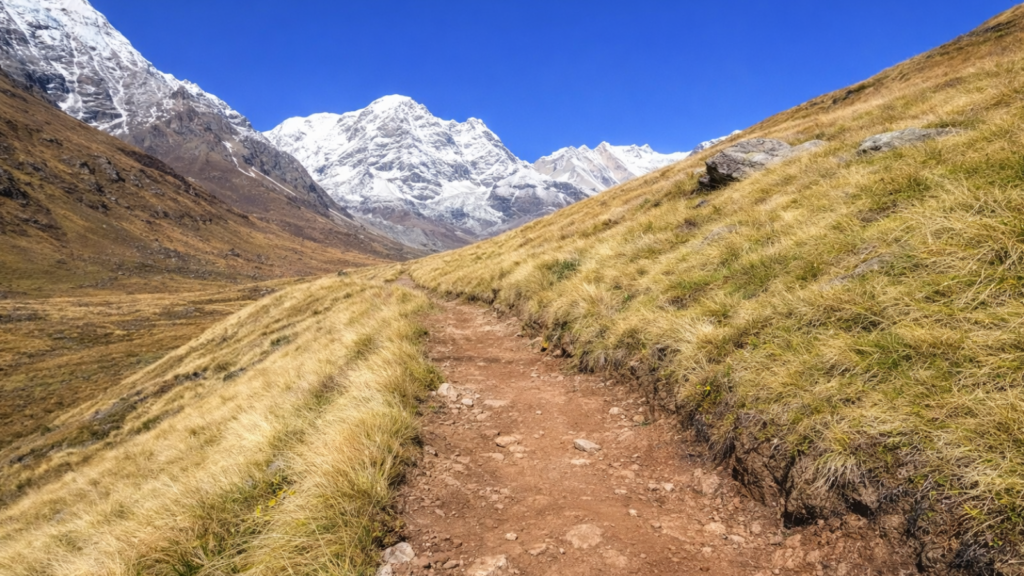
The 5 day Annapurna Base Camp trek follows the Modi Khola river valley through the Annapurna Conservation Area, starting from Nayapul or Phedi near Pokhara and terminating at the Annapurna Base Camp (ABC) at 4,130 meters before returning via the same path.
The route passes through 4 major teahouse stops, Tikhedhunga, Ghorepani, Chhomrong, and Dovan, before entering the upper sanctuary toward Machapuchare Base Camp (MBC) at 3,700m and finally ABC. The trail is well-marked, heavily used during peak seasons, and serviced by teahouse lodges throughout.
Day-by-Day Elevation Profile
The table below defines the exact elevation gain and distance for each of the 5 days.
| Day | Route | Start Elevation | End Elevation | Distance |
| 1 | Pokhara → Tikhedhunga | 822m | 1,540m | ~14 km |
| 2 | Tikhedhunga → Bamboo | 1,540m | 2,310m | ~16 km |
| 3 | Bamboo → Deurali | 2,310m | 3,230m | ~11 km |
| 4 | Deurali → ABC | 3,230m | 4,130m | ~13 km |
| 5 | ABC → Jhinu Danda | 4,130m | 1,780m | ~18 km |
How Does the 5-Day Trek Differ from the Standard 7–10 Day Route?
The standard Annapurna Base Camp trek takes 7 to 10 days because it includes the Ghorepani-Poon Hill variation, additional acclimatization nights, and a more gradual ascent profile. The 5-day version omits Poon Hill and compresses the middle section, making Day 3 and Day 4 consecutively demanding.
The 5-day route suits trekkers who are physically fit, have prior high-altitude experience above 3,000m, and want to minimize total trip duration without sacrificing the core ABC experience. It is not recommended for beginners who have never trekked above 2,500 meters.
Which Teahouses Are Available Along the 5-Day Route?
Teahouse accommodation runs the full length of the route. The 5 most important overnight stops offer lodges with private or dormitory rooms, attached bathrooms in lower sections, and shared facilities above Chhomrong. Hot showers are available at most stops below 3,500m for a fee of NPR 200–400. Above Deurali, cold water is standard.
What Permits Do You Need for the 5 Day Annapurna Base Camp Trek?
The 5 day Annapurna Base Camp trek requires two permits: the Annapurna Conservation Area Permit (ACAP) and the Trekkers’ Information Management System (TIMS) card. The ACAP regulates entry into the Annapurna Conservation Area, while the TIMS card records trekkers for safety, rescue coordination, and trail management. A licensed guide is also mandatory for foreign trekkers under Nepal’s trekking regulations.
Both permits are issued at the Nepal Tourism Board office in Kathmandu or the Pokhara Tourism Board office. Obtaining permits in Pokhara saves one day of travel compared to Kathmandu.
Annapurna Conservation Area Permit (ACAP)
The ACAP costs NPR 3,000 per person for foreign nationals and NPR 200 for SAARC nationals. The permit funds conservation efforts across the 7,629 km² Annapurna Conservation Area, the largest protected area in Nepal. You present this permit at checkpoints in Birethanti (the formal entry gate), Ghorepani, and Chhomrong. Carry the original, photocopies are not accepted.
Trekkers’ Information Management System (TIMS) Card
The TIMS card is required for most trekking routes in Nepal, including the Annapurna Base Camp trek. It allows authorities and trekking organizations to track trekkers on the trail and coordinate rescue operations if emergencies occur.
TIMS Card Cost (2026):
- Foreign independent trekkers: NPR 2,000
- Foreign trekkers with a guide: NPR 1,000
- SAARC nationals: NPR 600
TIMS cards are issued at the Nepal Tourism Board offices in Kathmandu and Pokhara or through registered trekking agencies. Trekkers must provide passport details, trekking itinerary, and emergency contact information when applying.
You may be asked to show your TIMS card at checkpoints along the Annapurna trekking corridor together with your ACAP permit.
Do You Need a Guide or Porter on This Trek?
As of the April 2023 Nepal government regulation, all foreign trekkers in designated trekking areas, including the Annapurna region, are required to hire a licensed guide. Solo trekking without a guide is officially prohibited.
A licensed guide costs USD 25–35 per day. A porter, who carries loads up to 20 kg, costs USD 15–20 per day. Hiring both is standard practice and supports the local mountain economy. Guides registered with the Nepal Government’s Department of Tourism carry an official license card, verify this before hiring.
What Are the Best Seasons for the 5 Day Annapurna Base Camp Trek?
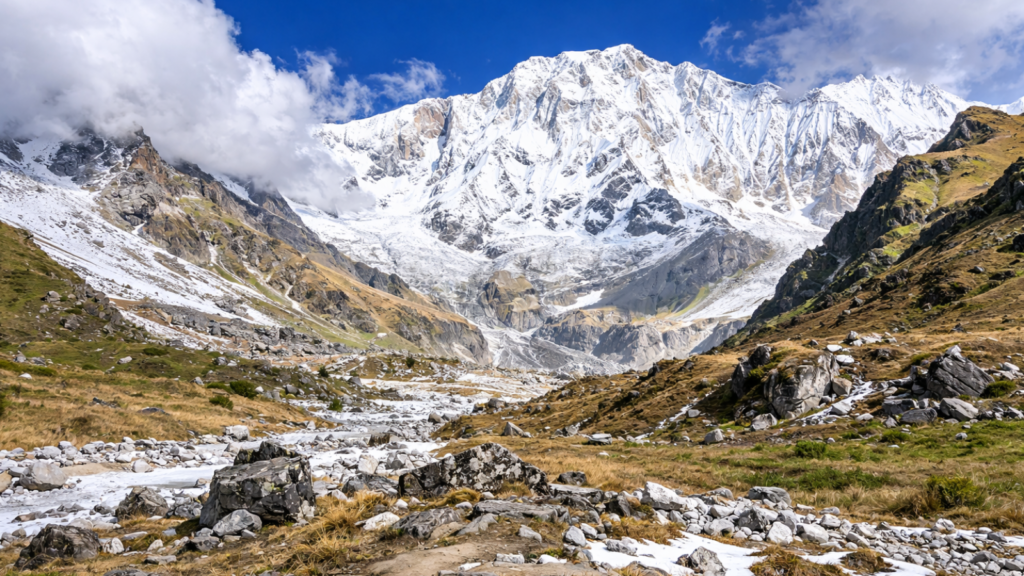
The 4 viable trekking windows for Annapurna Base Camp are spring (March–May), autumn (September–November), early winter (December), and late winter (February). Spring and autumn deliver the highest trail success rates and the clearest summit views.
Spring Season: March, April, and May
Spring is the most popular season for the 5-day Annapurna trek. Temperatures at ABC range from -5°C at night to 10°C during the day in March. By May, daytime temperatures at base camp reach 15°C. The rhododendron forests between Tikhedhunga and Bamboo bloom in full red and pink from late March through April, a spectacle most trekkers cite as one of the route’s defining experiences.
Visibility is generally excellent in March and April. May brings pre-monsoon cloud build-up in the afternoons, so plan to reach each campsite by 1:00 PM to avoid afternoon rain.
Autumn Season: October and November
October and November deliver the clearest skies and the sharpest views of Annapurna I (8,091m), Annapurna South (7,219m), Hiunchuli (6,441m), and Machapuchare (6,993m). Post-monsoon trails are stable and well-defined. Night temperatures at ABC drop to -10°C in November, so sleeping bag ratings of -15°C are essential in late autumn.
Autumn is also the busiest season. Teahouses at Dovan, Deurali, and MBC fill quickly by early afternoon. Book accommodation in advance during October, particularly the 15th to 31st, when trail congestion peaks.
Monsoon and Winter Conditions
Trekking from June through August during the monsoon season is not advised for the 5-day route. Landslides, leeches, washed-out trails between Bamboo and Himalaya, and persistent rain reduce the journey to a genuinely hazardous undertaking. The Modi Khola valley acts as a funnel for monsoon precipitation, receiving some of the heaviest rainfall in the Annapurna region.
December through February brings snowfall above 3,000m. The section between Deurali and MBC accumulates 1–2 meters of snow in January, making crampons and ice axes necessary for safe passage. Experienced mountaineers complete winter ABC treks, but the 5-day format in winter is only viable with full mountain equipment.
How Physically Demanding Is the 5 Day Annapurna Base Camp Trek?
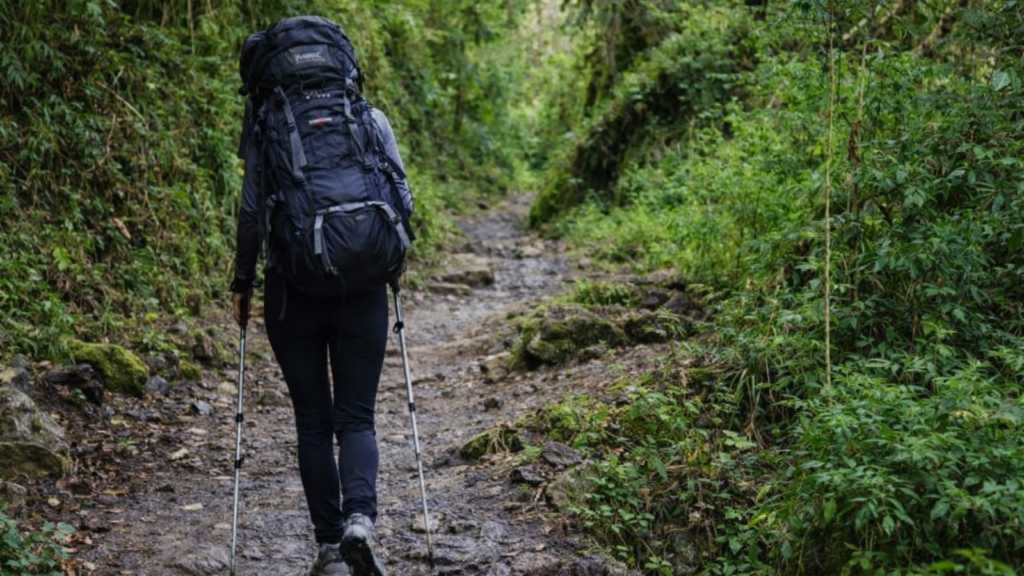
The 5 day Annapurna Base Camp trek is rated moderately difficult to strenuous, requiring 6–8 hours of walking daily across an elevation gain of 3,060 meters from the lowest to highest point. The trail demands cardiovascular endurance, leg strength, and altitude adaptability.
Fitness Requirements and Physical Preparation
Completing this trek comfortably requires 8–12 weeks of dedicated training before departure. The 3 training components that matter most are cardiovascular endurance, leg strength, and load-bearing capacity.
Run or hike for 45–60 minutes, 4 times per week, including uphill intervals. Stair climbing with a loaded backpack of 8–10 kg replicates the physical demand more accurately than flat running. On Day 3 and Day 4 of the trek, the trail gains over 900 meters of elevation in a single day, undertrained trekkers experience severe leg fatigue and slower breathing response at altitude.
Trekkers who arrive from sea-level destinations and begin the 5-day trek without any acclimatization time face a 25–35% higher risk of Acute Mountain Sickness (AMS) above 3,500 meters compared to those who spend one night in Pokhara (824m) and one night at a mid-route teahouse before pushing higher.
Understanding Altitude Sickness on the ABC Trek
Acute Mountain Sickness occurs when the body does not acclimatize to reduced oxygen levels at altitude. The 3 early symptoms of AMS are persistent headache, nausea, and dizziness, all occurring within 6–12 hours of arriving at a new altitude.
The most dangerous altitude gain on the 5-day route occurs on Day 4, ascending from Deurali (3,230m) through MBC (3,700m) to ABC (4,130m) in a single push of 5–7 hours. This 900-meter gain in one day exceeds the recommended maximum daily altitude gain of 500 meters above 3,000 meters.
To reduce AMS risk on Day 4, follow the “climb high, sleep low” principle: ascend to ABC for the panoramic views and descend back to MBC (3,700m) to sleep if you experience any early AMS symptoms. Never ascend further with a headache that does not resolve with rest and hydration.
Carry Diamox (Acetazolamide) 125mg tablets after consulting your physician before the trek. Most experienced guides recommend beginning Diamox 24 hours before reaching 3,000m if you have a history of altitude sensitivity.
What Should You Pack for the 5 Day Annapurna Base Camp Trek?
The 5 day Annapurna Base Camp packing list divides into 5 categories: clothing layers, footwear, shelter and sleep, nutrition and hydration, and documents and safety essentials. Total pack weight should not exceed 10–12 kg if trekking without a porter.
Essential Clothing Layers for ABC Altitude
Temperatures across the 5-day route range from 25°C at Pokhara to -10°C at ABC in October. The 3-layer clothing system, base layer, insulation layer, and shell layer, handles this 35-degree range effectively.
- Base layer: Merino wool or moisture-wicking synthetic, 2 sets
- Mid layer: Down jacket (600-fill or higher) for evenings and mornings above 3,000m
- Shell layer: Waterproof, breathable jacket (Gore-Tex or equivalent) rated for moderate rain
- Trekking trousers: 2 pairs, convertible design
- Thermal underwear: Essential above 3,500m
- Gloves: Lightweight liner gloves plus waterproof outer gloves
- Wool beanie: Temperature drop above MBC makes this non-negotiable
- Gaiters: Useful above Deurali in spring snowmelt conditions
Footwear and Foot Care
Trekking boots with ankle support and waterproofing are the single most important gear item on this trek. Trail runners are not suitable above Chhomrong, the rock, root, and snow terrain between Himalaya and ABC demands stiff-soled support.
Break in your boots for a minimum of 6–8 weeks before the trek. The number one reason trekkers abandon the ABC route is blisters from new footwear. Carry moleskin blister pads, anti-blister socks (wool or synthetic blend), and a spare pair of lightweight camp sandals for evenings at teahouses.
Sleeping Bags and Sleep System
Teahouses provide blankets, but quality and cleanliness vary significantly above Deurali. A sleeping bag rated to -10°C (comfort rating) is the correct choice for all seasons except summer. In October and November, ABC nighttime temperatures regularly fall to -8°C to -12°C, making the -10°C rating a practical minimum rather than an overcaution.
A sleeping bag liner adds 5–8°C of additional warmth and doubles as a hygiene layer in teahouse dorms.
Hydration and Water Safety
The Modi Khola valley supplies clean-looking water at every teahouse, but natural sources above Bamboo carry bacteria, protozoa, and particulates from glacial runoff. Purchase bottled water at lower altitudes (NPR 80–150 per liter at Chhomrong), or use a water purification system above 2,500m.
The 2 most reliable purification methods on this route are iodine tablets (effective against bacteria and protozoa, 20-minute contact time) and UV purifiers like SteriPen (effective in 90 seconds, requires clear water). Carry minimum 3 liters of water capacity for the Deurali-to-ABC section, where teahouses are spaced 2–3 hours apart.
Drink 3–4 liters of water per day above 3,000m. Dehydration accelerates altitude sickness, reduces physical performance by up to 20%, and impairs decision-making, the 3 outcomes most dangerous at high altitude.
How Do You Reach the Starting Point of the Annapurna Base Camp Trek?
The standard starting point for the 5 day Annapurna Base Camp trek is Nayapul (1,070m), which lies 42 kilometers west of Pokhara. The 2 transport options from Pokhara to Nayapul are local bus (NPR 200–250, 1.5–2 hours) and private jeep transfer (NPR 3,000–4,000, 1 hour).
Getting to Pokhara from Kathmandu
Pokhara is the gateway city for the Annapurna Base Camp trek. The 3 transport options from Kathmandu to Pokhara are:
- Tourist bus: NPR 700–1,200, 6–8 hours on the Prithvi Highway
- Greenline or Tata Sumo: NPR 2,000–2,500, 6–7 hours with AC
- Domestic flight: NPR 5,000–9,000, 25 minutes on Buddha Air, Yeti Airlines, or Tara Air
The flight option is recommended if you are arriving from outside Nepal and wish to begin trekking within 24 hours of landing. Pokhara’s Pokhara Regional International Airport (PKR) operates direct flights from Kathmandu on 6–8 daily schedules depending on the season.
The Birethanti Entry Gate and Permit Check
All trekkers officially enter the Annapurna Conservation Area at Birethanti, a 20-minute walk from Nayapul. The ACAP checkpoint here photographs your permits and registers your entry time. This is the last point with ATM access, withdraw sufficient Nepali Rupees (NPR) before passing the gate, as no ATMs exist beyond this point on the 5-day route.
Carry minimum NPR 15,000–20,000 per person in cash for teahouse accommodation, meals, water, and tips across the 5 days. Budget NPR 1,500–2,500 per night for accommodation and NPR 500–900 per meal at ABC-altitude teahouses.
What Do You See at Annapurna Base Camp?
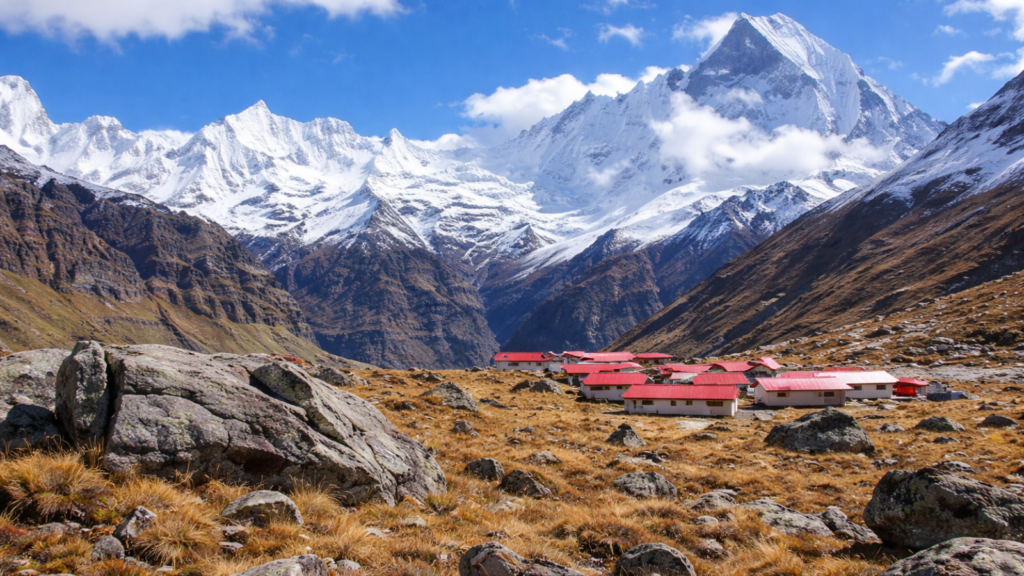
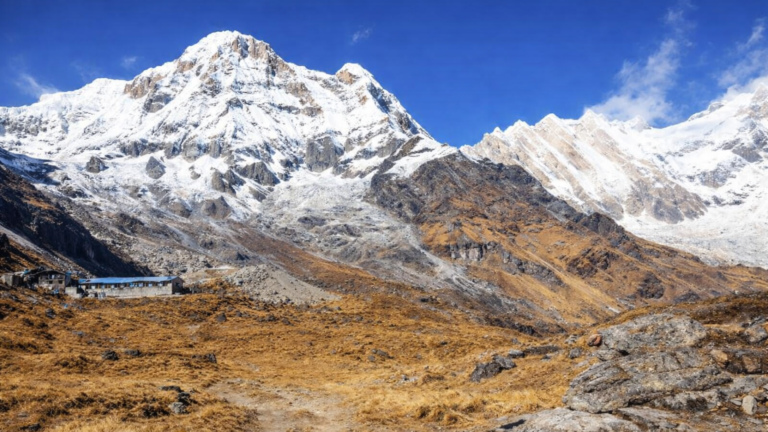
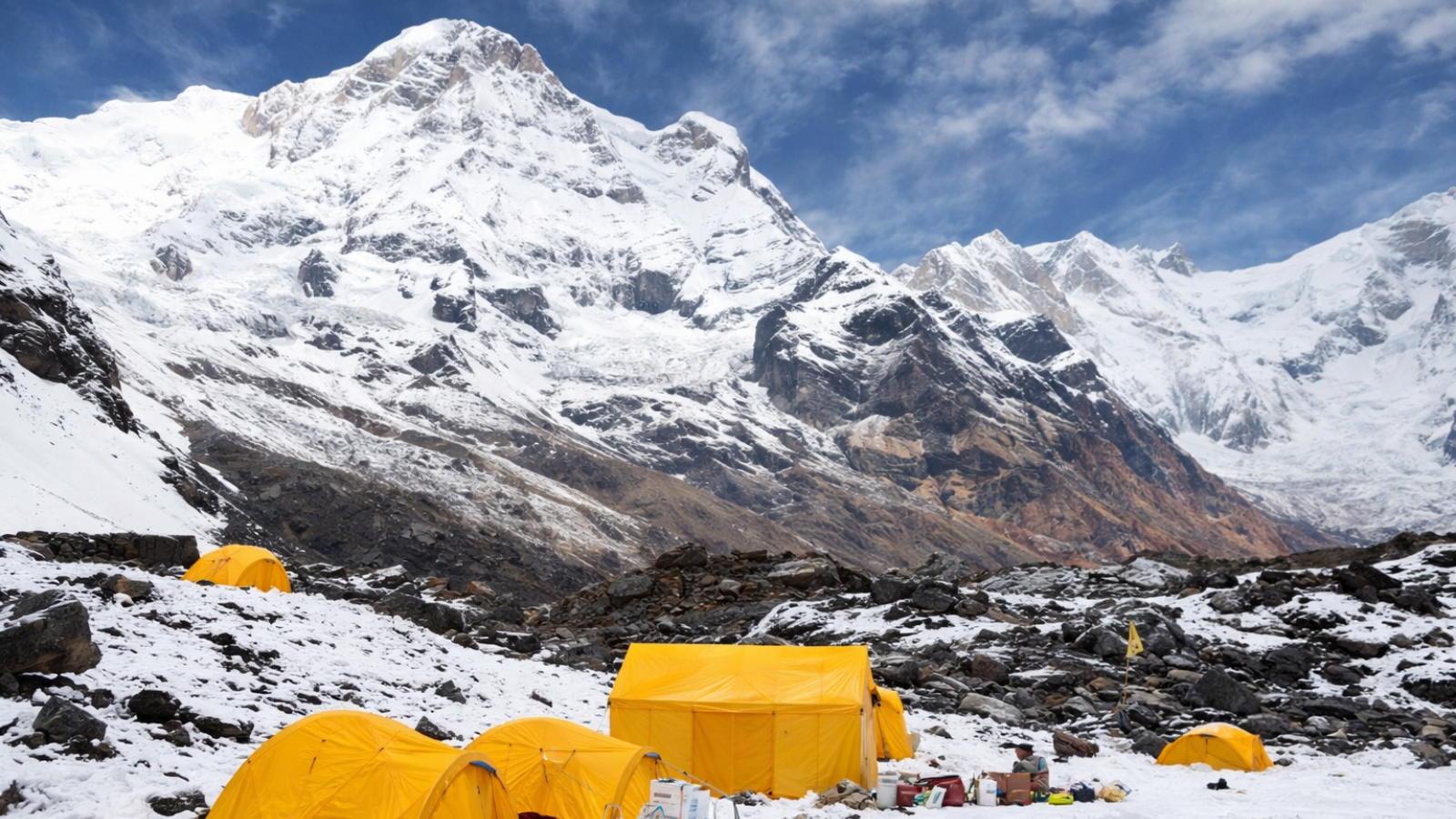
Annapurna Base Camp at 4,130 meters sits inside the Annapurna Sanctuary, a glacial amphitheater surrounded on three sides by peaks exceeding 6,000 meters. The views from ABC constitute one of the most complete high-altitude panoramas accessible without technical climbing skills anywhere in Nepal.
The Panoramic View from ABC at 4,130 Meters
From the ABC viewpoint, trekkers see 7 named peaks above 7,000 meters within a 270-degree arc. Annapurna I (8,091m) dominates the north, the 10th highest mountain on Earth and the first 8,000-meter peak ever summited (French expedition, 1950). Annapurna South (7,219m) rises directly to the west, its pyramid form creating one of the most photographed silhouettes in Himalayan trekking. Machapuchare (6,993m), the “Fishtail Mountain,” stands 8 kilometers to the southeast, sacred, unclimbed, and legally closed to climbing by the Nepalese government.
Sunrise at ABC between 6:00 AM and 6:30 AM illuminates the peaks in sequence: Hiunchuli (6,441m) catches the first light, followed by Annapurna South, then Annapurna I in a progression that takes approximately 12 minutes from first alpenglow to full illumination. Staying the night at ABC to witness sunrise is the defining experience most returning trekkers describe as the reason they came.
The Annapurna Sanctuary Glacier
ABC sits on the South Annapurna Glacier moraine, a deposit of rock and sediment left by glacial retreat over the past 60 years. The glacier itself is visible 400 meters above the base camp teahouses, and glaciologists have documented a retreat of 31 meters per year since 2000 in satellite studies of the Annapurna massif. The glacial landscape, blue-gray seracs, crevasse fields, and terminal moraine ridges, forms an active, changing environment that reminds trekkers of ABC’s position within a living glacial system.
What Are the Most Common Mistakes Trekkers Make on the 5-Day ABC Trek?
The 5 most frequent mistakes on the 5 day Annapurna Base Camp trek are ascending too fast on Day 4, underestimating afternoon weather changes, carrying excessive pack weight, failing to book teahouses in advance during peak season, and ignoring early AMS symptoms.
Ascending Too Fast Without Acclimatization
The compressed 5-day schedule leaves zero buffer time for acclimatization. Most altitude-related evacuations on the ABC route occur on Day 4 among trekkers who push from Deurali to ABC in a single push without a rest stop at MBC. Spending 30–45 minutes at MBC (3,700m) before continuing to ABC allows your body to begin partial acclimatization at that altitude before rising the final 430 meters.
Misjudging Afternoon Weather Windows
The Annapurna region generates convective cloud systems that build rapidly between 11:00 AM and 2:00 PM from spring through autumn. What begins as a clear morning at Chhomrong regularly transforms into limited visibility and rain by mid-afternoon above Deurali. The practical rule: start walking by 6:00 AM on Days 3 and 4 and reach your destination by 1:00 PM. Morning hours deliver the clearest views of the sanctuary and reduce exposure to afternoon precipitation.
Not Booking Teahouses in Advance
October’s peak season concentrates several hundred trekkers per day on the route. The teahouse at MBC holds approximately 40 guests, and the ABC teahouses together accommodate around 80 trekkers. Arriving without a reservation after 2:00 PM in October means sleeping on a mattress in a dining hall or being turned away entirely.
Book your teahouse sequence, particularly Dovan, Deurali, MBC, and ABC, through your guide or a Pokhara-based trekking agency at least 3 days before your departure date during October and November.
What Is the Cost Breakdown for the 5 Day Annapurna Base Camp Trek?
The total cost of the 5 day Annapurna Base Camp trek for a solo trekker with a guide ranges from USD 450 to USD 750, depending on accommodation standards, guide fees, and equipment rental. The breakdown covers 8 cost categories.
| Cost Item | Approximate Cost (USD) |
| ACAP Permit | USD 28 |
| TIMS Card | USD 8–15 |
| Licensed Guide (5 days) | USD 150–175 |
| Porter (optional, 5 days) | USD 75–100 |
| Teahouse accommodation (5 nights) | USD 5–15/night |
| Meals (3 meals/day × 5 days) | USD 8–15/meal |
| Water and snacks | USD 30–50 |
| Pokhara–Nayapul transport | USD 10–35 |
Guide fees include the guide’s food, accommodation, and insurance, all required by Nepal trekking regulations. Tipping guides and porters is customary: USD 10–15 per day for guides and USD 5–8 per day for porters at trek completion.
How Do You Plan the Complete 5-Day Annapurna Base Camp Itinerary?
The complete 5 day Annapurna Base Camp itinerary connects Nayapul to ABC and returns to Jhinu Danda hot springs in 5 sequential days, with each day’s walking time between 5 and 8 hours.
Day 1: Nayapul to Tikhedhunga (6 hours, 1,540m)
The trail begins at Birethanti (890m), ascending through Sudami and Hile villages to Tikhedhunga. The first 3 hours cross Modi Khola suspension bridges through subtropical vegetation, banana groves, terraced rice fields, and stone-flagged paths worn smooth by generations of local traffic. The final ascent to Tikhedhunga climbs 300 stone steps to reach the teahouse cluster at 1,540m. Accommodation here costs NPR 500–800 per person. This day is the easiest of the 5, use it to calibrate your pace and assess gear comfort.
Day 2: Tikhedhunga to Bamboo (7 hours, 2,310m)
Day 2 begins with a 3,000-step stone staircase ascent to Ulleri (1,960m), the steepest section of the entire trek by gradient, rising 400 meters in under 2 kilometers. Above Ulleri, the forest transitions from subtropical broadleaf to rhododendron, in spring, the trail passes through tunnels of red and pink bloom for approximately 4 continuous kilometers. Ghorepani (2,860m) is the natural lunch stop, after which the trail descends steeply to Bamboo at 2,310m. This descent is hard on knees, use trekking poles and take the descent slowly.
Day 3: Bamboo to Deurali (6 hours, 3,230m)
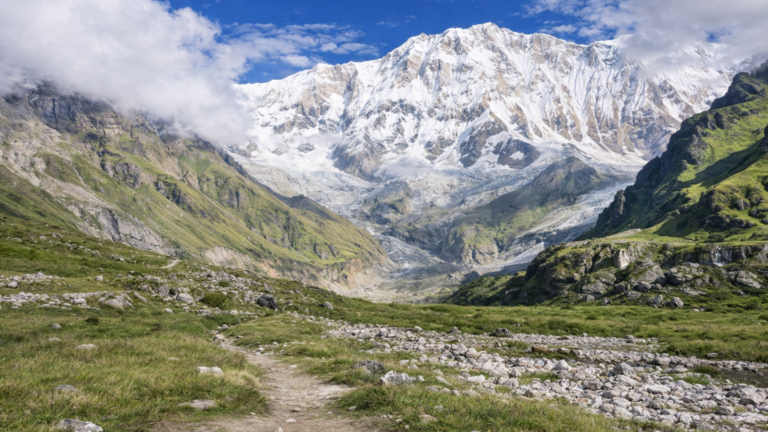
Day 3 ascends continuously through Dobato, Himalaya, and Dovan to Deurali. The forest thickens above 2,500m into bamboo groves and cloud forest draped in moss, the atmosphere changes completely from the open ridge walking of Day 2. Himalaya village (2,920m) makes an ideal morning rest stop. Above Dovan (2,600m), the valley narrows dramatically and the trail follows the Modi Khola river through increasingly glacial terrain. Deurali at 3,230m marks the entry into the Annapurna Sanctuary proper, the enclosing peaks become visible for the first time here.
Day 4: Deurali to Annapurna Base Camp (6 hours, 4,130m)
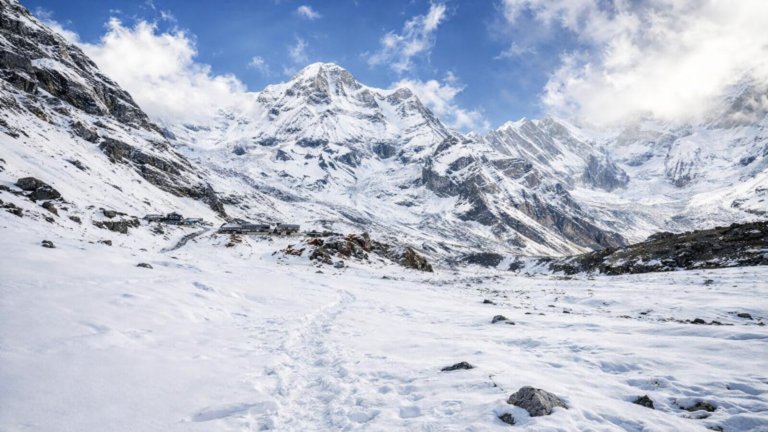
This is the summit day of the trek. Depart Deurali by 6:00 AM in clear conditions. The trail crosses glacial moraine terrain from Deurali through MBC (3,700m) to ABC (4,130m) over 5–6 hours. The landscape above Deurali is defined by boulder fields, snow patches (October–March), and increasingly vast views of the surrounding walls of Annapurna South, Hiunchuli, and Gangapurna (7,455m). Arrive at ABC by 12:00–1:00 PM for afternoon views in clear weather before cloud typically moves in. Spend the afternoon exploring the glacier edge and acclimatizing. Sunrise the next morning, or the following morning if staying 2 nights, justifies every step of the ascent.
Day 5: ABC to Jhinu Danda (7 hours, 1,780m)
The descent retraces Day 3 and Day 4 terrain in a single long day from ABC to Jhinu Danda. Strong trekkers complete this in 6–7 hours; a comfortable pace brings most trekkers in by late afternoon. Jhinu Danda (1,780m) is a riverside teahouse village famous for its natural hot spring pool on the Modi Khola riverbank, accessible via a 20-minute descent from the main village. Soaking in 40°C mineral water after 4 days of high-altitude trekking is a deeply therapeutic conclusion to the journey. A bus or jeep from Jhinu to Pokhara takes 2.5–3 hours.
Is the 5 Day Annapurna Base Camp Trek Right for You?
The 5 day Annapurna Base Camp trek is right for you if you are physically fit, have trekked above 3,000m before, have 6–7 days available in Nepal including travel to Pokhara, and want to experience the Annapurna Sanctuary without spending 10+ days on trail. It demands a higher fitness baseline and a tighter schedule than the extended 7-day version but delivers the same destination, the glacial amphitheater at 4,130m, framed by 8 peaks above 6,000 meters.
The trek is not recommended for trekkers with no previous high-altitude experience, those with cardiovascular or respiratory conditions, or those traveling during the June–August monsoon season without full mountain weather gear.
If this is your first Himalayan trek, consider the 7-day itinerary with an acclimatization stop at Ghorepani (2,860m) before ascending to the sanctuary. The extra 2 days increase summit success probability and reduce AMS risk significantly, making the experience safer, more comfortable, and ultimately more memorable.
Plan your Annapurna Base Camp trek with enough time to acquire permits in Pokhara, hire a licensed guide, and begin trekking with properly broken-in boots, a -10°C sleeping bag, and a clear understanding of AMS warning signs. Those preparations, not trail difficulty, determine whether your 5 days in the Annapurna Sanctuary become the journey you describe for the rest of your life.
How difficult is the 5 day Annapurna Base Camp trek for beginners?
The 5 day Annapurna Base Camp trek is rated moderately strenuous and is not recommended for first-time high-altitude trekkers. Daily walking covers 11–18 kilometers with elevation gains of up to 900 meters on Day 3 and Day 4. Beginners with no experience above 2,500 meters face a significantly higher risk of Acute Mountain Sickness, particularly above Deurali at 3,230 meters.
What is the best time of year for the 5 day Annapurna Base Camp trek?
The 2 best seasons for the 5 day Annapurna Base Camp trek are spring (March–May) and autumn (October–November). Spring delivers rhododendron blooms and stable temperatures, while autumn offers the clearest post-monsoon skies and the sharpest panoramic views from ABC at 4,130 meters. Monsoon season (June–August) is strongly discouraged due to landslides, leeches, and near-daily trail flooding in the Modi Khola valley.
How much does the 5 day Annapurna Base Camp trek cost in total?
The total cost of the 5 day Annapurna Base Camp trek ranges from USD 450 to USD 750 per person when trekking with a licensed guide. This figure covers the ACAP permit (USD 28), TIMS card (USD 8–15), guide fees (USD 150–175), teahouse accommodation, and daily meals. Optional porter hire adds USD 75–100, and tipping guides and porters at trek completion is standard practice.
Do you need a guide for the 5 day Annapurna Base Camp trek?
Yes, a licensed guide is legally required for all foreign trekkers in the Annapurna Conservation Area under Nepal’s April 2023 trekking regulation. Solo trekking without a registered guide is officially prohibited, and permits are cross-checked at multiple trail checkpoints. A licensed guide costs USD 25–35 per day and is verifiable by their Nepal Government Department of Tourism license card.
What permits are required for the Annapurna Base Camp trek?
The 5 day Annapurna Base Camp trek requires two permits: the Annapurna Conservation Area Permit (ACAP) and the Trekkers’ Information Management System (TIMS) card. ACAP Permit: NPR 3,000 for foreign nationals and TIMS Card: NPR 1,000–2,000 depending on whether you trek with a guide or independently.
What sleeping bag rating do you need for the 5 day ABC trek?
A sleeping bag with a comfort rating of -10°C is the minimum requirement for the 5 day Annapurna Base Camp trek in spring and autumn. Nighttime temperatures at ABC (4,130m) regularly drop to -8°C to -12°C in October and November, making a warmer-rated bag a practical necessity rather than an overcaution. Adding a sleeping bag liner provides an extra 5–8°C of warmth and serves as a hygiene layer in shared teahouse dormitories.
How do you prevent altitude sickness on the 5 day Annapurna Base Camp trek?
The 3 most effective measures for preventing altitude sickness on the ABC trek are ascending gradually, staying well hydrated, and recognizing early AMS symptoms. Drink 3–4 liters of water daily above 3,000 meters and spend 30–45 minutes resting at Machapuchare Base Camp (3,700m) before continuing to ABC on Day 4. Consult your physician about carrying Diamox (Acetazolamide) 125mg tablets before departure, particularly if you have a history of altitude sensitivity above 3,000 meters.
Where does the 5 day Annapurna Base Camp trek start and finish?
The 5 day Annapurna Base Camp trek starts at Nayapul (1,070m), located 42 kilometers west of Pokhara, and finishes at Jhinu Danda (1,780m) after the descent from ABC. Trekkers reach Nayapul by local bus (NPR 200–250, 2 hours) or private jeep from Pokhara (NPR 3,000–4,000, 1 hour). The formal Conservation Area entry checkpoint is at Birethanti, a 20-minute walk from Nayapul, and is the last point with ATM access before the trail begins.
What food and accommodation is available along the 5 day ABC trek route?
Teahouse lodges line the entire 5-day route, providing private or dormitory rooms with blankets, shared bathrooms, and dining facilities at every overnight stop. Meals cost NPR 500–900 per dish above 3,000 meters and include dal bhat, pasta, noodle soups, porridge, eggs, and hot drinks. Accommodation costs NPR 500–1,500 per night depending on altitude, and teahouses at MBC and ABC command higher prices due to the logistical cost of supplying goods at elevation.
What is the highest point reached on the 5 day Annapurna Base Camp trek?
The highest point on the 5 day Annapurna Base Camp trek is Annapurna Base Camp at 4,130 meters, reached on Day 4 of the itinerary. From this elevation, trekkers see a 270-degree panorama that includes Annapurna I (8,091m), Annapurna South (7,219m), Machapuchare (6,993m), and Hiunchuli (6,441m) within a single viewpoint. Sunrise at ABC between 6:00 AM and 6:30 AM illuminates the surrounding peaks in sequence over approximately 12 minutes and is consistently rated the defining experience of the entire trek.