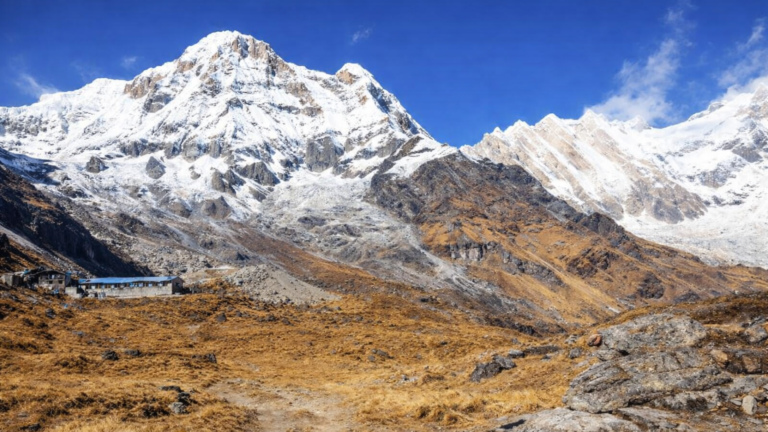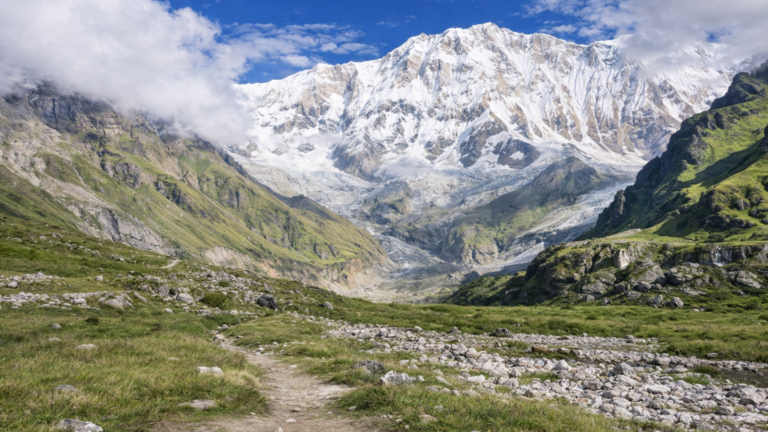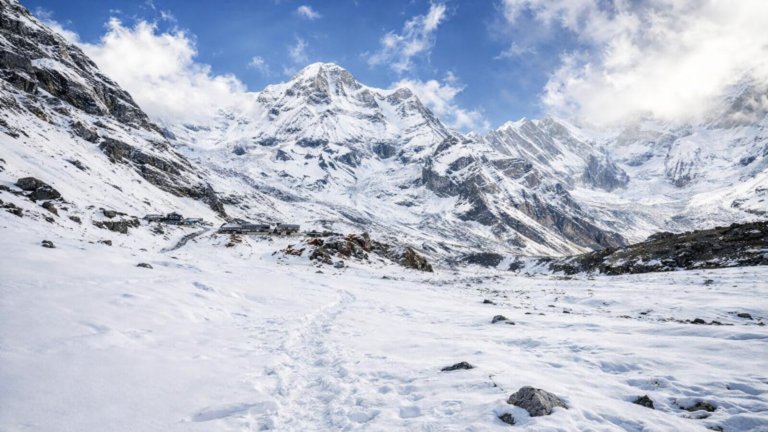
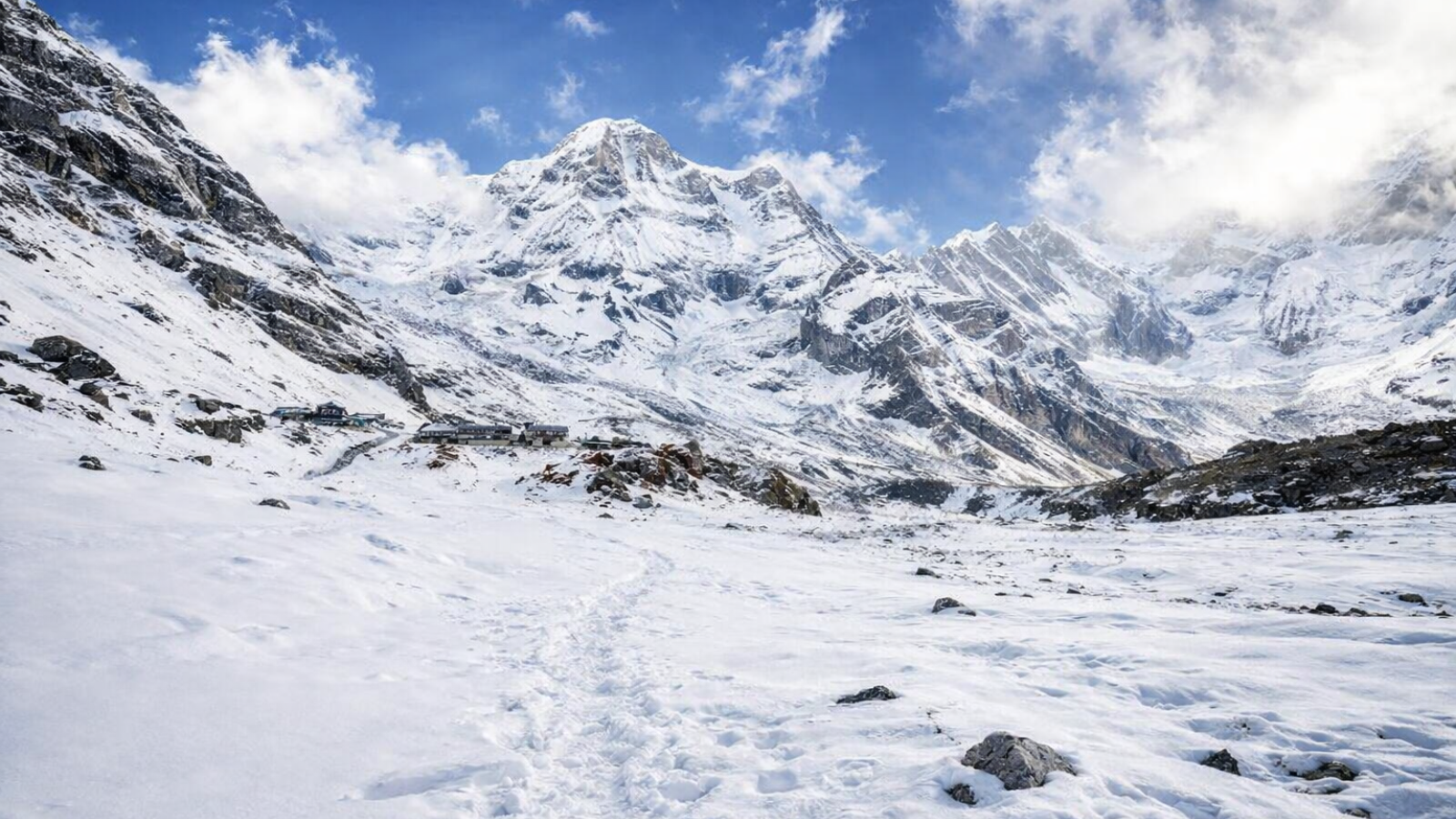

The 4 Day Annapurna Base Camp Trek is an accelerated high-altitude Himalayan trekking itinerary that reaches Annapurna Base Camp (4,130 m) inside the Annapurna Sanctuary in just four days. This compressed route covers 55–65 kilometres with a net ascent of roughly 1,600 metres, beginning from Jhinu Danda after a jeep transfer from Pokhara. Unlike the traditional 7–10 day itinerary, this fast-paced version eliminates buffer days while maintaining a safe altitude gradient through Chhomrong, Deurali (3,230 m), and Machhapuchhre Base Camp (3,700 m). High-intensity Annapurna Base Camp trekking for time-limited travellers, this format prioritises efficiency without sacrificing the full amphitheatre panorama of Annapurna I (8,091 m) and the surrounding 6,000–8,000 metre peaks.
Designed for experienced and physically conditioned hikers, the 4-day Annapurna Base Camp trek with sustained 6–10 hour walking days delivers the same summit objective as longer routes at lower cost and higher intensity. Standard itineraries distribute elevation gain over 7–10 days for acclimatisation; the 4-day structure instead relies on early departures, strategic overnight stops at 3,230 metres, and a climb-high-sleep-low descent from 4,130 metres back to 2,310 metres on Day 3. Efficient Himalayan base camp trekking with controlled altitude exposure, this route suits trekkers who have previously hiked above 3,000 metres and want a direct, performance-driven approach to one of Nepal’s most visited mountain sanctuaries.
Is a 4 Day Annapurna Base Camp Trek Actually Possible?
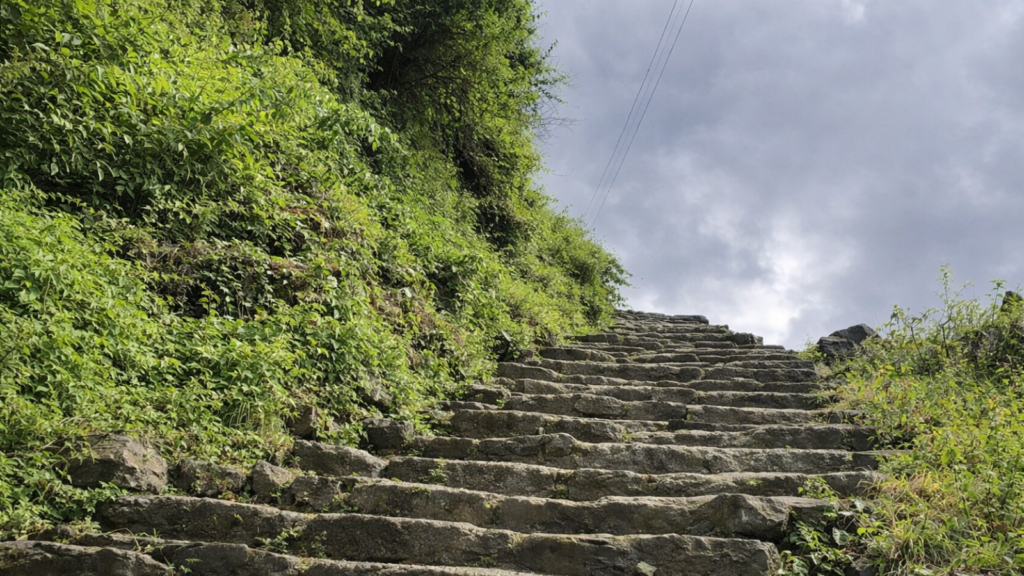
A 4 day Annapurna Base Camp trek is possible for fit trekkers who begin from Jhinu Danda or Nayapul after an early morning jeep transfer from Pokhara. The route covers approximately 55–65 kilometres with a net ascent of around 1,600 metres, averaging 6–8 hours of walking per day. Most standard itineraries spread this across 7–10 days to allow rest, acclimatisation, and sightseeing. The 4-day version achieves the same destination through earlier starts, longer daily distances, and a carefully chosen approach route.
The standard 7-day trek from Nayapul uses the classic Pothana–Ghandruk–Chhomrong corridor. The 4-day version bypasses Ghandruk and instead uses the Jhinu Danda trailhead, cutting one to two days from the approach without sacrificing the critical acclimatisation gradient. The altitude gain remains manageable: you pass through Chhomrong (2,170 m), Bamboo (2,310 m), Himalaya (2,920 m), Dovan (2,600 m), and Machhapuchhre Base Camp (3,700 m) before reaching Annapurna Base Camp (4,130 m).
The key distinction is that this itinerary is not suitable for beginners or those with no prior trekking experience at altitude. Trekkers who have previously hiked above 3,000 metres, maintain regular cardiovascular fitness, and can sustain 6–8 hour walking days will find the 4-day timeline achievable and deeply rewarding.
Why Choose the 4 Day trek Over Longer Itineraries?
The 4 day Annapurna Base Camp trek serves 3 specific groups of trekkers: those with strict time constraints (10 days or fewer for Nepal travel), experienced trekkers returning to the region who want an efficient objective, and physically conditioned hikers who find longer itineraries unnecessarily slow-paced.
What the 4-day version delivers that longer itineraries sometimes dilute: intensity. Each day has a clear purpose and a meaningful elevation gain. There is no rest day spent in a village waiting out weather. The pace forces trekkers to stay present, every kilometre walked is a kilometre earned. The views at Annapurna Base Camp, surrounded on all sides by Annapurna I (8,091 m), Annapurna South (7,219 m), Machhapuchhre (6,993 m), and Hiunchuli (6,441 m), feel all the more earned after 4 focused days of effort.
From a cost perspective, the shorter duration also reduces total expenditure. A 4-day guided trek costs approximately $300–$600 USD depending on guide and porter fees, versus $600–$1,200 for the standard 7–12 day version. Teahouse accommodation averages NPR 800–1,200 per night at lower altitudes and NPR 1,000–1,500 near Annapurna Base Camp during peak season.
4 Day Annapurna Base Camp Trek: Day-by-Day Itinerary
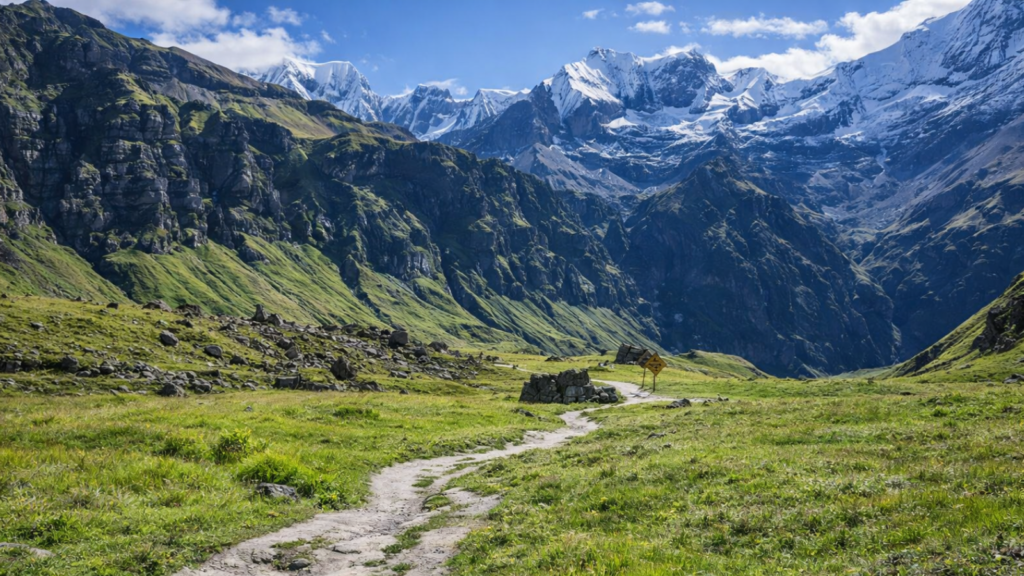
The itinerary below uses Jhinu Danda as the entry trailhead, reached by a 1–1.5 hour jeep drive from Pokhara. This approach eliminates the first day’s walk from Nayapul to Tikhedhunga and shaves one full trekking day from the standard route without compromising altitude safety.
Day 1: Jhinu Danda (1,760 m) → Chhomrong (2,170 m) → Bamboo (2,310 m)
Distance: 14–16 km | Walking time: 5–6 hours | Altitude gain: ~550 m
The first day begins at Jhinu Danda, a small settlement famous for its natural hot springs. After a pre-dawn breakfast in Pokhara and a jeep transfer arriving by 7:30 AM, the trail begins immediately. The first 2 hours climb steeply through Modi Khola valley to Chhomrong village at 2,170 metres, a Gurung community of stone-paved lanes, Buddhist prayer flags, and panoramic views of Machhapuchhre.
Chhomrong is the last permanent village before the Annapurna Sanctuary. Dal bhat (NPR 700–1,000 at lower elevations and NPR 1,000–1,400 above Deurali), the high-calorie staple that fuels Himalayan trekking. After a 45-minute lunch break, continue descending to Chhomrong Khola and climb again to Sinuwa, then proceed through forest to Bamboo at 2,310 metres. Overnight at Bamboo.
What most guides miss about Day 1: The altitude gain to Chhomrong feels sharp because it comes after a vehicle ride from Pokhara at 822 metres. The body has not had time to walk at moderate altitude before the steeper gradient. Drinking 3–4 litres of water throughout Day 1 and maintaining an even pace on the Chhomrong climb reduces Day 1 fatigue significantly.
Day 2: Bamboo (2,310 m) → Deurali (3,230 m)
Distance: 10–12 km | Walking time: 5–6 hours | Altitude gain: ~920 m
Day 2 enters the Annapurna Sanctuary proper. The trail passes through Sinuwa (2,340 m), Himalaya (2,920 m), and Dovan (2,600 m) before a steep climb to Deurali at 3,230 metres. This section traverses dense bamboo and rhododendron forest, some of the most ecologically diverse terrain on any Himalayan trek. The Annapurna Conservation Area contains over 500 bird species and supports populations of snow leopard, Himalayan tahr, and musk deer.
The gorge narrows above Himalaya village and the trail becomes more challenging underfoot, crossing boulder fields and small streams. Cloud regularly fills the gorge from midday, so early starts (5:30–6:00 AM are critical on Day 2) to reach Deurali before afternoon mist obscures mountain views.
Altitude alert: At 3,230 metres, Deurali is the first point where AMS (Acute Mountain Sickness) becomes a genuine risk. Common early symptoms include headache, nausea, and mild dizziness, reported by approximately 25–40% of trekkers reaching this altitude without prior acclimatisation. Drink water, avoid alcohol, eat a light meal, and monitor symptoms before sleep.
Day 3: Deurali (3,230 m) → Annapurna Base Camp (4,130 m) → Bamboo (2,310 m)
Distance: 18–20 km | Walking time: 8–10 hours | Altitude gain to summit: 900 m, then 1,820 m descent
Day 3 is the most demanding day of the 4 day Annapurna Base Camp trek and one of the most spectacular days in Himalayan trekking. Depart Deurali at 5:00–5:30 AM to catch sunrise at or near Machhapuchhre Base Camp (MBC) at 3,700 metres. The walk from Deurali to MBC takes approximately 90 minutes on a clear trail above the treeline. At MBC, the full amphitheatre of the Annapurna Sanctuary opens for the first time: a 360-degree wall of 6,000–8,000 metre peaks.
From MBC, continue another 2 hours to Annapurna Base Camp (ABC) at 4,130 metres. The trail follows the lateral moraine of the South Annapurna Glacier, a feature that does not appear on most standard trail maps but defines the walking surface above 3,900 metres. Sunrise at ABC, when alpenglow turns the south face of Annapurna I from grey granite to deep rose, is the defining moment of the trek.
After a minimum 1-hour stay at ABC, begin the long descent back through MBC, Deurali, Himalaya, and Dovan to Bamboo. This 1,820-metre descent takes 5–6 hours on tired legs. Trekking poles are essential on this section. Overnight at Bamboo.
Common mistake on Day 3: Rushing the descent to complete more distance. Eat a full meal at ABC before descending and stop at Himalaya for a secondary meal. Hyponatremia (low sodium from excessive plain water intake without food) is as common a risk on descent days as dehydration.
Day 4: Bamboo (2,310 m) → Jhinu Danda (1,760 m) → Pokhara
Distance: 10–12 km | Walking time: 3–4 hours | Altitude loss: ~550 m
The final day descends back through Chhomrong to Jhinu Danda. The 3–4 hour walk finishes at the Jhinu hot springs, where trekkers traditionally soak aching legs before the jeep returns to Pokhara. The hot springs at 1,760 metres are maintained by the local community (entry fee: NPR 200–400). Pokhara arrival by early-to-mid afternoon makes Day 4 also a full rest and celebration day, lakeside restaurants, massage, and direct views of Machhapuchhre from the city streets give you a final reminder of how close you stood to that summit just 24 hours earlier.
What Permits Do You Need for the Annapurna Base Camp Trek?
The 4 day Annapurna Base Camp trek requires two permits: the Annapurna Conservation Area Permit (ACAP) and a Trekkers’ Information Management System (TIMS) card. Both permits help regulate trekking activities and fund conservation and safety systems in the Annapurna region. It can be obtained at the Nepal Tourism Board office in Pokhara or Kathmandu and take approximately 30–60 minutes to process.
| Permit | Cost (Foreign Trekkers) | Cost (SAARC) | Validity | Where to Get |
| ACAP (Annapurna Conservation Area Permit) | NPR 3,000 (~$23) | NPR 1,000 | Per Entry | Nepal Tourism Board office in Kathmandu or Pokhara |
| TIMS Card (Trekkers’ Information Management System) | NPR 2,000 (~$15) | NPR 1,000 | Per Trek | Nepal Tourism Board or registered trekking agencies |
Required documents: passport copy, two passport-size photographs, trekking itinerary details, and payment in Nepalese rupees. If you arrange your trek through a licensed trekking agency, the agency typically handles the TIMS registration.
The ACAP permit specifically funds the Annapurna Conservation Area Project, which manages the 7,629 square kilometre protected area across 5 districts: Kaski, Lamjung, Manang, Myagdi, and Mustang. These funds support trail maintenance, wildlife conservation, and the 87 village wards within the conservation zone.
When Is the Best Time for the 4 Day Annapurna Base Camp Trek?
The 2 optimal windows are spring (March–May) and autumn (September–November). These 6 months account for approximately 75–80% of all annual trekker arrivals in the Annapurna Conservation Area.
| Season | Trail Conditions | Avg Temp at ABC | Recommendation |
| March–May | Excellent, rhododendrons in bloom | -2°C to 8°C | Highly Recommended |
| June–August | Monsoon, wet, landslide risk | 5°C to 12°C | Not Recommended |
| Sept–November | Best visibility, post-monsoon clarity | -5°C to 5°C | Highly Recommended |
| December–February | Cold, snow risk above 3,000 m | -15°C to -5°C | Experienced Only |
Spring offers rhododendron forests in full bloom at 1,600–3,000 m, a significant visual element of the lower trail sections. April is the peak spring month; ACAP recorded 44,763 arrivals in April 2025 alone, the busiest single month in the region’s history.
Autumn delivers the sharpest, most consistent visibility of the year. Post-monsoon skies in October clear rapidly after rain, and mountain views from MBC and ABC are often photograph-perfect.
Altitude Sickness on the 4 Day Trek: What You Need to Know
Acute Mountain Sickness (AMS) is the primary safety concern, and the 4-day version compresses the altitude gain faster than standard itineraries. The 3 core symptoms of AMS are headache (the most universal indicator), nausea or vomiting, and dizziness or loss of balance. These can appear from 3,200 metres upward, corresponding to the Deurali overnight on Day 2.
The critical rule of Himalayan trekking: never ascend with AMS symptoms. Descent of even 300–500 metres typically resolves early-stage AMS within 2–4 hours.
Practical prevention on the 4-day route:
- Drink 3–4 litres of water daily starting from Day 1 in Pokhara
- Avoid alcohol for the first 3 days of the trek
- Sleep below your highest point of the day (the ‘climb high, sleep low’ rule applies naturally to this itinerary)
- Carry Diamox (Acetazolamide) 125–250 mg twice daily if prescribed by a physician, starting 24 hours before reaching 3,000 m
- Never ascend from Deurali to ABC if you have a persistent headache that does not resolve with 2 Ibuprofen, 1 litre of water, and 1 hour of rest
The 4-day itinerary is designed so that Day 3’s ascent to 4,130 m is followed by descent back to 2,310 m the same evening, which naturally applies the climb-high-sleep-low principle at its most effective altitude range. This structural decision is what makes the 4-day trek safe despite its pace.
Essential Gear Packing List for the 4 Day Trek
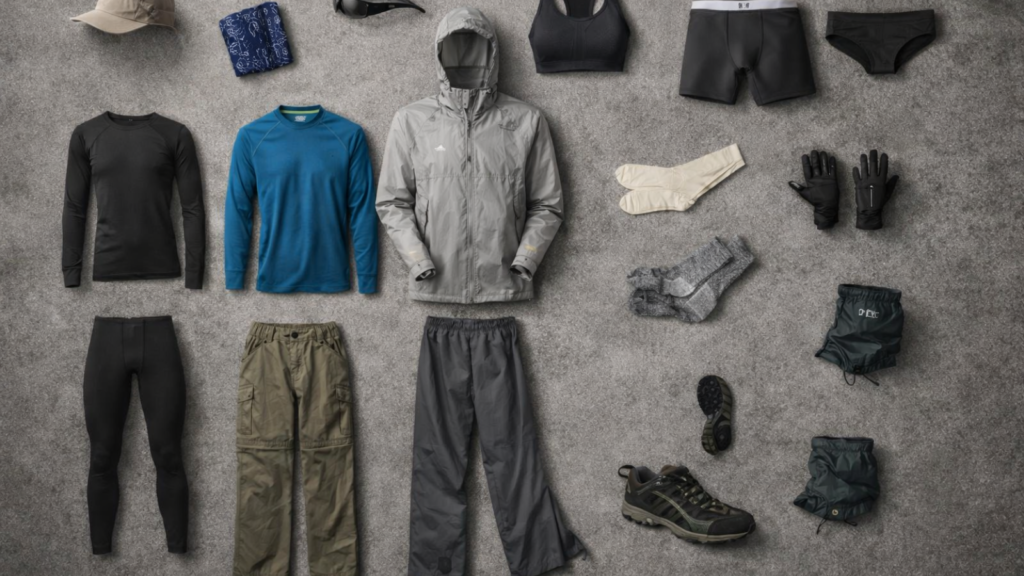
Total pack weight with porter service should not exceed 8–10 kg in your day bag. Most trekkers hire a porter for their main bag (NPR 1,500–2,000 per day) and walk with a 3–4 kg daypack.
Clothing: 6 Essential Items
- Moisture-wicking base layer (2 sets): Merino wool or synthetic, NOT cotton
- Insulating mid-layer: 200-weight fleece or lightweight down jacket
- Waterproof outer shell: Hardshell jacket, NOT a softshell above 3,000 m
- Trekking trousers: Convertible zip-off trousers for temperature regulation
- Warm hat and gloves: Essential above 3,500 m even in spring and autumn
- Gaiters: Optional but valuable above Deurali when wet snow is on the trail
Equipment: 5 Non-Negotiable Items
- Trekking poles: Both poles, not one. The 1,820 m descent on Day 3 is gruelling on knees without support
- Headlamp with spare batteries: 5:00 AM starts require 60–90 minutes of headlamp trail walking
- Sleeping bag rated to -10°C minimum: Teahouse blankets alone are insufficient above 3,500 m
- Water purification: Iodine tablets or a Steripen UV purifier. Do not rely solely on bottled water above Chhomrong
- Sun protection: SPF 50+ sunscreen and UV-blocking sunglasses. UV radiation at 4,130 m is approximately 40% more intense than at sea level
Medical Kit: 4 Core Items
- Ibuprofen 400 mg: Primary treatment for altitude headache, do not use to mask AMS symptoms and continue ascending
- Oral Rehydration Salts (ORS): Critical for Day 3 when 1,820 m of descent follows 900 m of ascent
- Blister care: Moleskin, Compeed blister pads, and adhesive bandages
- Altitude medication: Consult a travel medicine physician about Diamox before travelling to Nepal
Do You Need a Guide and Porter for the 4 Day Trek?
For the 4-day version, hiring a licensed guide is strongly recommended. On a 7–10 day trek, solo trekkers have more margin for route-finding questions and acclimatisation decisions. On the 4-day version, where every day has a demanding agenda and no built-in buffer days, a guide provides 3 critical functions: real-time altitude health monitoring, route optimisation based on current trail conditions, and logistical support with teahouse reservations during peak season.
| Service | Daily Rate (NPR) | Daily Rate (USD) | 4-Day Total (USD) |
| Licensed Guide | NPR 3,000–5,000 | $22–$38 | ~$88–$152 |
| Porter | NPR 1,500–2,000 | $11–$15 | ~$44–$60 |
| Guide-Porter (combined) | NPR 2,500–4,000 | $18–$30 | ~$72–$120 |
What most trekking blogs overlook: During peak spring and autumn seasons, popular teahouses at Bamboo, Himalaya, and Deurali fill up by early afternoon. A guide who phones ahead secures beds at the best-located guesthouses. Without this, independent trekkers arriving after 3:00 PM on busy days have found themselves without accommodation at Deurali, a situation with no good resolution at 3,230 metres after dark.
Trail Profile: Full Altitude and Distance Breakdown
| Checkpoint | Altitude (m) | Day | Distance from Prev (km) | Key Feature |
| Jhinu Danda | 1,760 | Day 1 Start | –- | Hot springs, jeep trailhead |
| Chhomrong | 2,170 | Day 1 | 4 | Last major Gurung village |
| Sinuwa | 2,340 | Day 1 | 3 | Forest entry point |
| Bamboo | 2,310 | Day 1 End | 2 | Overnight |
| Himalaya | 2,920 | Day 2 | 4 | Mountain views begin |
| Deurali | 3,230 | Day 2 End | 3 | AMS threshold, Overnight |
| Machhapuchhre BC | 3,700 | Day 3 | 5 | Sunrise views, sanctuary entry |
| Annapurna Base Camp | 4,130 | Day 3 Summit | 4 | Central objective |
| Bamboo (descent) | 2,310 | Day 3 End | 13 | Overnight |
| Jhinu Danda | 1,760 | Day 4 End | 9 | Hot springs, jeep return |
What Does Annapurna Base Camp Actually Look Like?
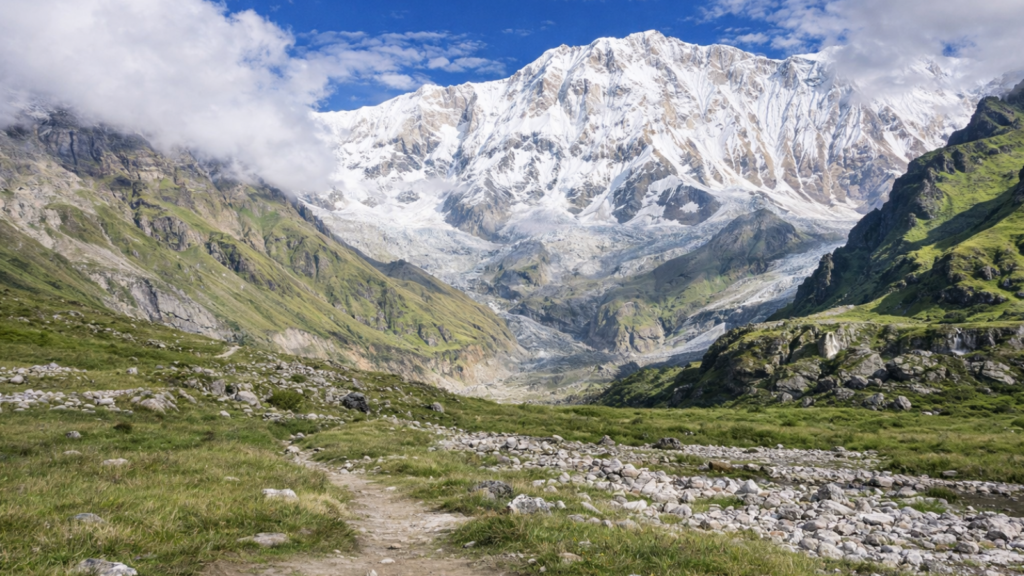
Annapurna Base Camp at 4,130 metres is not the wild, isolated wilderness that many first-time visitors imagine. During peak season, the base camp area hosts 15–25 operational teahouses and on busy October days, several hundred trekkers. The commercial development is concentrated, however, and the mountaineering setting remains overwhelming.
The 3 peaks that dominate the ABC panorama:
- Annapurna I (8,091 m): The 10th highest mountain in the world and one of the most technically dangerous to climb, its south face rises 3,961 metres directly from the sanctuary floor
- Annapurna South (7,219 m): Its south ridge frames the left side of the base camp panorama
- Machhapuchhre (6,993 m): The sacred ‘fishtail’ peak that remains officially restricted for climbing, Nepal government prohibits all ascent attempts
Temperature at ABC ranges from -2°C during spring days to -15°C on clear autumn nights. Food at base camp teahouses costs approximately NPR 600–1,200 per meal. The cost reflects the logistical challenge of supplying guesthouses at 4,130 metres, where all goods arrive by porter carry.
How to Train for the 4 Day Trek: 8-Week Preparation Plan
The 4-day version requires more targeted conditioning than the standard 7-day itinerary because rest days are eliminated. An 8-week programme with 4 progressive training phases achieves the required fitness base.
- Weeks 1–2: Base aerobic fitness: 4 runs or hikes per week, 45–60 minutes each at 65–70% maximum heart rate. Build the aerobic engine that will sustain 6–8 hours of continuous effort
- Weeks 3–4: Consecutive day training: Saturday–Sunday back-to-back 3–4 hour hikes with 800–1,000 m of elevation gain. The most specific preparation for Days 2 and 3 of the trek
- Weeks 5–6: Load-bearing training: Carry a 10 kg pack on all weekend hikes. Trains the postural muscles used on long descents
- Weeks 7–8: Taper and test: Reduce volume by 30% in Week 7. Complete one final long back-to-back day in Week 8, then rest 10–12 days before the trek
The 3 most neglected aspects of preparation: descending training (most hikers only practise ascending, but the Day 3 descent from 4,130 m to 2,310 m is where knees fail), core and hip flexor strength (prevents the lateral knee pain that ends treks early), and heat-to-cold acclimatisation (arriving in Pokhara at 822 m feeling strong is different from sustaining that strength at 3,230 m on Day 2).
Teahouse Accommodation: What to Expect
All 3 overnight points use teahouse accommodation, basic guesthouses that provide a bed, blankets, and meals within a single building.
Bamboo (Days 1 & 3): 6–8 teahouses with shared facilities. Room cost is typically free or NPR 200–400 when meals are purchased from the same establishment. Wi-Fi is intermittent; device charging via solar panel costs NPR 200–400.
Deurali (Day 2): 4–5 teahouses at the Sanctuary entry. Facilities are more basic and prices slightly higher. Rooms average NPR 300–500. This is the last point with reliable mobile network signal before ABC.
What most trekking blogs do not address: Flush toilets are not universally available above Himalaya village. Pit toilets are standard at Deurali, and on a busy peak-season morning the queue for 3 communal facilities can take 20–30 minutes. Factor this into departure timing on Day 3, when a 5:00 AM departure is already required.
Trekking Responsibly in the Annapurna Conservation Area
The Annapurna Conservation Area covers 7,629 square kilometres and is a UNESCO Biosphere Reserve managed by ACAP. The record visitor numbers of 2024–2025 create both economic opportunity and environmental pressure. 3 specific practices that protect the trail:
- Waste management: All non-biodegradable waste must be carried out from above Chhomrong. Plastic water bottle purchases above Chhomrong are prohibited, bring a reusable bottle with purification
- Firewood prohibition: Cooking and heating with firewood is banned above 3,000 metres throughout the ACA. All teahouses use kerosene or LPG. Do not request wood fire heating regardless of temperature
- Cultural respect: The Annapurna Sanctuary is sacred to the local Gurung community. Machhapuchhre is officially restricted from climbing due to its sacred status. Dress modestly in village areas and always ask permission before photographing people or religious structures
Is the 4 Day Annapurna Base Camp Trek Right for You?
The 4 day Annapurna Base Camp trek is one of the most efficient and rewarding mountain experiences available anywhere in the world. For physically fit trekkers with limited time, it delivers the full visual and emotional impact of the Annapurna Sanctuary within a format that fits a 10–12 day Nepal itinerary with days to spare.
The 244,045 trekkers who visited the Annapurna region in 2024, and the 246,575 who arrived by October 2025, are testament to the enduring power of this landscape. The trek consistently ranks among the world’s top trekking routes because it delivers an experience larger than its difficulty: accessible enough for non-technical trekkers, spectacular enough to justify the effort of travelling to Nepal, and meaningful enough to remain in your memory long after the soreness fades.
Plan the 4 days carefully. Prepare the body thoroughly. Hire a licensed guide. Arrive with the right gear and the right attitude toward altitude. The Annapurna Sanctuary will deliver everything you came for.
Is a 4 Day Annapurna Base Camp Trek Possible for Beginners?
The 4 day Annapurna Base Camp trek is not recommended for absolute beginners with no prior hiking experience. It requires 6–8 hours of uphill and downhill walking on consecutive days, with overnight stays up to 3,230 metres. Trekkers who have hiked above 2,500 metres and maintain regular cardiovascular fitness are suitable for this itinerary.
What Permits Do You Need for the Annapurna Base Camp Trek?
Two mandatory permit required: the Annapurna Conservation Area Permit (ACAP) and TIMS. Permit is issued at the Nepal Tourism Board in Pokhara or Kathmandu and require 2 passport photos and a passport copy.
What Is the Best Time of Year for the 4 Day Annapurna Base Camp Trek?
The best time for the 4 day Annapurna Base Camp trek is spring (March–May) and autumn (September–November). These two seasons account for 75–80% of annual trekker arrivals in the Annapurna region. April and October are peak months, with 44,763 arrivals recorded in April 2025.
How Difficult Is the 4 Day Annapurna Base Camp Trek Compared to the Standard Route?
The 4-day Annapurna Base Camp trek is moderate-to-strenuous and more demanding than the standard 7–10 day route. It covers the same elevation but removes rest days. Daily walking increases to 6–10 hours, with a 900-metre ascent to 4,130 metres and a 1,820-metre descent to 2,310 metres on Day 3.
How Do You Prevent Altitude Sickness on the 4 Day Trek?
Prevent altitude sickness by drinking 3–4 litres of water daily, avoiding alcohol for the first 3 days, and never ascending with an unresolved headache. The itinerary follows the climb high, sleep low principle on Day 3, ascending to 4,130 metres and descending to 2,310 metres. Consult a physician about Diamox if you have AMS history.
Do You Need a Licensed Guide for the 4 Day Annapurna Base Camp Trek?
A licensed guide is not legally mandatory on the Annapurna trail but is strongly recommended for the 4-day itinerary. Guides provide altitude health monitoring, route optimisation, and teahouse reservations during peak season. Guide rates in Pokhara average NPR 3,000–5,000 per day ($22–$38 USD).
What Gear Is Absolutely Essential for the 4 Day Trek?
Essential gear includes a -10°C sleeping bag, trekking poles, a headlamp with spare batteries, a water purification system, and a hardshell waterproof jacket. UV radiation at 4,130 metres is 40% stronger than sea level, requiring SPF 50+ sunscreen and UV-blocking sunglasses.
How Much Does the 4 Day Annapurna Base Camp Trek Cost in Total?
A 4-day guided Annapurna Base Camp trek costs $300–$600 USD total. Costs include permits (~$38–$40 USD total for ACAP and TIMS), guide and porter fees ($120–$180 USD), accommodation (NPR 500–1,000 per night), and meals. Budget $80–$250 USD for trekking insurance that includes high-altitude helicopter rescue up to 4,500 metres.
What Happens if You Develop Severe AMS Symptoms on Day 3?
Severe AMS requires immediate descent to the lowest safe point. Never continue above 3,500 metres with symptoms. Helicopter evacuation is available from Machhapuchhre Base Camp and Annapurna Base Camp, and insurance must cover high-altitude rescue.
Is 4 Days Enough to Fully Experience the Annapurna Base Camp Trek?
Four days is enough to reach Annapurna Base Camp at 4,130 metres and experience the Annapurna Sanctuary amphitheatre. The itinerary bypasses Ghandruk village and Poon Hill (3,210 metres). Trekkers seeking those highlights should choose a minimum 6-day itinerary.