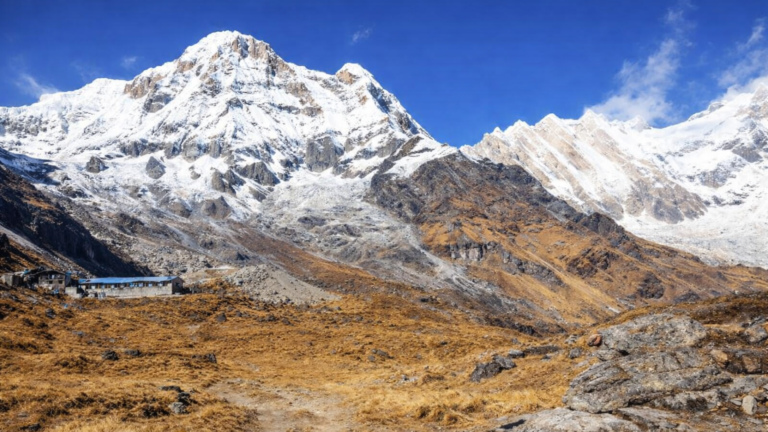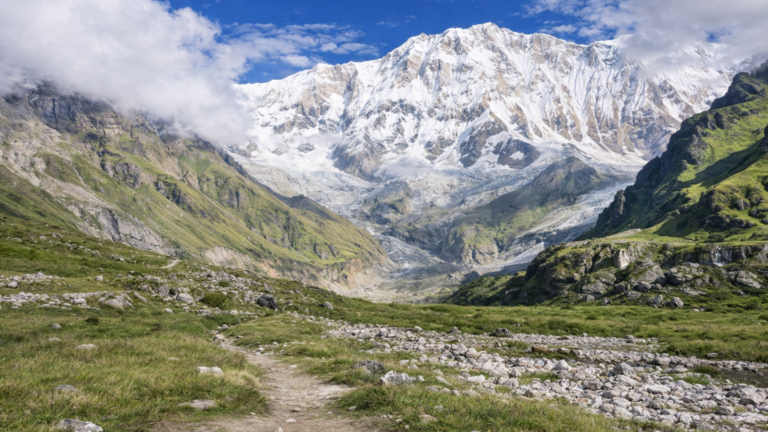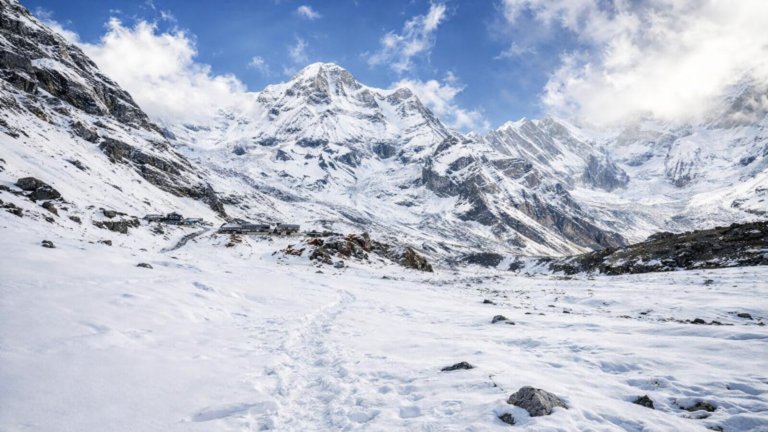
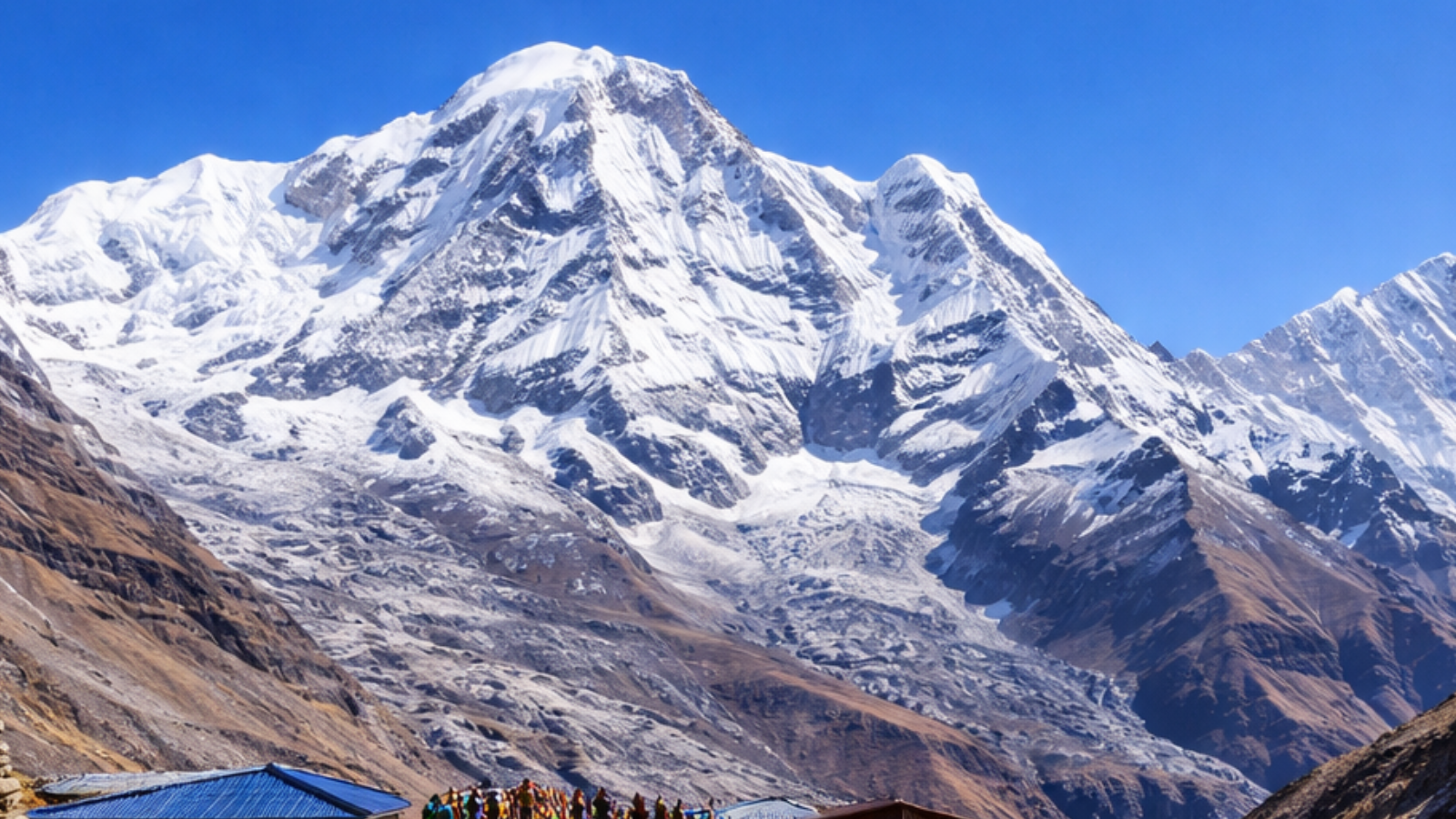

Annapurna Base Camp (ABC) Trek is a multi-day teahouse trek in Nepal’s Annapurna region that ends inside the Annapurna Sanctuary, a high Himalayan amphitheater beneath Annapurna I, Machapuchare, and Annapurna South. This ABC Trek complete guide covers the exact planning topics most trekkers search for: itinerary lengths (6–7, 9–10, or 12–14 days), total cost (DIY vs guided), best time by season, difficulty on stair-heavy trail days, required permits, and a weight-saving packing system. ABC reaches about 4,130 m, so acclimatization and altitude-safety habits matter even for fit hikers.
Use the quick planner to choose days, common trailheads from Pokhara (Nayapul/Kande), and whether to hire a licensed guide or add a porter. Route sections, then break down day-by-day options, realistic teahouse budgets, and month-by-month weather and visibility so expectations match the trail. Permit rules change, and enforcement varies, so the guide includes an official “status check” workflow using Nepal Tourism Board (NTB) updates plus what checkpoints typically ask for, including ACAP and, when required, TIMS; the National Trust for Nature Conservation (NTNC) runs the ACAP portal.
ABC Trek Quick Planner
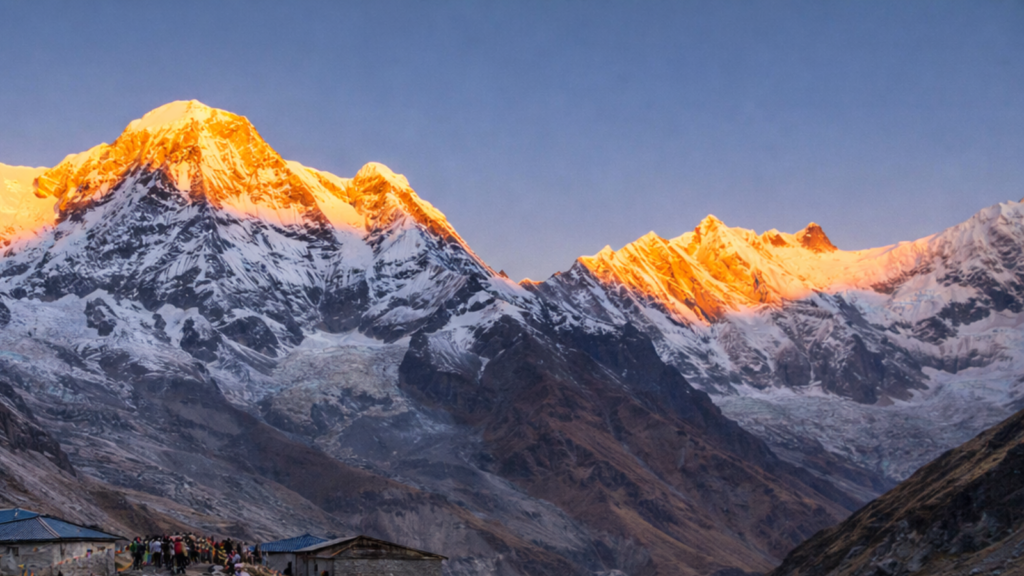
This section gives you the “plan it in one sitting” overview: what the ABC Trek is, how it compares to Mardi Himal or the Annapurna Circuit, and which version matches your time and fitness. You’ll also get a simple decision map for choosing 6–7 vs 9–10 vs 12–14 days so you don’t over-compress the trek and turn it into a suffer-fest. Finally, it sets expectations for daily walking hours, stairs, and altitude so the difficulty feels measurable, not vague.
What the ABC Trek Is (Annapurna Sanctuary Highlights and What “Base Camp” Means Here)
The Annapurna Base Camp (ABC) Trek is a multi-day trekking route in the Annapurna region of Nepal that leads trekkers into the Annapurna Sanctuary, a glacially carved amphitheatre ringed by 7 peaks above 6,000 metres (19,685 feet). The term “base camp” here does not refer to a technical mountaineering staging point in the Everest sense. It refers to the approach base used historically by expedition teams attempting Annapurna I (8,091 m / 26,545 ft), the world’s 10th highest mountain.
The sanctuary itself is the standout. You walk through rhododendron forests at lower elevations, pass through the Modi Khola river valley, and then emerge into a vast glacial bowl enclosed by Annapurna South (7,219 m), Hiunchuli (6,441 m), Machapuchare (6,993 m), and Annapurna I. There are few places in the world where trekkers of moderate fitness stand this close to 8,000-metre peaks without technical climbing skills. That closeness, not just altitude, is what makes the ABC Trek special.
The highest point is the base camp itself at 4,130 m (13,549 ft). Most trekkers spend 1 night there, rise before dawn to photograph the alpenglow on the summits, and then begin their descent the same morning.
ABC vs Annapurna Circuit vs Mardi Himal: Which Trek Fits Your Time, Fitness, and Goals
These 3 Annapurna treks serve very different trekkers. The right choice depends on your available time, fitness level, and the type of experience you want.
- The ABC Trek suits trekkers who want dramatic high-altitude scenery, close-up views of Annapurna peaks, and a manageable challenge without extreme altitude or technical terrain. The trail is well-established, teahouses are reliable, and the route has a clear destination that feels like a genuine achievement. Budget 9 to 10 days for a comfortable experience.
- The Annapurna Circuit is a longer, more diverse trek that circumnavigates the entire Annapurna massif. Its highest point is Thorong La Pass at 5,416 m (17,769 ft), significantly higher than ABC, and it crosses distinct climate zones, from subtropical forest to high-altitude desert. Budget 14 to 21 days. It suits trekkers with stronger altitude tolerance and those who want a full cultural immersion across different Nepali ethnic communities.
- Mardi Himal is a shorter, quieter alternative that reaches a high camp at 4,500 m (14,764 ft) with equally stunning Annapurna views but far fewer crowds. Budget 5 to 6 days. It suits trekkers with limited time who want less-crowded trails and are comfortable with fewer teahouse options at higher elevations.
The ABC Trek remains the most popular of the 3 for first-time Nepal trekkers because it balances accessibility with reward.
How Many Days You Need (6–7 vs 9–10 vs 12–14) and the “Choose-Your-Itinerary” Decision Map
The number of days you need for the ABC Trek depends on 3 factors: your fitness level, your acclimatization needs, and the experience you want.
Here is a simple decision map:
- Choose 6 to 7 days only if you have prior high-altitude trekking experience (above 3,500 m), are in excellent cardiovascular fitness, and accept the higher risk of Acute Mountain Sickness (AMS) from a compressed schedule. This is not the route for first-timers.
- Choose 9 to 10 days if this is your first high-altitude trek or if you have moderate fitness. This is the standard itinerary and it works well for the majority of international trekkers. You get proper acclimatization, rest days where needed, and time to enjoy the villages along the trail.
- Choose 12 to 14 days if you want the most comfortable experience, have limited trekking experience, prefer a slower pace, or travel during shoulder season when trail conditions require more flexibility. This itinerary adds exploration days in Ghorepani, Poon Hill, or Chomrong, and is the safest option for trekkers over 55 or those with any respiratory concerns.
Difficulty Snapshot: Daily Hours, Stairs, Highest Altitude, and Who Should Avoid It
The ABC Trek is rated moderate in difficulty, with the primary challenge coming from stone-stair ascents, cumulative elevation gain, and altitude above 3,500 m.
On an average trail day, you walk 5 to 7 hours and cover 10 to 15 km (6.2 to 9.3 miles). The trail involves extensive stone staircases, particularly between Jhinu Danda and Chomrong, and between Deurali and Machhapuchhre Base Camp (MBC). These are not simple uphill paths. Thousands of steps cut into steep valley walls mean your knees take significant load, especially on descent.
The highest altitude is 4,130 m (13,549 ft) at ABC itself.
Trekkers who should avoid the ABC Trek or consult a physician before attempting it include those with uncontrolled high blood pressure, severe asthma, chronic heart or lung conditions, or a history of AMS at moderate altitudes. The trek is not suitable for children under 10 years old due to both altitude and distance demands.
ABC Trek Itineraries and Route Options
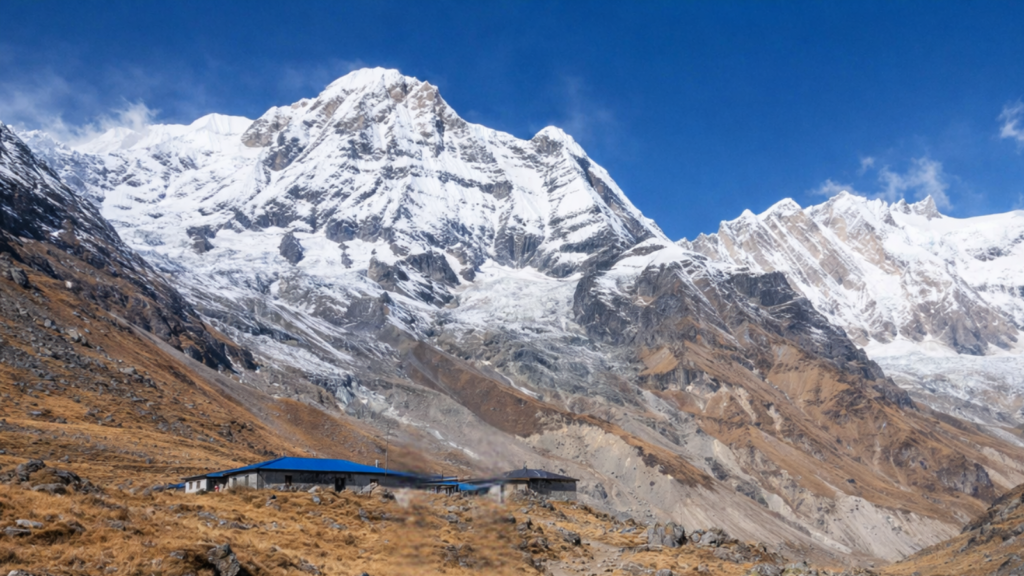
Here you’ll see the classic itinerary first, then the short and longer/safer options, so you can pick the route that fits your schedule without guessing. The key upgrade is a day-by-day table (time, distance, elevation change) plus “hard day” callouts so beginners know where the trek bites. You’ll also learn which add-ons (like hot springs) are actually worth it for recovery and experience.
Classic ABC Itinerary (Most Popular 9–10 Day Route for First-Timers)
The classic 9-night route from Pokhara remains the most balanced itinerary for the majority of trekkers. It moves at a pace that allows genuine acclimatization while keeping the experience manageable.
| Day | Route | Elevation | Est. Walk Time |
| 1 | Pokhara → Nayapul → Tikhedhunga | 1,495 m | 5–6 hrs |
| 2 | Tikhedhunga → Ghorepani | 2,874 m | 5–6 hrs |
| 3 | Ghorepani (Poon Hill sunrise) → Tadapani | 2,630 m | 4–5 hrs |
| 4 | Tadapani → Chomrong | 2,170 m | 4–5 hrs |
| 5 | Chomrong → Dovan | 2,600 m | 5–6 hrs |
| 6 | Dovan → Machhapuchhre Base Camp (MBC) | 3,700 m | 5–6 hrs |
| 7 | MBC → ABC → MBC | 4,130 m / return to 3,700 m | 6–7 hrs |
| 8 | MBC → Bamboo | 2,310 m | 5–6 hrs |
| 9 | Bamboo → Jhinu Danda (hot springs) → Nayapul | 1,010 m | 6–7 hrs |
| 10 | Transfer back to Pokhara | , | 1.5 hrs by jeep |
Hard day callout: Day 1 involves the steep climb out of Nayapul to Tikhedhunga. Day 5 (Chomrong to Dovan) includes the famous Chomrong staircases, over 2,500 steps descending and then ascending, and is considered the most physically demanding day of the trek. Day 7 at ABC is not the hardest in terms of distance, but altitude effects make exertion feel significantly greater.
Short ABC Itinerary (6–7 Days): What You Sacrifice and How to Reduce Risk
A 6 to 7-day ABC itinerary compresses the schedule by skipping Ghorepani and taking a direct route via Ghandruk and Chomrong. You arrive at ABC faster but with less acclimatization time. The risk of AMS increases meaningfully, particularly on Days 5 and 6 when elevation gain is highest.
To reduce that risk on a short itinerary: hydrate aggressively (minimum 3 to 4 litres per day), ascend no more than 500 m (1,640 ft) of sleeping altitude per day above 3,000 m, and carry Diamox (acetazolamide) only if prescribed by your physician before departure. Descend immediately at any sign of worsening AMS.
What you sacrifice on the short route is Poon Hill sunrise, which many trekkers describe as one of the finest panoramic mountain views in Nepal. You lose the rhododendron forest sections between Ghorepani and Tadapani, and you miss the gradual mental and physical adjustment that makes the summit day more enjoyable.
Longer/Safer ABC Itinerary (12–14 Days): Easier Pacing, Better Acclimatization, More Villages
A 12 to 14-day itinerary is the safest and most immersive option for first-time Nepal trekkers. This schedule builds in a rest day at Chomrong (2,170 m) and another at MBC (3,700 m) before the final push to ABC. Those rest days are not wasted time, they are acclimatization investments that significantly reduce AMS risk and improve summit-day energy.
Additional villages you explore on this itinerary include Sinuwa, Kuldi, and the less-visited Gurung village of Ghandruk. Trekkers choosing this route frequently report a qualitatively richer experience because they interact more with local communities, have time for photography, and do not feel rushed through Nepal’s most beautiful trail.
This itinerary is particularly well-suited for trekkers over 50, those carrying heavier packs without a porter, and travelers who want flexibility for weather delays, which are common in both spring and autumn.
Route Map, Trail Character, and Day-by-Day Distance/Elevation/Time Table
The ABC trail follows the Modi Khola river valley from the south, entering the Annapurna Sanctuary through a narrow gorge between Hiunchuli and Machapuchare. This geographical funnel means the sanctuary feels suddenly revealed rather than gradually approached, a moment almost every trekker describes as one of the most dramatic on any Nepal trail.
Trail character by zone:
- Below 2,500 m (Nayapul to Chomrong), the trail passes through rhododendron and oak forests, traditional Gurung villages, terraced farmland, and several suspension bridges over the Modi Khola. The trail is wide and well-maintained.
- Between 2,500 m and 3,500 m (Chomrong to MBC), the terrain transitions to alpine bamboo forest, then open moraine ridges. The trail narrows and stone sections increase. Weather changes faster in this zone.
- Above 3,500 m (MBC to ABC), the trail crosses an open glacial plain with minimal vegetation. Wind, cold, and the scale of surrounding peaks dominate. This section is closed by the Nepal Department of National Parks if avalanche risk is assessed as high, always verify current conditions with your guide or the Annapurna Conservation Area Project (ACAP) checkpoint at MBC.
ABC Trek Cost (DIY vs Guided) and Realistic Budget You Can Trust
This section breaks cost into real categories, transport, permits, teahouses, meals, showers, charging, Wi-Fi, so you can estimate totals instead of relying on random numbers. It then gives a daily spend plan that explains why prices rise with altitude and how to build a safe cash buffer. Finally, it clarifies guide vs porter vs DIY in practical terms (safety, comfort, pacing, load management), not sales talk.
Total Cost Breakdown: Transport, Permits, Teahouses, Meals, Showers, Charging, Wi-Fi, Snacks
The total cost of the ABC Trek for a solo independent trekker ranges from USD $600 to $1,000 for the trek itself, excluding international flights to Nepal.
Here is a realistic per-day cost breakdown on a DIY basis:
| Category | Low Budget (USD) | Mid Budget (USD) | High Budget (USD) |
| Teahouse room | $5–8 | $10–15 | $18–25 |
| Meals (3/day) | $12–15 | $18–25 | $28–35 |
| Water/snacks | $3–5 | $5–8 | $8–12 |
| Shower/charging/Wi-Fi | $2–4 | $4–6 | $5–8 |
| Daily total | $22–32 | $37–54 | $59–80 |
Permits add NPR 3,000 (approximately USD $22 to $23) for the Annapurna Conservation Area Permit (ACAP) and NPR 2,000 (approximately USD $15) for the Trekkers’ Information Management System (TIMS) card, a combined baseline of roughly USD $37 for non-SAARC nationals.
Transport from Pokhara to the trailhead by jeep costs USD $8 to $15 per person shared, or USD $50 to $70 for a private jeep.
Daily Spend Plan by Altitude: Low/Medium/High Budget Examples
What most budget guides fail to mention is that costs escalate significantly above 3,000 m. This happens because all supplies are carried by porters or mules. A simple Dal Bhat meal that costs NPR 450 (approximately USD $3.30) in Pokhara costs NPR 900 to 1,200 (approximately USD $7 to $9) at MBC or ABC. A 500 ml bottle of boiled water costs NPR 200 to 300 above 3,500 m. Charging your phone costs NPR 200 to 400 per session.
Budget trekkers at altitude who rely on bought meals and single-use water bottles routinely overspend their plan by 30 to 40 percent. Carrying a water purification solution (iodine tablets or a Steripen UV purifier) eliminates one of the largest unnecessary costs above 3,000 m.
Guide vs Porter vs DIY: Beginner Decision Rules
From 1 April 2023, the Nepal Tourism Board (NTB) made licensed guides mandatory for foreign trekkers on most trekking routes in Nepal, including the ABC Trek. This rule applies to independent trekkers, trekking without a guide is no longer legally permitted, and ACAP checkpoint staff verify compliance.
Beyond compliance, the practical case for a licensed guide is strong. The trail above Dovan involves several junctions with poor signage, and weather in the sanctuary deteriorates rapidly. A licensed guide carries knowledge of current trail conditions, has relationships with teahouse owners that benefit trekkers during peak-season room shortages, and provides emergency first-aid capability.
A porter serves a different function. Porters carry your main pack (typically up to 15 kg / 33 lbs), reducing your daily load to a small daypack. This materially improves both speed and safety on steep descents.
DIY trekking is no longer a legal option. The question is whether you hire through a licensed operator (which includes guide, permits, accommodation coordination, and emergency support) or hire a guide independently through Pokhara agencies. Hiring through a reputable operator provides accountability, insurance verification, and a support system that independent hiring does not.
Money Logistics: Cash Plan, ATMs, Payments, Tipping Norms, and How to Avoid Running Short
There are no ATMs on the ABC trail above Nayapul. Withdraw all cash from Pokhara before departure. ATMs on Lakeside Road in Pokhara reliably dispense up to NPR 35,000 (approximately USD $260) per transaction. Withdraw NPR 40,000 to 60,000 for a 9 to 10-day trek to cover incidentals, tips, and emergency funds.
Teahouses do not accept credit cards. Visa and Mastercard are usable in Pokhara and Kathmandu, nowhere on the trail.
Tipping norms: for a 9 to 10-day trek, a customary tip for your licensed guide is USD $80 to $120, and USD $50 to $70 for your porter. Tipping is not mandatory but is culturally significant and forms a meaningful part of guide and porter income.
Best Time for ABC Trek (Weather, Visibility, Crowds, Trail Conditions)
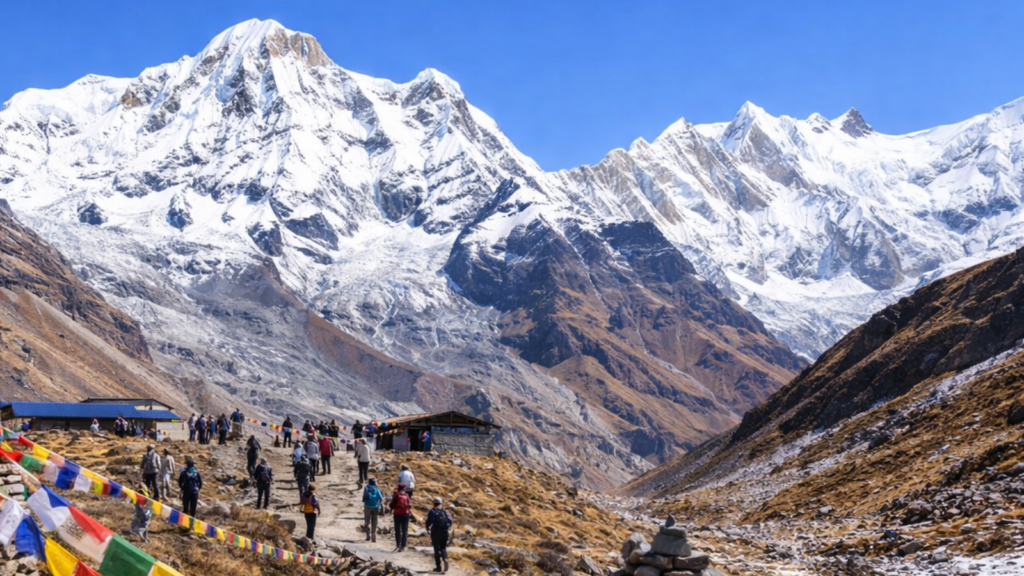
This section helps you choose dates based on your priorities: clear mountain views, fewer crowds, warmer nights, or drier trails. It includes a month-by-month cheat sheet so you understand what changes across spring, autumn, winter, and monsoon. If you’re trekking in shoulder seasons, it also explains the likely trade-offs (cold mornings, snow chances, lodge availability).
Spring vs Autumn: Which Is Best for Most People (and What “Best” Really Means)
The best overall season for the ABC Trek is autumn (October to November), when the air is clear, the monsoon has ended, and the mountains are fully visible from base camp. Spring (March to May) is the second-best season, offering rhododendron blooms along the lower trail that make the forest sections exceptionally beautiful.
The honest trade-off: spring brings more atmospheric haze at altitude, which slightly reduces the crispness of mountain views at ABC. Autumn brings drier, clearer air and the most photogenic light on the high peaks. Both seasons have crowded trails and teahouses, with October being the single busiest month on the entire ABC route.
For trekkers who prioritize photography and visibility over crowds, late November offers excellent clarity with noticeably fewer trekkers, though temperatures drop to -5°C (23°F) or below at ABC at night.
Month-by-Month Conditions Cheat Sheet
| Month | Avg Temp at ABC | Rain/Snow Risk | Visibility | Crowd Level |
| January | -8°C to 2°C | Snow (high) | Good on clear days | Very low |
| February | -6°C to 5°C | Snow (moderate) | Good to excellent | Low |
| March | -2°C to 10°C | Low | Good | Moderate |
| April | 2°C to 14°C | Low | Moderate (haze builds) | High |
| May | 5°C to 16°C | Moderate (pre-monsoon) | Variable | Moderate |
| June | 7°C to 18°C | Very high (monsoon) | Poor | Very low |
| July | 8°C to 17°C | Extreme | Very poor | Minimal |
| August | 8°C to 17°C | Extreme | Very poor | Minimal |
| September | 5°C to 15°C | High (late monsoon) | Poor to moderate | Low |
| October | 0°C to 12°C | Very low | Excellent | Very high |
| November | -5°C to 8°C | Very low | Excellent | Moderate |
| December | -8°C to 3°C | Low–moderate snow | Good | Very low |
Winter and Monsoon Reality: Snow, Landslides, Closures, Lodge Availability, and Itinerary Adjustments
Winter trekking (December to February) on the ABC Trek is possible but requires serious preparation and carries meaningful risk. Snow accumulation above 3,000 m regularly closes sections of the trail, and ACAP checkpoint rangers close access to MBC and ABC during periods of high avalanche risk. Lodge availability drops sharply, many teahouses above Chomrong close entirely between late December and mid-February.
Trekkers who complete ABC in winter typically report deeply rewarding, crowd-free experiences on the days the trail is open. The key is flexibility. Add 2 to 3 buffer days to your itinerary and monitor ACAP trail reports daily.
Monsoon trekking (June to August) is strongly discouraged for the ABC route specifically. The sanctuary gorge is one of the most rainfall-intensive zones in Nepal, receiving 3,000 to 5,000 mm (118 to 197 inches) of annual precipitation, the majority of which falls between June and August. Landslides regularly cut the trail in the Modi Khola valley during this period. Multiple lodges have been damaged by landslides historically, and the gorge above Deurali is frequently impassable.
Difficulty, Altitude, and Safety
Here you get the honest difficulty picture: the stairs, the long climbs, and what “moderate” means day after day with a pack. You’ll learn a simple altitude and AMS prevention approach, including red flags and when descending is the smartest move, since ABC sits around 4,130 m. Finally, it covers practical safety habits, hydration, blister prevention, warm layers timing, and weather awareness, so beginners avoid preventable problems.
Fitness and Training Plan (2–4 Weeks): Stairs, Uphill Endurance, Pack Comfort, Pacing Habits
4 weeks of targeted preparation significantly reduces the physical difficulty of the ABC Trek and meaningfully lowers your AMS risk. The specific demands of this trail, long stair climbs, sustained uphill stretches at elevation, and multi-hour descents, respond well to a focused training protocol.
In the 4 weeks before departure:
Train on stairs or inclines for a minimum of 45 minutes, 4 times per week. If access to hills is limited, a stair-climber machine at 50 to 70 percent max heart rate achieves comparable leg conditioning. Progressively add weight to your daypack across the training weeks, begin at 5 kg (11 lbs) and work up to 8 to 10 kg (17 to 22 lbs) by the final week. Complete at least 2 continuous hikes of 4 hours or more in the final 2 weeks, wearing your trekking boots.
The 2 most common fitness failures on the ABC Trek are undertrained knees (causing pain and slowing descent) and poor cardiovascular recovery at altitude. Both are directly preventable with structured training.
Altitude Profile and AMS Prevention: Symptoms, “Stop/Go” Rules, Acclimatization Tactics That Work
Acute Mountain Sickness (AMS) is a physiological response to reduced oxygen partial pressure at altitude. It becomes relevant above 2,500 m and its incidence increases significantly above 3,500 m, the elevation range covering MBC and ABC.
The standard AMS symptom set includes headache, nausea, fatigue beyond normal exertion, dizziness, and disrupted sleep. The critical distinction is between mild AMS (which resolves with rest and hydration at the same elevation) and moderate to severe AMS (which requires immediate descent).
Apply the following stop/go rules:
Stop and rest at current elevation if you have a headache that responds to ibuprofen (400 mg) and water within 2 hours. Do not ascend further that day.
Descend immediately if the headache does not improve after 2 hours of rest and medication, if you experience loss of coordination (ataxia), persistent vomiting, confusion, or breathlessness at rest. Descent of 300 to 500 m (984 to 1,640 ft) typically produces rapid improvement.
Never ascend to sleep at a higher elevation on the same day you develop AMS symptoms. This rule overrides all itinerary plans.
ABC Safety SOP: Weather Checks, Hydration, Warm-Up/Cool-Down, Blister Prevention, Day Pacing
Begin each trekking day with a weather check at the teahouse and a 10-minute warm-up walk before reaching full pace. The sanctuary is known for weather that shifts from clear to dangerous within 90 minutes. Starting each afternoon section early, beginning each day by 7:00 AM and reaching camp by 14:00, keeps you ahead of afternoon thunderstorm patterns common in spring.
Hydration target: 3 to 4 litres of water per day above 3,000 m. Thirst is a lagging indicator at altitude, drink on a schedule, not when you feel thirsty.
Blister prevention starts at Pokhara, not on the trail. Break in trekking boots in the 2 weeks before departure. Wear liner socks under wool trekking socks. Apply anti-chafe balm to known friction points before Day 1 and every morning thereafter. Treat hot spots immediately, a blister caught at the “hot” stage takes 30 seconds to tape; an open blister at altitude takes days to heal properly.
Emergency Readiness: Insurance, Evacuation Basics, Communication Options, When to Descend Immediately
Every trekker on the ABC route must carry travel insurance that explicitly covers helicopter evacuation to a minimum altitude of 4,200 m (13,780 ft). Helicopter evacuation from ABC costs USD $3,000 to $6,000 depending on conditions and operator. This cost is not covered by basic travel insurance policies, verify altitude coverage before purchasing any policy.
Communication on the trail: mobile network (NTC/Ncell) is available intermittently up to MBC. Above MBC, signal becomes unreliable. Your guide carries a local SIM and is the primary communication link.
Descend immediately without waiting for guide confirmation in 4 scenarios: firstly, loss of coordination or inability to walk a straight line; secondly, severe confusion or inability to answer simple questions; thirdly, breathlessness at rest with chest tightness; fourthly, any trekking companion requesting descent due to their own symptoms.
Permits, Logistics, Teahouses, Food/Water, and Packing System
This section shows what permits you typically need and how to get them efficiently, including official online pathways for the conservation area permit. It also covers the logistics that make or break the trek: transport to trailheads, teahouse realities, charging/Wi-Fi expectations, and a simple food/water safety routine. Finally, you’ll get a packing system (layering, essentials and rent vs buy) so you carry less but stay warmer and safer.
Permits and Entry Rules: ACAP/TIMS Explained and “Status Check” List to Verify Before You Fly
Every foreign trekker on the ABC route requires 2 permits: the Annapurna Conservation Area Permit (ACAP) and the TIMS e-card (Trekkers’ Information Management System card). As of 2026, fees stand at NPR 3,000 (approximately USD $22) for the ACAP and NPR 2,000 (approximately USD $15) for the TIMS card, applicable to non-SAARC nationals.
ACAP permits are issued by the Nepal Tourism Board (NTB) office in Kathmandu (Bhrikutimandap) or the Pokhara Tourism Information Centre. TIMS e-cards are now issued online through the NTB portal with QR code verification at checkpoints.
Pre-departure status check: verify that your ACAP permit number is registered, that your TIMS card carries the correct passport details, and that both documents are physically or digitally accessible offline, checkpoint rangers scan QR codes and compare passport information.
Transport Logistics: Kathmandu → Pokhara → Trailhead Options and Return Planning
Pokhara is the gateway city for the ABC Trek. The journey from Kathmandu to Pokhara takes 25 to 35 minutes by domestic flight (USD $80 to $120 one-way) or 6 to 7 hours by tourist bus (USD $12 to $20). Flying is strongly recommended for trekkers with limited time, as road conditions on the Prithvi Highway cause frequent delays, particularly in wet weather.
From Pokhara, the standard trailhead is Nayapul, reached in 1.5 to 2 hours by jeep (USD $8 to $15 per person shared). Some itineraries begin at Phedi and take a different approach to Ghorepani, or at Kande for a direct route to Australian Camp and Ghandruk, all are viable trailhead options depending on itinerary choice.
Return planning: build a minimum 1-day buffer in Pokhara before any onward flight from Kathmandu. Trail delays from weather, injury, or personal pace adjustments are common, and same-day connections from trailhead to KTM airport involve very tight margins.
Teahouse Reality: Rooms, Toilets, Heat, Charging/Wi-Fi, Booking Strategy in Peak Season
Teahouses on the ABC route range from simple wooden-frame guesthouses in lower villages to stone-built lodges with solar power and attached bathrooms at higher elevations, though “attached bathroom” above 3,000 m almost always means a shared solar-heated shower and a squat or basic flush toilet.
Rooms in most teahouses are twin or double-bedded with thin foam mattresses, basic blankets, and minimal storage. Bring your own sleeping bag liner or a light sleeping bag, teahouse blankets are adequate in spring and autumn but insufficient in winter. Heat in rooms is generally limited to a dining hall wood stove.
Charging: solar charging stations in dining halls cost NPR 200 to 400 per session. Power banks are essential for photography-heavy days when charging access is limited.
Booking strategy in October (peak month): Independent trekkers face genuine room shortages above Chomrong in the first 3 weeks of October. Arrive at your intended stop by 14:00 to secure a room. Alternatives exist, the trail has more teahouse options than most maps show, but carrying a lightweight tent as backup above 3,000 m is not advisable due to park regulations.
Food and Drinking Water: What You’ll Eat, Safe Water Options, Stomach-Issue Prevention Rules
The teahouse menu across the ABC trail is consistent and calorie-dense. Dal Bhat (lentil soup with rice, vegetables, and pickle) is the staple and provides 700 to 1,000 calories per serving with free refills, making it the best value high-calorie meal on the trail. Other standard options include pasta, fried rice, noodle soup, porridge, pancakes, and eggs. Dahl Bhat is nutritionally complete and recommended as the primary meal at least once per day.
Safe water options: boiled water purchased from teahouses (NPR 100 to 200 per litre at lower elevations, NPR 200 to 300 at higher), water from tap filters at ACAP-approved stations, or personally purified water using iodine tablets or a UV purifier. Bottled plastic water is available above MBC but is the least environmentally responsible and most expensive option.
Stomach-issue prevention: wash hands before every meal using soap, teahouses provide it. Avoid raw salads and unpeeled fruit above 2,500 m where water quality for food preparation is harder to verify. Probiotics taken 1 week before departure reduce traveller’s diarrhoea incidence. Carry oral rehydration salts (ORS) packets for any fluid-loss episodes.
ABC Packing System (Not Just a List): Layering by Season, Rent vs Buy in Nepal, Weight-Saving Checklist
A functional ABC packing system is built around 3 principles: layered insulation, redundant rain protection, and sub-10 kg total pack weight for your daypack.
- Layering system by zone: Base layer (moisture-wicking synthetic or merino wool): worn daily below 3,000 m. Mid layer (fleece or light down jacket): added above 3,000 m and at all teahouse evenings. Outer layer (waterproof shell jacket): mandatory from Day 1 regardless of season. Insulated jacket (down or synthetic, rated to -10°C / 14°F): essential above 3,500 m at night and at ABC.
- Rental vs purchase in Nepal: high-quality trekking gear is available for rent in Kathmandu (Thamel district) and Pokhara (Lakeside) at very reasonable rates. A down jacket rental costs NPR 200 to 400 per day. Trekking poles rental costs NPR 100 to 200 per day.
- Weight-saving checklist: limit clothing to 2 pairs of trekking trousers, 3 moisture-wicking shirts, 4 pairs of socks, 4 pairs of underwear. Use a 25 to 30 litre daypack for trekking days, your main bag goes with the porter. Eliminate all non-essential items at Pokhara before departure. Every gram above 8 kg in your daypack increases fatigue disproportionately on stair sections.
How many days do you need for the ABC Trek?
Most trekkers need 9–10 days for the Annapurna Base Camp (ABC) Trek for safer acclimatization and manageable daily climbs. Fit, experienced hikers can finish in 6–7 days, but the compressed schedule increases fatigue and AMS risk. Choose 12–14 days for easier pacing, weather buffers, and better sleep above 3,000 m.
How hard is the Annapurna Base Camp Trek for a beginner?
The Annapurna Base Camp (ABC) Trek is moderate and beginner-friendly with basic training and steady pacing. Expect 5–7 hours of walking per day, frequent steep stone stairs, and cumulative up-and-down days. The main difficulty comes from long descents, heavy packs, and altitude above 3,500 m, not technical terrain.
What is the maximum altitude on the ABC Trek, and is altitude sickness a concern?
The maximum altitude on the Annapurna Base Camp (ABC) Trek is about 4,130 m (13,549 ft), which makes altitude sickness a real concern. Reduce AMS risk by increasing sleeping altitude by no more than ~500 m per day above 3,000 m, drinking 3–4 liters daily, and stopping ascent if headache, nausea, or unusual fatigue worsens.
What permits do you need for the ABC Trek?
You typically need the Annapurna Conservation Area Permit (ACAP) for the Annapurna Base Camp (ABC) Trek because the route enters the Annapurna Conservation Area. Carry your passport details and permit proof for checkpoint verification. Confirm current requirements 1–3 days before departure in Kathmandu or Pokhara because rules and enforcement can change by season and route.
Is a TIMS card required for ABC, and do you need a guide in 2026?
TIMS and guide rules for the Annapurna Base Camp (ABC) Trek can vary by enforcement, so plan for both: carry TIMS if required and hire a licensed guide to avoid checkpoint issues. Verify the latest requirement in Kathmandu or Pokhara with Nepal Tourism Board offices or your operator 1–3 days before you start, because checks can change by route.
How much does the ABC Trek cost per day?
The ABC Trek typically costs $25–$55 per day for a DIY teahouse trek, depending on meals, water, and paid extras like hot showers, charging, and Wi-Fi. Expect daily costs to rise above 3,000 m because supplies get carried in. Add a 20–30% cash buffer so you never skip food, warmth, or safe water.
What is the best time to do the ABC Trek?
The best time to do the Annapurna Base Camp (ABC) Trek is October–November for the clearest skies and the most reliable mountain visibility after monsoon. March–May is the second-best window with warmer days and rhododendron blooms, but haze can increase. Avoid June–August for heavy monsoon rain and higher landslide risk on the approach.
Can you do the ABC Trek solo?
You can complete the ABC Trek with solo logistics, but solo trekking increases risk because you must manage navigation, weather calls, and emergencies alone. Confirm current guide rules and checkpoint enforcement before starting, because requirements can change. If you trek without a support team, keep a conservative 9–10 day plan, share your itinerary, and carry insurance for 4,200 m+ evacuation.
What should you pack for the ABC Trek?
Pack for the ABC Trek with a simple layering system: base layer, warm mid layer, and a waterproof shell every day, plus an insulated jacket for nights near 4,130 m. Bring blister prevention, a headlamp, trekking poles, and a power bank for paid charging. Add water treatment to reduce cost and stomach risk, and keep your daypack under ~8–10 kg.
Are teahouses available on the ABC route, and do you need to book?
Teahouses operate along the full ABC route, so you can sleep and eat in villages each night instead of camping. Booking is usually unnecessary in low season, but rooms can sell out in peak weeks, especially October, above key stops like Chomrong. Start early, arrive by ~14:00, and use a guide or calls ahead to lock rooms when crowds spike.